The rain in Philadelphia always seems to smell of old paper and wet brick. If you stand near Independence Hall on a quiet evening, you can almost hear the scratch of quill pens from 1776. It is a sacred space, or at least, we have spent two and a half centuries telling ourselves it is.
But history is a messy playwright. Also making news in this space: Why Trump Freedom 250 Concert Series is Imploding.
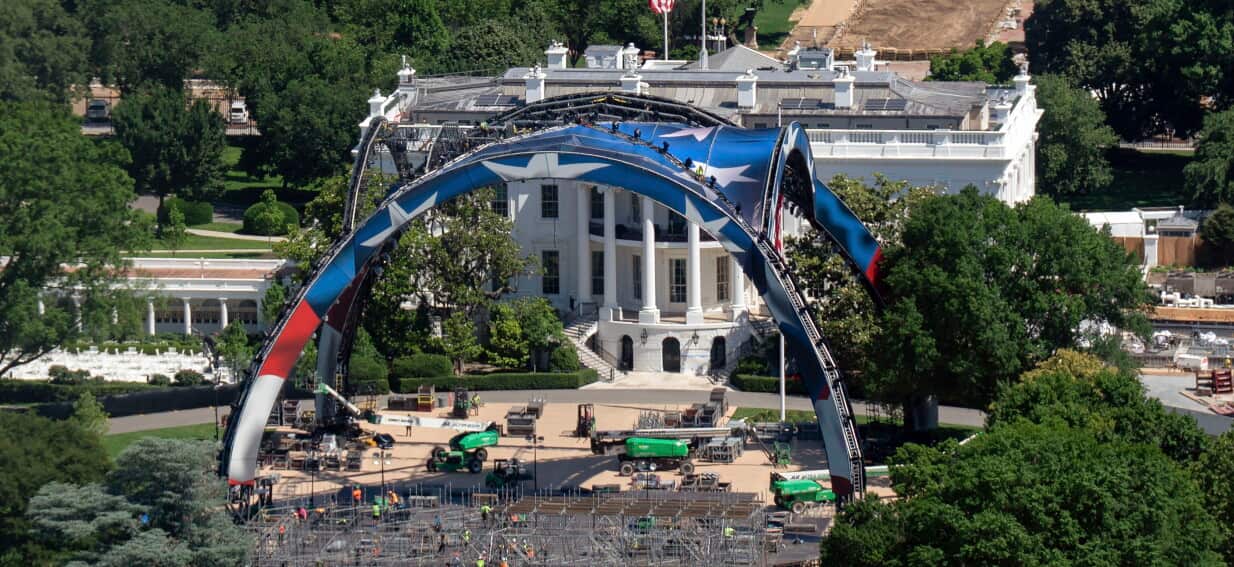
As the United States barrels toward its 250th anniversary—the Semiquincentennial—the stage is being set for a massive national birthday party. The invites are out. The stages are built. Yet, behind the velvet curtains, a quiet panic has taken hold. The artists are walking out, the politicians are moving in, and a celebration meant to unify a fractured country is morphing into something else entirely.
A spotlight. A microphone. An empty stage. Additional information on this are covered by USA Today.
The Audition for America’s Birthday
Consider the logistics of a milestone. When a nation turns 250, you do not just buy a cake. You build a spectacle. The planners envisioned a sprawling, star-studded tribute to the American experiment. Musicians, actors, and cultural icons from every corner of the republic were supposed to stand shoulder to shoulder. They were meant to sing a song of collective progress.
Then came the headliner.
Donald Trump, fresh off political victories and back in the ultimate seat of power, was announced as the central figure of the celebration. For the organizers, it was a matter of protocol. The sitting president hosts the national jubilee. It is how it has always been done. Gerald Ford held the center stage in 1976 for the Bicentennial, standing beneath the fireworks in a different, though similarly fractured, America.
But 2026 is not 1976.
The announcement acted like a sudden drop in barometric pressure. Within days, the cultural architecture of the event began to splinter. Creatives—the singers, dancers, and writers who provide the emotional heartbeat of such celebrations—started quietly, then loudly, pulling their names from the roster.
The reasons given were varied, wrapped in the polite legalese of public relations statements. Scheduling conflicts. Sudden conflicts in interest. Personal reasons. But everyone reading between the lines knew the truth. Art and raw politics were colliding, and art was choosing to leave the room.
The View from the Back Row
To understand why this matters, look at a hypothetical performer. Let us call her Sarah.
Sarah is a violinist, the kind of musician who spent her childhood with bleeding fingertips and her twenties playing in drafty community centers before finally landing a seat in a major metropolitan orchestra. For Sarah, being invited to play at the 250th anniversary was the summit. It was validation. It meant playing the music of Aaron Copland while fireworks painted the sky above the Delaware River.
Now, imagine Sarah sitting in her apartment, looking at her instrument, and weighing a choice.
If she plays, she becomes part of a visual narrative. She is a prop in a political theater. In a hyper-polarized world, her presence is interpreted as an endorsement of the man at the podium. Her social media feeds will explode. Half her audience will brand her a sellout; the other half will cheer her as a patriot, though neither side will actually be listening to the music she spent thirty years mastering.
If she drops out, she loses the biggest gig of her life. She stays silent.
Sarah’s dilemma is the dilemma of the modern American artist. When the national identity becomes synonymous with a single, highly polarizing political figure, the common ground vanishes. The stage shrinks.
What happens to a national celebration when only one side of the nation wants to show up?
The Lesson of 1976
We have a habit of romanticizing the past. We look back at the 1976 Bicentennial through a nostalgic haze of red, white, and blue tall ships sailing into New York Harbor. We remember Johnny Cash singing on CBS and Elton John topping the charts.
But that era was bleeding from its own deep wounds.
The country was reeling from the visceral trauma of the Vietnam War. The Nixon administration had collapsed under the weight of Watergate just two years prior. Inflation was rampant. The cities were burning, both literally and socioeconomically.
Yet, when Gerald Ford stood on the Mall, the celebration did not collapse into a partisan rally. Why? Because the cultural fabric held. The artists of that era—even those who hated the war and detested the political establishment—still saw the American story as something larger than the man occupying the Oval Office. They believed the country belonged to the people, and the birthday party was for the ideals, not the administration.
Fifty years later, that belief has eroded.
Today, the political figure does not just preside over the culture; they consume it. When Donald Trump headlines America’s 250th, it ceases to be a commemoration of a 1776 document. It becomes an extension of a contemporary political movement. The historical context is swallowed by the present-day news cycle.
The Sound of Silence
The danger of an event where the cultural elite drop out is not that the seats remain empty. They won't. The stadium will be packed. The flags will wave. The applause will be deafening.
The real loss is the texture.
America’s strength has never been its uniformity. It has been its friction. The best American art—the jazz born in New Orleans, the literature of Baldwin and Steinbeck, the protest songs of Dylan—grew out of the discomfort of a nation trying to reconcile its high ideals with its flawed reality.
When you remove the dissenting voices, the skeptics, and the boundary-pushers from a national celebration, you are left with pageantry. It is clean, it is ordered, and it is entirely devoid of life. It becomes a monologue rather than a chorus.
Consider what happens next: the organizers are forced to fill the gaps. They bring in performers who are willing to align with the political brand. The event transforms from a collective national milestone into a targeted rally for a specific faction. The remaining audience feels vindicated; the absent audience feels further alienated.
The gap widens. The bridge burns.
The Epilogue on the Tarmac
A few weeks ago, I watched a small local parade march down a main street in a Pennsylvania town. It wasn't grand. There were no pop stars or presidential motorcades. There was a high school marching band with slightly tarnished brass, a fleet of shiny red fire trucks, and a group of elderly veterans walking with canes.
The crowd was a mix of everything this country is. There were hats bearing political slogans from both sides of the aisle. There were people arguing about local taxes on the sidewalk, and kids chasing candy dropped in the gutter.
For a few minutes, nobody was dropping out. Nobody was boycotting. The music wasn't perfect, but everyone stayed to listen.
As the 250th anniversary approaches, the grand stages in Washington and Philadelphia will undoubtedly draw the cameras. The lights will be blindingly bright. The speech will be loud, dominant, and analyzed by talking heads for weeks afterward.
But as the final fireworks explode over the Potomac, the most telling sound won't be the pyrotechnics or the political rhetoric. It will be the echoes from the empty dressing rooms backstage, where the instruments were packed away early, leaving a nation to celebrate its history with half its voice missing.