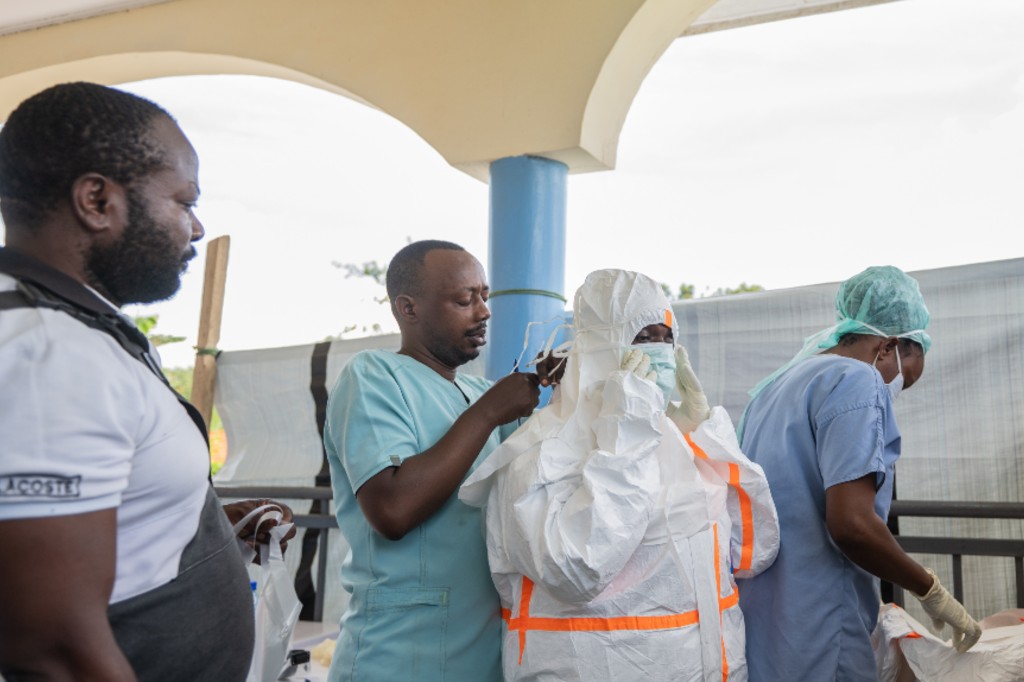
The containment of any viral pathogen relies on a baseline mathematical certainty: reducing the effective reproduction number below 1.0. When an outbreak is driven by the Bundibugyo ebolavirus strain, this operational mandate faces a compounding structural deficit. Unlike the more common Zaire ebolavirus strain, Bundibugyo lacks any approved vaccine or targeted therapeutic protocol. The current outbreak, centered in the eastern Ituri province of the Democratic Republic of the Congo (DRC) and extending into neighboring Uganda, has reached 282 confirmed cases and 42 confirmed deaths. This epidemiology demands an evaluation of containment mechanics, supply-chain vulnerabilities, and international surveillance nodes.
The trajectory of this specific outbreak is governed by a distinct epidemiological profile that complicates traditional containment playbooks. The absence of biomedical countermeasures means mitigation strategies cannot rely on ring vaccination or post-exposure prophylaxis. Instead, containment is entirely dependent on non-pharmaceutical interventions. The efficacy of these interventions is currently constrained by three distinct operational bottlenecks. Meanwhile, you can explore similar developments here: Why This New Urine Test For Bladder Cancer Changes Everything.
The Three Bottlenecks of Non-Pharmaceutical Containment
The primary operational constraint is a severe deficit in contact tracing coverage. Public health authorities report a contact tracing coverage rate of approximately 45%, though independent non-governmental organizations estimate that systematically tracked contacts may be closer to 20% in specific sub-zones. Mechanistically, when contact tracing falls below the critical threshold required to disrupt transmission networks, the volume of unmonitored vectors increases exponentially. This dynamic explains why, alongside the 282 confirmed cases, there are approximately 220 official suspected cases under active investigation, with broader regional estimates from the Africa Centres for Disease Control and Prevention tracking over 1,000 unverified suspected cases across the DRC and Uganda.
The second bottleneck is defined by delayed diagnostics and structural backlogs. In the Mongbwalu and Rwampara health zones of Ituri province, geographic isolation combined with persistent regional insecurity limits the rapid transit of blood samples to specialized testing laboratories, such as the National Institute of Biomedical Research. The resulting latency between symptom onset, sample collection, and polymerase chain reaction (PCR) confirmation creates a systemic data lag. This lag obscures the true scale of transmission, allowing generations of viral propagation to occur before public health teams can deploy targeted isolation measures. To understand the complete picture, check out the excellent report by World Health Organization.
The third bottleneck involves nosocomial transmission within local healthcare infrastructure. Of the early documented recoveries, all five patients—four nurses and one laboratory technician—were healthcare workers. While these recoveries demonstrate that aggressive symptom management and early supportive care can mitigate mortality rates, the disproportionate infection rate among frontline staff indicates significant failures in infection prevention and control protocols. Nosocomial vectors turn local medical centers into amplification nodes rather than containment zones, driven primarily by shortages of personal protective equipment and inadequate isolation architecture.
Cross-Border Transmission Mechanics and Sentinel Surveillance
The geographic footprint of the Bundibugyo outbreak illustrates the high fluid mobility of populations within the Albertine Rift region. Artisanal mining activities, internal displacement driven by armed conflict, and established informal trade routes create constant population churn across the DRC-Uganda border. Uganda has confirmed nine cases of Ebola linked directly to cross-border movement from Ituri province, resulting in one fatality and prompting the enforcement of border screening protocols.
The systemic risk of long-range exportation is highlighted by the recent activation of public health protocols in South America. Brazilian health authorities recently isolated two international travelers exhibiting symptoms consistent with viral hemorrhagic fevers. Evaluating these cases reveals both the sensitivity and the limitations of global sentinel surveillance systems.
[International Travel Hub] ──> [Port of Entry Screening] ──> [Clinical Isolation Node]
                                                                        │
                                       ┌────────────────────────────────┴────────────────────────────────┐
                                       ▼                                                                 ▼
                         [Differential Diagnosis: PCR]                                     [Genomic Sequencing]
                                       │                                                                 │
                   ┌───────────────────┴───────────────────┐                                             ▼
                   ▼                                       ▼                                     [Viral Strain
           [Malaria Positive]                    [Meningitis Positive]                           Identification]
         (Patient 1 - Rio de Janeiro)              (Patient 2 - São Paulo)
The first case involved a traveler arriving in Rio de Janeiro from Uganda who presented with fever, chills, cough, and diarrhea. Initial differential diagnostic assays returned positive results for malaria, a common confounding endemic pathogen that frequently triggers false alarms in global health screening. The second case, a 37-year-old individual who traveled from the DRC to São Paulo, presented with a high fever and subsequently tested positive for meningococcal meningitis via blood PCR.
While initial testing has indicated negative results for Ebola in these specific sentinel cases, both patients remain under strict quarantine pending full laboratory verification and genomic analysis. The operational reality demonstrated by these events is that international ports of entry must maintain high clinical suspicion and robust isolation protocols. However, the true risk of immediate South American establishment remains low due to the low baseline transmission velocity of Ebola compared to aerosolized pathogens, alongside the absence of direct, high-volume transit corridors from northeastern DRC.
The Strategic Pathogen Response Matrix
To systematically address the current Bundibugyo expansion, intervention frameworks must shift from reactive crisis management to a structured, resource-optimized deployment model. The table below outlines the core strategic priorities required to stabilize the transmission index.
| Operational Priority | Core Vulnerability | Tactical Countermeasure |
|---|---|---|
| Contact Tracing Optimization | 45% coverage ceiling due to community distrust and geographic fragmentation. | Decentralize tracing networks by leveraging localized community health workers; implement mobile-based digital tracking logs. |
| Diagnostic Latency Reduction | Sample transport delays leading to unmonitored transmission windows. | Deploy mobile GeneXpert diagnostic units to regional health hubs in Bunia and surrounding mining zones to cut turnaround times below 6 hours. |
| Nosocomial Risk Mitigation | High infection rates among clinical staff due to barrier degradation. | Establish rigid, single-point-of-entry isolation wards; mandate verified peer-to-peer personal protective equipment auditing. |
| Cross-Border Vector Management | Informal transit points bypassing standard health screening checkpoints. | Deploy joint DRC-Uganda mobile health screening teams at high-volume informal trade crossings; integrate community-level alerts. |
The execution of this response matrix faces clear limitations. Insecurity within the Ituri conflict zones restricts the movement of epidemiological teams, meaning that regardless of resource availability, physical access will dictate containment limits. Furthermore, because supportive care—such as intravenous fluid management, electrolyte correction, and targeted treatment of secondary infections—is the only available therapeutic avenue, clinical success remains highly dependent on patients presenting early in the disease progression.
The immediate trajectory of the outbreak depends on whether contact tracing can be scaled past the 80% efficiency threshold within the next 30 days. If regional instability prevents this operational scaling, the undetected transmission chains in informal mining communities will continue to seed new clusters. This will transform a localized public health emergency into a prolonged regional endemic challenge requiring permanent border containment infrastructure. Public health agencies must prioritize local diagnostic autonomy in Ituri to match the actual velocity of the pathogen.