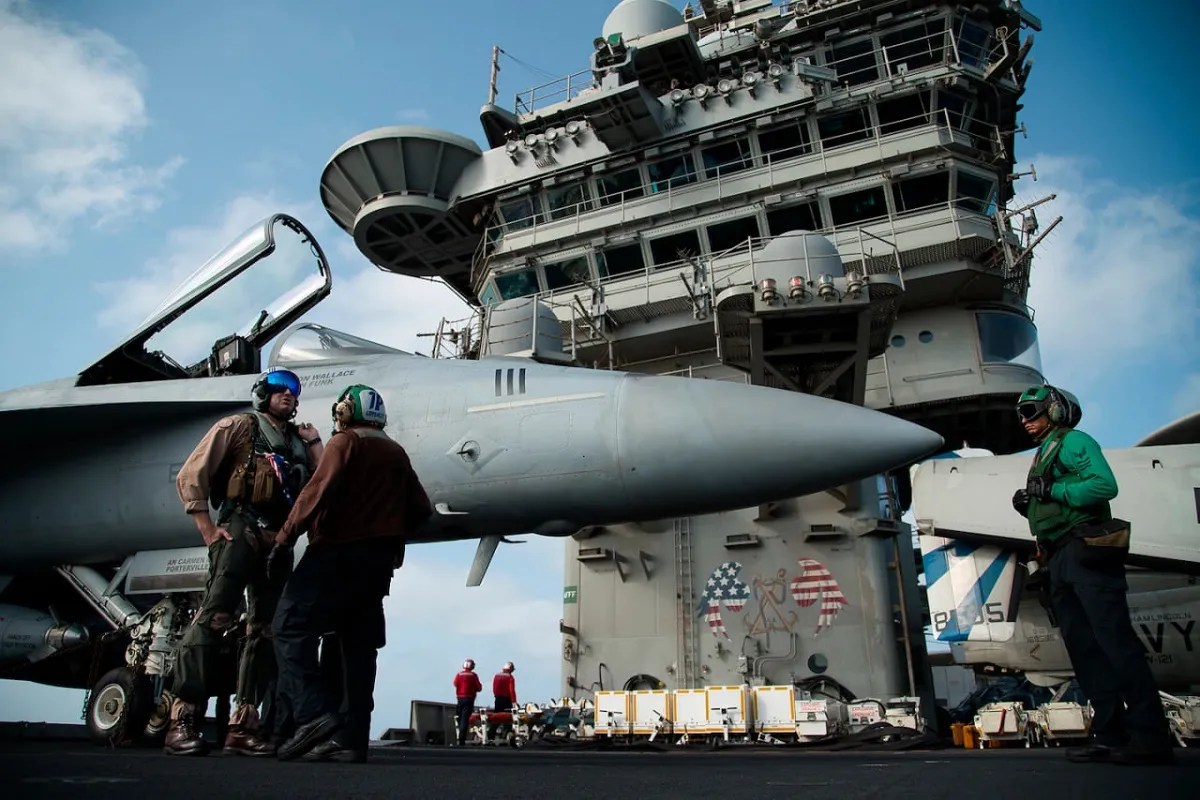
The deployment of sea-based missile platforms by the United States against Iranian targets represents a fundamental shift from gray-zone signaling to active kinetic containment. While sensationalist reporting focuses on the immediate visual of missile launches, the strategic reality centers on the Calculated Threshold of Deterrence. This mechanism relies on the precise calibration of force to degrade specific capabilities without triggering a full-scale regional conflagration. The current theater of operations is defined not just by the projectiles themselves, but by the logistics of maritime dominance and the intersection of electronic warfare with ballistic physics.
The Architecture of Maritime Strike Groups
Modern naval engagement in the Middle East is governed by the Integrated Air and Missile Defense (IAMD) framework. This is not a series of isolated ships, but a networked ecosystem where information is the primary currency. The U.S. Navy utilizes the Aegis Combat System to synchronize data from satellites, high-altitude surveillance drones, and forward-deployed sensors. This creates a "fused" tactical picture that allows for the simultaneous tracking of hundreds of sub-sonic and super-sonic threats.
The strike capacity is categorized by three functional layers:
- Kinetic Interception: Utilizing the SM-3 and SM-6 interceptor families to neutralize incoming Iranian ballistic missiles during their mid-course or terminal phases.
- Offensive Precision: Deploying the Tomahawk Land Attack Missile (TLAM). These cruise missiles utilize Terrain Contour Matching (TERCOM) and Digital Scene Matching Area Correlation (DSMAC) to strike hardened infrastructure with sub-meter accuracy.
- Electronic Suppression: Neutralizing enemy radar and communications through non-kinetic means to ensure the ingress of physical munitions.
This layered approach solves the "Cost-Exchange Ratio" problem. Traditionally, it is far more expensive to intercept a cheap drone than it is to launch one. By utilizing sea-based assets, the U.S. maintains a mobile, replenishable magazine that complicates Iranian "Anti-Access/Area Denial" (A2/AD) strategies.
Geopolitical Friction Points and the Strait of Hormuz
The geography of the Persian Gulf creates a unique bottleneck constraint. Iran’s primary tactical advantage lies in its ability to deploy "swarming" tactics—hundreds of small, fast-attack craft and suicide drones designed to overwhelm a high-value target’s defensive systems. The U.S. response, characterized by sea-launched strikes, is designed to neutralize these assets while they are still in their coastal hangars or launch pads.
The strategic logic follows a strict Escalation Ladder:
- Phase I: Intelligence and Reconnaissance. Monitoring the movement of mobile Transporter Erector Launchers (TELs) within Iranian territory.
- Phase II: Targeted Attrition. Striking Command and Control (C2) nodes to sever the link between central leadership and decentralized militia proxies.
- Phase III: Infrastructure Degradation. Targeting fuel depots and manufacturing facilities to slow the replenishment of missile stockpiles.
A critical misunderstanding in common discourse is the idea that these strikes are intended to start a war. In the framework of Coercive Diplomacy, these strikes are intended to stop a war by demonstrating that the cost of Iranian aggression exceeds any potential territorial or political gain. The maritime positioning allows for a rapid "reset" of the threat level; ships can withdraw or re-position faster than land-based divisions, offering the U.S. maximum flexibility in negotiations.
Ballistic Mechanics and Technical Parity
The technical core of the Iran-Israel conflict involves a competition between Iranian missile volume and Israeli-U.S. interceptor sophistication. Iran possesses the largest and most diverse missile arsenal in the Middle East, including the Khorramshahr and Sejjil series. These are solid-fuel, multi-stage rockets capable of reaching targets over 2,000 kilometers away.
To counter this, the tactical engagement follows a specific Time-on-Target (ToT) calculus. When sea-based missiles are launched, they must account for:
- Atmospheric Drag and Re-entry: The friction generated as a warhead re-enters the atmosphere at Mach 5 or higher requires advanced thermal shielding.
- Terminal Maneuverability: Modern Iranian warheads have incorporated "fins" or small thrusters to change direction in the final seconds, making them harder for Aegis or Iron Dome systems to predict.
- CEP (Circular Error Probable): This is the measure of a weapon system's precision. U.S. sea-based missiles currently maintain a significantly lower CEP than their Iranian counterparts, meaning fewer munitions are required to achieve the same operational objective.
The second limitation of land-based defense is the Sensor Horizon. Because the Earth is curved, ground-based radars cannot "see" low-flying cruise missiles until they are very close. Sea-based platforms, particularly when augmented by E-2D Hawkeye airborne early warning aircraft, extend this horizon, providing vital extra minutes of reaction time.
The Economic Impact of Kinetic Engagement
Warfare in the 21st century is inseparable from global supply chain volatility. The maritime strikes directly impact the Insurance Risk Premium for commercial shipping. Every missile launched increases the cost of "War Risk" insurance for oil tankers passing through the region.
The cost function of this conflict can be broken down into three primary economic variables:
- The Transit Surcharge: The increased cost of re-routing ships around the Cape of Good Hope to avoid the Red Sea and the Persian Gulf.
- The Replenishment Cost: The price of a single SM-6 interceptor is approximately $4 million. In a high-intensity conflict, the U.S. could expend $100 million in munitions in a single afternoon.
- Commodity Volatility: The "Fear Index" in Brent Crude markets, which fluctuates based on the perceived stability of Iranian oil infrastructure.
This creates a bottleneck where the tactical victory (destroying a target) must be weighed against the strategic cost (economic disruption). The U.S. objective is to maintain a "Stable Disquilibrium"—enough pressure to keep Iran contained, but not so much that the global economy suffers a systemic shock.
Strategic Projection
The move to sea-based missile strikes indicates that the U.S. is prioritizing "Over-the-Horizon" capabilities. This minimizes the footprint of boots on the ground while maximizing the threat to Iranian internal security. The bottleneck for Iran is its reliance on localized, fixed-point infrastructure for its drone and missile programs. By utilizing the mobility of the sea, the U.S. renders many of Iran's static defensive positions obsolete.
The immediate operational requirement for regional actors is the hardening of civilian infrastructure and the integration of decentralized energy grids. For the United States, the focus remains on the "Kill Web"—the ability to identify, track, and strike a target in under three minutes from the initial sensor detection. This speed of engagement is the only viable counter to the mass-proliferation of low-cost autonomous weapons. The conflict is no longer a battle of ideologies, but a high-stakes competition in algorithmic processing and logistics.
The next tactical shift will likely involve the deployment of High-Energy Laser (HEL) systems on naval vessels to address the drone-swarming threat at a lower cost-per-shot. Until these systems are fully operational, the reliance on traditional missile platforms will continue to define the risk profile of the region. Strategic planners must now account for the reality that the maritime domain is no longer just a transit route; it is the primary launchpad for the next generation of precision warfare.
Ensure all regional defense procurement focuses on Multi-Domain Command and Control (MDC2). Without the ability to link sea, air, and land sensors into a single, real-time interface, even the most advanced missile platforms will be overwhelmed by the sheer volume of asymmetric threats. The priority must be the "Automation of the OODA Loop" (Observe, Orient, Decide, Act) to outpace the decision-making cycles of decentralized militia networks.