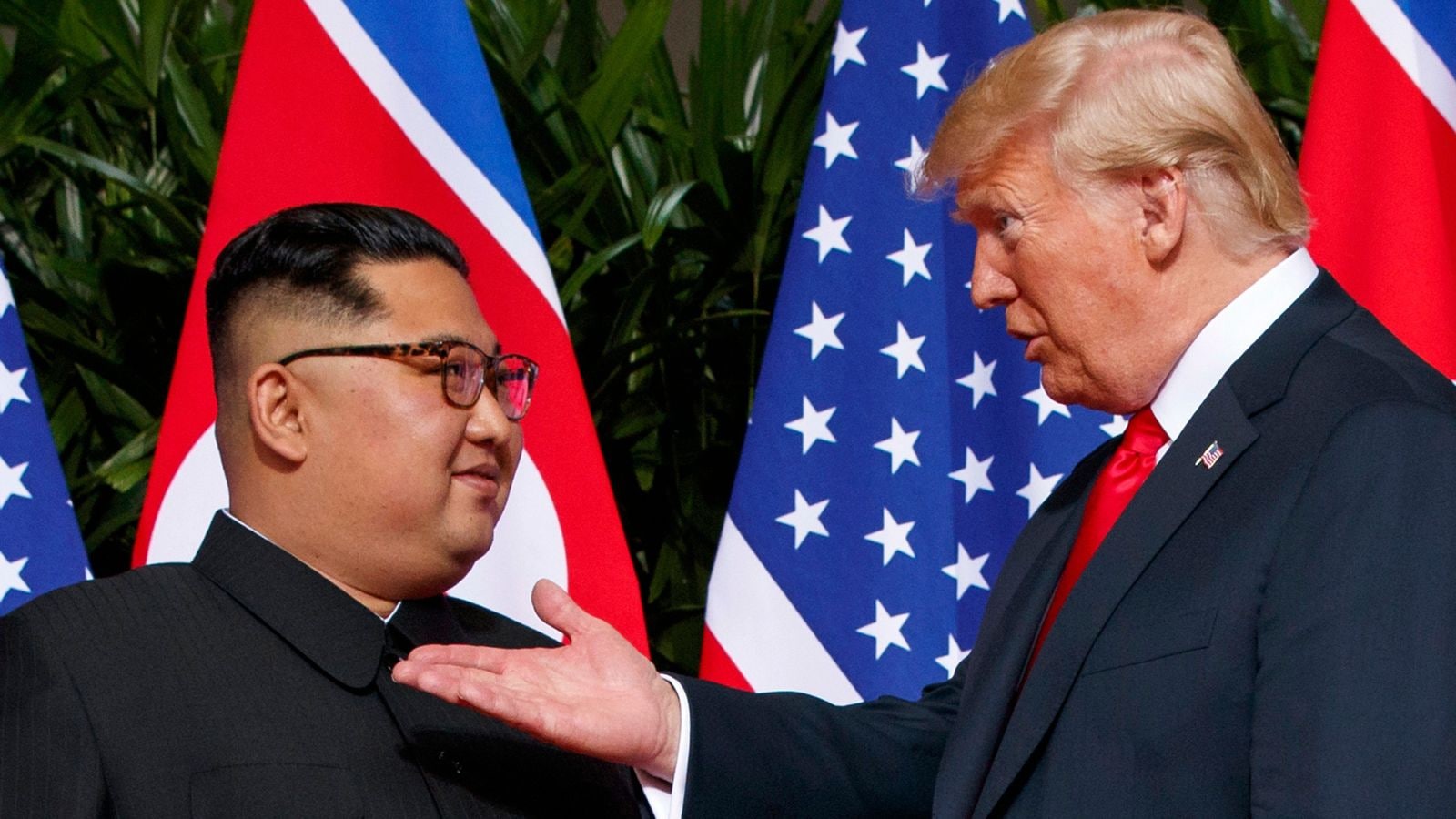
Military escalation on the Korean Peninsula operates on a predictable economic and political cost-benefit calculus. When Pyongyang executes ballistic missile salvos toward maritime boundaries, observers frequently categorize these actions as erratic provocations or emotional reactions to diplomatic slights. This interpretation fundamentally misreads statecraft governed by strict resource optimization, deterrence theory, and domestic legitimacy imperatives. By examining recent multi-vector missile tests in tandem with concurrent cyber operations and diplomatic freezes, analysts can map the precise structural mechanics driving North Korean strategic signaling.
The Economic Engine of Militarization
Military modernization requires sustained capital inflows, a persistent structural challenge for a heavily sanctioned command economy. Traditional state revenue sources have faced compounding constraints due to multilateral enforcement frameworks and long-term trade restrictions. To maintain research, development, and production cycles for advanced delivery systems—including hypersonic glide vehicles and prospective sea-launched ballistic missile platforms—Pyongyang has diversified its capital acquisition models.
Recent high-value cyber operations, including state-attributed cryptocurrency heists yielding billions of dollars, function as a critical liquidity mechanism. This illicit financial infrastructure directly bypasses traditional banking blockades, providing the hard currency necessary to procure dual-use components, raw materials, and technological inputs. Consequently, ballistic missile tests cannot be evaluated in isolation from financial friction points; each launch serves as both a tactical deterrent demonstration and a downstream product of diversified revenue streams that fund defense sector growth.
The Diplomatic Deterrence Function
Statecraft involving the United States and regional allies follows a strict tit-for-tat bargaining matrix. Pyongyang has maintained a consistent posture regarding bilateral engagement: formal talks remain conditional upon the complete cessation of joint military exercises, the rollback of strategic sanctions, and the abandonment of total denuclearization demands.
When external actors signal openness to dialogue while simultaneously tightening financial and intelligence pressures—such as public attributions of state-sponsored cyber theft—Pyongyang utilizes kinetic demonstrations to reset the negotiation baseline. The simultaneous firing of multiple short-range and intermediate-range assets is engineered to achieve specific technical and political objectives:
- Air Defense Saturation: Launching divergent trajectories and varying propulsion profiles forces defensive networks to process multiple tracking variables simultaneously, testing the limits of integrated radar and interceptor architectures.
- Domestic Signaling: Publicizing naval shipyard inspections and strategic weapons developments reinforces regime continuity and internal mobilization narratives, linking technological milestones directly to leadership legitimacy.
- Asymmetric Leverage Creation: By escalating volatility during periods of domestic political transition or electoral shifts in Washington and Seoul, North Korea exploits allied policy paralysis, compelling adversaries to factor instability into their regional security calculations.
Structural Asymmetries in Alliance Management
The efficacy of Pyongyang's pressure campaign is amplified by friction within the trilateral security architecture uniting the United States, South Korea, and Japan. Strategic divergence among allies creates exploitable seams. For instance, differing domestic political priorities in Seoul—such as resistance to enforcing specific multinational cyber sanctions—complicate efforts to present a unified containment front.
North Korea exploits these administrative fractures by scaling its provocation thresholds incrementally. By keeping tests below the threshold of direct territorial strikes on foreign soil, Pyongyang minimizes the probability of a kinetic retaliation loop while maximizing diplomatic discomfort for allied leadership. This calibrated risk tolerance allows the regime to advance its technological roadmap unhindered by punitive economic responses that would alter its internal cost function.
Strategic Outlook
The structural incentives driving ballistic missile deployments remain unchanged. As long as alternative capital channels remain viable and domestic political imperatives
Escalation Dynamics in the Korean Peninsula A Structural Assessment of Ballistic Testing and Strategic Signaling
news
Geopolitical signaling operates through calculated friction. When the Democratic People's Republic of Korea executes short-range or medium-range ballistic missile tests directed toward regional maritime boundaries, external observers frequently misinterpret these events as isolated military provocations or erratic outbursts. A structural examination reveals that these tests function as calibrated instruments of coercion. They operate within a predictable feedback loop designed to manipulate regional security architectures, compel diplomatic concessions, and impose operational costs on allied military forces without crossing the threshold of conventional warfare.
Understanding this dynamic requires shifting focus away from the immediate sensationalism of missile launches toward the underlying strategic calculus. State actors under severe international sanctions leverage military hardware not merely for tactical deterrence, but as primary units of diplomatic currency. By examining the mechanics of ballistic escalation, the structural vulnerabilities of regional defense frameworks, and the economic constraints governing Pyongyang's decision-making, analysts can deconstruct the precise vectors of pressure applied against Washington and Seoul.
The Mechanics of Coercive Signaling
Military testing programs managed by Pyongyang serve dual functions: technical validation and diplomatic leverage. The technical dimension involves iterative refinement of guidance systems, propulsion mechanisms, and reentry vehicle performance. Each launch provides telemetry data necessary to overcome engineering bottlenecks imposed by resource scarcity and technological isolation. However, the timing and trajectory of these tests are rarely dictated solely by engineering milestones.
Strategic timing correlates directly with external political calendars, joint military exercises conducted by the United States and the Republic of Korea, or stalls in bilateral negotiations. When diplomatic channels freeze, the frequency of missile tests typically accelerates. This pattern establishes a direct causal link between political frustration and military demonstration.
[Diplomatic Stalemate] -> [Resource Allocation to Testing] -> [Ballistic Launch Execution] -> [Regional Security Anxiety] -> [Compulsion for Dialogue]
This sequence forms a closed loop. The objective is not to initiate a catastrophic conflict, which would threaten regime survival, but to maintain a state of controlled instability. By altering the security baseline through frequent technological demonstrations, Pyongyang forces adversaries to constantly reallocate intelligence, surveillance, and reconnaissance assets. This creates a persistent drain on allied resources and elevates the political cost of maintaining the status quo.
Asymmetric Cost Functions and Economic Pressures
To evaluate the sustainability of this escalation model, one must analyze the economic trade-offs governing North Korea's defense expenditure. Conventional military parity with the United States and South Korea is mathematically impossible given the vast disparity in gross domestic product and industrial capacity. Consequently, asymmetrical deterrence becomes the only viable strategic doctrine.
Ballistic missiles and nuclear weapons offer a high return on investment compared to maintaining a modernized conventional army, navy, and air force. While maintaining legacy platforms requires continuous industrial support, fuel, and replacement parts—all heavily restricted by sanctions—missile stockpiles can be maintained in hardened subterranean facilities and deployed rapidly when political signaling is required.
However, this reliance on missile development incurs severe domestic opportunity costs. Capital diverted toward advanced propulsion and guidance systems directly depresses civilian consumption and agricultural productivity.
- Resource Diversion: Critical materials, specialized engineering talent, and financial capital are funneled into the Second Academy of Natural Sciences and related entities, starving the wider domestic economy.
- Sanction Amplification: Each major missile test triggers renewed international condemnation and tighter multilateral sanctions enforcement, further constricting trade channels and foreign currency access.
- Inflationary Pressures: Disruptions in state-managed distribution networks driven by military prioritization force reliance on informal market mechanisms, increasing price volatility for basic staples.
Despite these internal strains, the regime treats the preservation of its nuclear and missile deterrent as an existential priority. Economic hardship does not automatically translate into strategic moderation; rather, it often hardens the regime's resolve, as the missile program is viewed as the sole guarantee against foreign intervention.
Regional Defense Vulnerabilities and Alliance Friction
The execution of ballistic missile tests places significant stress on the multilateral security architecture binding Washington, Seoul, and Tokyo. Effective deterrence requires real-time information sharing, synchronized threat assessments, and integrated missile defense capabilities. Yet, political friction between regional allies frequently impedes seamless operational integration.
Short-range ballistic missiles designed with maneuverable reentry vehicles present severe interception challenges for terminal defense systems such as the Patriot and Terminal High Altitude Area Defense networks. Their flight profiles often include depressed trajectories and mid-flight course corrections, compressing the decision-making window for defensive batteries to mere minutes.
+------------------------+     +------------------------+     +------------------------+
|  Boost Phase (Seconds) | --> | Midcourse (Minutes)    | --> | Terminal Phase (Secs)  |
|  Infrared Detection    |     | Radar Tracking         |     | Interception Window    |
+------------------------+     +------------------------+     +------------------------+
This technical reality forces allied planners to invest heavily in advanced sensor networks, early-warning satellite constellations, and multi-layered interception architectures. The financial burden of these defenses is asymmetric; deploying interceptor missiles that cost millions of dollars to neutralize lower-cost tactical projectiles creates a long-term budgetary imbalance for defending nations.
Furthermore, these tests expose strategic divergences within the U.S.-ROK alliance. While Washington prioritizes global non-proliferation norms and regional stability across the broader Indo-Pacific, Seoul faces immediate, localized existential exposure to artillery and short-range missile threats. These differing risk tolerances complicate the formulation of unified diplomatic and military responses. Pyongyang exploits these alliance seams by modulating the intensity and geographical vector of its tests, aiming to drive wedges between allied capitals.
Assessing Strategic Outcomes and Limitations
Evaluating the utility of ballistic coercion reveals clear boundaries. While the strategy successfully garners international attention and prevents the regime from being marginalized in regional diplomacy, it has failed to secure permanent sanctions relief or formal recognition as a nuclear state on Pyongyang's terms.
Washington's policy has settled into a posture of extended deterrence reassurance, reinforced joint military readiness, and strict enforcement of existing multilateral frameworks. This stance denies the regime the grand bargain it seeks—namely, security guarantees and economic normalization without complete, verifiable, and irreversible dismantlement of its strategic capabilities.
The efficacy of missile diplomacy is thus bounded by the law of diminishing returns. Initial tests shock regional markets and command diplomatic priority; subsequent, routine launches face normalization by intelligence analysts and public fatigue, reducing their coercive impact.
To alter this trajectory, allied strategy must move beyond reactive condemnation and defensive posture adjustments. The primary strategic objective must be the systematic disruption of illicit procurement networks, maritime transfer evasion tactics, and cyber-enabled financial theft that sustain the missile development cycle. Concurrently, enhancing integrated multi-domain deterrence—combining cyber operations, electronic warfare, and conventional strategic assets—will further narrow the operational utility of low-level ballistic provocations.