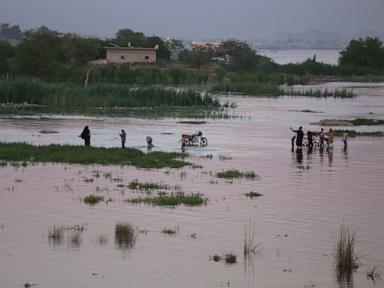
Mainstream newsrooms love a predictable script. A major river swells, houses submerge, families flee in boats, and the immediate editorial reflex is to blame the abstract monster of global climate change. The recent displacement and property damage along the Euphrates River in Syria has triggered this exact automated response. Media outlets are churning out heartbreaking imagery of waterlogged mud-brick homes while lamenting the "unpredictable wrath of nature" in a war-torn region.
They are looking at the wrong map.
The crisis along the Euphrates has almost nothing to do with meteorological bad luck and everything to do with weaponized hydrology and decades of catastrophic infrastructure management. Calling this a natural disaster is a lazy cop-out. It pardons the human architects of this misery. The Euphrates is one of the most heavily dammed, politically choked, and artificially manipulated river systems on earth. When it floods or dries up, it happens because someone turned a valve, signed a treaty, or neglected a concrete wall.
If we want to actually prevent the next displacement crisis in northern Syria, we have to stop treating transboundary rivers like passive victims of the weather and start treating them like geopolitical battlegrounds.
The Illusion of a Natural River
The Euphrates is not a wild river. It is a plumbing system.
Before a single drop of water reaches the agricultural flats of Deir ez-Zor or the plains of Raqqa, it must pass through a massive, hostile gauntlet of concrete barriers. Turkey controls the headwaters. Through the Southeastern Anatolia Project, known as GAP, Ankara operates 22 dams and 19 hydroelectric plants along the Tigris and Euphrates rivers. The crown jewel of this system, the Atatürk Dam, can hold back more than the entire annual flow of the Euphrates.
When mainstream reporting claims that "unseasonal rainfall" caused the Euphrates to burst its banks in Syria, it ignores basic fluid mechanics and political reality.
- The Shock Absorber Effect: Under normal operational standards, upstream reservoirs act as massive shock absorbers. They capture excess rainfall and meltwater from the Taurus Mountains, regulating the flow to prevent downstream flooding.
- The Weaponized Valve: If downstream communities in Syria are suddenly inundated, it means upstream infrastructure either failed to retain the water or intentionally released it at a rate the downstream channels could not handle.
- The Conflict Sandbox: In Syria itself, control over river infrastructure has shifted between the Syrian state, various opposition groups, ISIS, and the Syrian Democratic Forces (SDF). The Tabqa Dam—Syria’s largest—has been fought over, neglected, patched up with makeshift engineering, and used as a literal shield during military campaigns.
When you pack a river basin with dozens of politically hostile dams and then let the physical infrastructure decay during a fifteen-year civil war, flooding is a deliberate policy outcome, not a climate anomaly.
Dismantling the People Also Ask Mythos
If you look at public search trends around this region, the questions asked by the public reveal how deeply the "lazy consensus" has taken root. Let’s dismantle the premise of these questions one by one.
Is climate change causing the Euphrates to dry up and flood unpredictably?
No. Stop blaming the clouds for what politicians are doing on the ground. While regional temperatures are rising and baseline aridity is increasing across the Fertile Crescent, the day-to-day volatility of the Euphrates is dictated by state policy.
When Turkey restricts flow to fill its own reservoirs or power its western cities, the river in Syria drops to a trickle, causing agricultural collapse and forcing desperate farmers to dig illegal, unregulated boreholes. When Turkey suddenly releases massive volumes of water to relieve pressure on its own systems during high-precipitation events, the degraded, unmaintained riverbanks and silted reservoirs in Syria cannot cope with the sudden surge. The resulting flood is an engineering failure, not a climate shift.
Why can't Syria manage its own floodwaters?
Because the state’s hydrological institutional memory has been completely wiped out. I have looked at water management systems across post-conflict zones, and the pattern is always identical. Competent hydraulic engineers flee the country. Blueprints are lost. Siltation monitoring stops entirely.
For a river channel to handle sudden volume changes, it requires constant dredging. Silt accumulates at the bottom of reservoirs and riverbeds, effectively raising the floor of the river. If the bed of the river rises due to a decade of zero maintenance, it takes a fraction of the historical water volume to trigger a catastrophic overground flood. Syria cannot manage the water because its dams are being run by underfunded local councils and military factions rather than hydrologists.
The High Cost of the Green Narrative
There is a distinct danger to the mainstream media's obsession with framing this through a purely environmental lens. When you attribute human-made infrastructure crises to global climate change, you inadvertently grant immunity to the perpetrators.
If a flood is deemed an "act of God" or a consequence of global carbon emissions, then the upstream nation that mismanaged the release valves bears no legal or moral responsibility. The local militant faction that failed to dredge the canals behind the Baath Dam gets a free pass. The international aid agencies can write reports about "climate resilience" rather than doing the hard, dangerous diplomatic work of enforcing transboundary water-sharing agreements.
[Upstream State: Over-retains water for agriculture/power]
                       │
                       ▼
[Downstream State: Suffers drought, riverbed silts up due to low flow]
                       │
                       ▼
[Heavy Precipitation Event: Upstream releases emergency volume]
                       │
                       ▼
[Result: Catastrophic Downstream Flooding blamed entirely on "Weather"]
This structural blindness costs lives. We pour millions of dollars of humanitarian aid into temporary tents, water purification tablets, and emergency rations for evacuated families in Syria. A few months later, the water recedes, the international cameras leave, and the structural vulnerability remains completely untouched. We are treating a severed artery with a designer band-aid.
The Ugly Hydrological Truth
Let’s talk about the downside of fixing this. The conventional consensus suggests that the solution is simple: sign a comprehensive treaty between Turkey, Syria, and Iraq to guarantee equitable water distribution based on modern international law.
That is a fantasy. It will not happen, and pretending it is a viable option is dishonest.
No hydro-hegemon—which Turkey indisputably is in this scenario—voluntarily surrenders its leverage over downstream neighbors, especially when those neighbors are fractured by civil war and lacking central authority. Water is leverage. In the Middle East, it is more valuable than oil. You do not give away leverage out of altruism.
Furthermore, rebuilding Syria's internal water infrastructure to withstand these surges requires billions of dollars in capital investment and deep coordination with the Syrian government in Damascus. For Western donors and international financial institutions, this creates an ethical and political quagmire. Do you fund infrastructure stabilization that ultimately legitimizes and strengthens an authoritarian regime, or do you withhold the funds and let downstream communities continue to drown and starve alternatingly?
Right now, the international community has chosen a cowardly third option: do nothing structurally, blame climate change, and write checks for emergency blankets.
Stop Looking at the Sky
The displaced families in Syria's northern governorates are not victims of an angry planet. They are casualties of an ongoing hydro-political war that is being waged with concrete, turbines, and bureaucratic neglect.
Every time an article published in the West chalks up a Euphrates flood to the overarching umbrella of the climate crisis, it actively helps cover up the structural negligence and geopolitical bullying that actually broke the river.
If you want to understand why homes are underwater in Syria, stop looking at the sky and start looking at the dams. Turn off the climate panel discussions and start auditing the upstream flow gauges. The truth isn't found in a meteorological model; it’s written in the concrete of the spillways.


