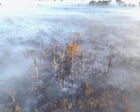
The skies over southwestern France and central Spain don’t look real right now. They glow a bruised, apocalyptic orange, choked by smoke from monster blazes that have already forced roughly 330,000 people to pack up whatever they can carry and flee.
If you think this is just another normal seasonal wildfire season, you're missing the terrifying reality on the ground. Firefighters are locked in a desperate, round-the-clock race against time. Another brutal heatwave is slamming into western Europe, threatening to wipe out days of exhausting containment work. The United Nations has put it bluntly, warning that the climate alarm is blaring from every direction.
So, what is actually happening across the continent, why are these fires so impossible to stop, and what does this mean for the future of European summers? Let's break it down.
Anatomy of a Wildfire Emergency
Right now, the numbers coming out of southern Europe are staggering. In France, the infamous Gironde region near Bordeaux—a landscape famous for postcard-worthy pine forests and world-class vineyards—is once again ground zero. A massive fire has scorched over 420 square kilometers, forcing fresh evacuations around tourist hotspots like Lacanau.
Across the border in Spain, the situation is even grimmer. A relentless blaze in the hilly Ávila province west of Madrid has ballooned into Spain's largest wildfire on record, consuming roughly 50,000 hectares. Combined with other fires north and west of the capital, scorched land near Madrid alone has hit an astonishing 70,000 hectares.
Fire services are dealing with meteorological phenomena that used to be rare. In France, the National Firefighters Federation reported the creation of a massive "pyrocumulonimbus"—a giant fire cloud generated by the blaze itself. These monstrous clouds create their own erratic winds and strike the earth with lightning, sparking entirely new fires miles away from the main front. When a fire starts breeding its own weather system, standard firefighting tactics simply stop working.
Why This Heatwave is Different
You can't talk about these fires without looking at the tinderbox condition of the soil. Successive waves of extreme heat since late spring have sucked every drop of moisture out of the earth.
Forest floors in Spain and France aren't just dry; they are baked to a crisp. Spain's government reported that the forested land burned this year is six times greater than the exact same period last year. When temperatures push past 40 degrees Celsius, water evaporates from plant life almost instantly.
Spanish Prime Minister Pedro Sánchez noted during a climate briefing that these disasters are no longer shocking exceptions. They are the new baseline rule. Governments are scrambling, activating the European Union's emergency assistance mechanism to pool resources. Planes and helicopters are being shuttled frantically between French airfields and Spanish control centers, but air support can only do so much when the ground itself feels like an oven.
The Human Cost and Economic Toll
Evacuation centers look like refugee camps. The Bordeaux Exhibition Centre has transformed into a massive temporary home for thousands of displaced residents and panicked holidaymakers. Campsites along the Atlantic coast have been emptied at gunpoint-level urgency as local police urge tourists to abandon cars and possessions.
The economic hit is devastating. Agriculture across Europe is buckling under the strain. Farmers face some of the driest soils on record, threatening millions of tonnes of grain and driving down maize harvests. Regional tourism—the lifeblood of rural economies in Gironde and Ávila—is taking a massive beating right in the middle of peak summer vacation season.
European Union officials have issued a grim warning that this wildfire season, which kicked off unusually early in April, might not truly let up until early November. That leaves months of vulnerability ahead.
Preparing for a Permanently Altered Landscape
Living through a climate emergency requires rewriting emergency response playbooks from scratch. Local authorities are learning that traditional firebreaks aren't wide enough, evacuation routes get clogged too easily, and public warning systems need to be faster and sharper.
If you are planning travel to southern Europe during the summer months, stay glued to local meteorological alerts like Météo-France or Spain's Aemet. Keep a close eye on regional access restrictions to national parks and forested zones. Governments are increasingly locking down high-risk areas entirely to prevent accidental human-triggered sparks from compounding an already unmanageable crisis.
The flames in France and Spain will eventually be extinguished, but the structural reality of Europe's climate crisis is here to stay.