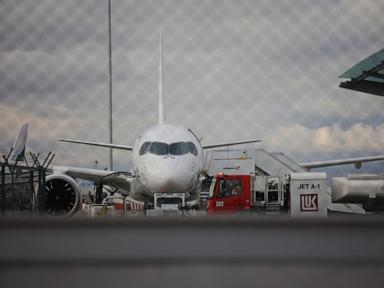
Mainstream travel coverage treats the wave of hoax bomb threats across European airports and airlines like a weather event. Flights divert. Fighter jets scramble. Terminals empty onto the tarmac. Journalists dutifully file breathless reports reminding passengers that "safety comes first" and assuring the public that law enforcement is "investigating."
That comforting narrative is the exact reason the attacks keep working.
Every time an airline dumps two hundred passengers onto an emergency slide because an anonymous ProtonMail account sent a three-sentence threat to a generic customer service inbox, the attacker wins without spending a single euro. European aviation isn't suffering from a sudden spike in physical terror plots. It is suffering from a self-inflicted asymmetric warfare problem—one where legacy security protocols designed for 1970s hijackings are being weaponized by internet trolls, extortionists, and state-backed agitators using free Wi-Fi and basic VPNs.
If you want to understand why your flight out of Frankfurt, Paris, or Warsaw suddenly turned around over the Alps, stop looking at baggage scanners. Look at the incentives.
The Lazy Consensus Around "Abundance of Caution"
Ask any aviation spokesperson why an unverified email triggers a full-scale military scramble, and you will get the corporate catechism: We cannot afford to be wrong even once.
On paper, that sounds noble. In practice, it is an abdication of risk management.
True aviation security—the kind built by organizations like the International Civil Aviation Organization (ICAO) and implemented by intelligence-driven carriers like El Al—relies on threat credibility assessment, not blanket panic. Under ICAO Annex 17 standards, states are required to establish procedures for evaluating threat levels before tearing an operation apart. There is a massive operational difference between a specific, actionable intelligence intercept and a copy-pasted mass email blasted simultaneously to forty regional airports.
Yet across Europe, risk aversion has calcified into institutional paralysis. Nobody in an airline operations center gets fired for diverting a plane. Plenty of middle managers get fired if they ignore a warning and something goes wrong, even if the warning had zero physical plausibility.
So they hit the panic button every single time.
The result? We have handed a zero-cost denial-of-service switch to anyone with an internet connection. Think about the economics of this asymmetry:
- Cost to the attacker: $0. Ten minutes to spin up an encrypted email address, route traffic through a Tor exit node, and hit send on a script targeting fifty European aviation authorities.
- Cost to the aviation ecosystem: Upward of €100,000 per wide-body diversion in burned jet fuel, crew overtime, airport landing fees, EU261 passenger compensation claims, and scrambled Eurofighter Typhoons or Rafales.
I have sat in crisis rooms where senior operations directors watched six-figure losses pile up in real time over threats so poorly written they looked like machine-translated spam. Everyone in the room knew the aircraft was clean. Nobody had the bureaucratic courage to sign off on keeping it in the air.
The Anatomy of a Modern Aviation Hoax
To understand why these hoaxes paralyze European airspace, you have to understand how airside security actually works—and why a remote bomb threat defies basic physical logic.
Modern commercial aviation operates on strict sterile-area containment. Before a single bag enters the belly of an Airbus A320 at Schiphol or Charles de Gaulle, it passes through multi-view X-ray tomography and automated Explosive Detection Systems (EDS). Every passenger clears millimeter-wave imaging or walk-through metal detectors. Under European Commission Regulation (EU) 2015/1998, positive passenger-bag matching is absolute: if a passenger does not board the aircraft, their checked luggage is pulled before pushback. No exceptions.
Now, picture a hypothetical scenario. Suppose a malicious actor actually managed to defeat multi-layered EDS screening, bypass airside access controls, and plant an explosive device aboard a commercial airliner.
Why on earth would they email the airport's public press office twenty minutes after takeoff to warn them?
Terrorists want mass casualties and spectacle; they do not send polite heads-up emails so passengers can evacuate safely onto the tarmac. Historically, warnings prior to bombings—like those used by the IRA in the 1970s and 1980s—were tied to specific political bargaining and pre-arranged codewords verified by intelligence services. Today's wave of European flight threats has no demands, no ideology, and no verified codewords.
They are swatting attacks at 35,000 feet.
Just as online gamers and extortionists call fake hostage reports into local police departments to watch SWAT teams kick down a streamer's door on a livestream, digital disruptors target commercial flights to watch Flightradar24 light up with emergency squawk codes (7700) and military interceptors. When major news outlets run live-blogs tracking every diverted Ryanair or Lufthansa flight, they provide the exact public scoreboard the attackers crave.
Why Europe Is Uniquely Vulnerable Right Now
If this is a global vulnerability, why has Europe absorbed the brunt of coordinated flight and airport hoax campaigns over the past few years? Three structural flaws explain the spike.
1. Fragmented Jurisdictions Across Tight Airspace
Europe packs dozens of sovereign states, national police forces, and air navigation service providers into a geographic footprint roughly the size of the United States. When a threat hits a flight crossing from French into Swiss and then Italian airspace, command authority fractures instantly. National aviation authorities default to their most conservative local protocol rather than risk diplomatic blame if a neighboring country's aircraft goes down on their soil.
2. Automated Intake Without Triage
For years, European airports and carriers modernized their digital customer service by exposing direct email portals, web forms, and social media channels to the public—and routing urgent keywords straight into security dispatch queues without behavioral filtering. Attackers realized they didn't need to breach an air-gapped air traffic control network. They just needed to trigger keyword alerts on public-facing servers.
3. Grey-Zone Geopolitical Spillover
Security analysts at agencies like Europol and national domestic intelligence services have repeatedly flagged how cyber-harassment overlaps with hybrid warfare. Since the escalation of conflict on Europe's eastern flank, low-level cyber proxies have tested European critical infrastructure constantly. Bomb hoaxes against rail networks, schools, and commercial aviation serve as cheap stress tests—measuring response times, exhausting emergency responders, and eroding public trust in European transport reliability without crossing the threshold of an armed attack.
Dismantling the Questions Passengers Actually Ask
When flights start dropping out of the sky onto alternate runways, stranded travelers flood search engines with the same predictable questions. Most of those questions are built on false premises.
"How can I tell if a flight threat is real or a hoax?"
You can't, and trying to guess from your seat in row 24 is pointless. Even the flight crew doesn't make that call. The captain receives an ACARS text message from airline dispatch ordering an immediate diversion to the nearest suitable airfield. Your only job when the cabin crew announces an unscheduled landing is to leave your carry-on bag in the overhead bin if the slides deploy. Every passenger who stops to grab a roller bag during an evacuation steals seconds from the people behind them.
"Are European airports getting less safe?"
No. In fact, physical airport security in Europe is tighter than it has ever been. The rollout of Computed Tomography (CT) C3 scanners across major hubs allows security officers to inspect 3D volumetric images of carry-on luggage with vastly higher explosive-detection accuracy than older 2D X-rays. The spike in diversions is proof of over-reaction to digital noise, not a collapse in physical screening. Confusing a spike in hoax emails with a spike in actual bombs is like confusing an increase in fire drills with an increase in arson.
"Why don't police just trace the emails and arrest them?"
Because attribution across encrypted infrastructure takes months, while an aviation diversion takes six minutes. Attackers chain commercial VPNs with privacy-focused email providers based in strict data-protection jurisdictions, or compromise legitimate third-party accounts to relay threats. Even when Europol and national cybercrime units successfully unmask and arrest perpetrators—which they have done in multiple cross-border sweeps—the deterrent effect is weak when copycats see headlines proving how easily a single message can ground an entire terminal.
What Aviation Security Must Do Next (And Why It Won't Be Popular)
Stopping this cycle requires abandoning the fantasy that zero risk is achievable without shutting down commercial flight altogether. Aviation authorities need to move from reactive panic to intelligence-led filtering—and accept the political heat that comes with it.
- Enforce Strict Threat Credibility Matrixes: Security directors must be empowered—and legally insulated—to classify anonymous, non-specific mass emails as low-credibility nuisance events when physical screening integrity is verified. If every bag was screened via EDS and every passenger cleared sterile checkpoints, an uncorroborated email from an untraceable webmail provider should not automatically trigger a military scramble.
- Quarantine Public Intake Channels: Airlines and airport authorities must stop routing unauthenticated public web forms and generic press emails directly into emergency operations triggers. Digital threat triage needs metadata analysis, linguistic fingerprinting, and cross-border threat-intelligence sharing (via bodies like the European Union Aviation Safety Agency, EASA) to spot automated bot campaigns within seconds rather than treating every duplicate message as a novel emergency.
- Starve the Spectacle: Law enforcement and aviation regulators should stop issuing real-time play-by-play confirmations of hoax diversions while incidents are unfolding. Confirming that a specific email successfully grounded Flight 402 gives the perpetrator instant gratification and hands copycats a blueprint.
- Treat Digital Aviation Disruption as Felony Sabotage: Fines and suspended sentences for juvenile or young-adult swatting offenders do nothing. Cross-border European prosecution frameworks need mandatory restitution orders tying perpetrators to the actual economic damages of a diversion—alongside extradition agreements that eliminate safe havens for cyber-extortionists.
There is an obvious downside to raising the threshold for diversions: optical risk. The first time an intelligence-led triage system correctly ignores a hoax, nothing happens—and nobody writes a thank-you note for a flight that landed on schedule. The one time an edge case slips through, the executives who signed off on the new protocol will face parliamentary inquiries and front-page crucifying.
That asymmetry of blame is the real vulnerability in European aviation. Not the luggage hold. Not the cockpit door. Until regulators care more about operational resilience than covering their own backsides in a press conference, a bored teenager with a burner email address will remain more powerful than Europe's air defense network.