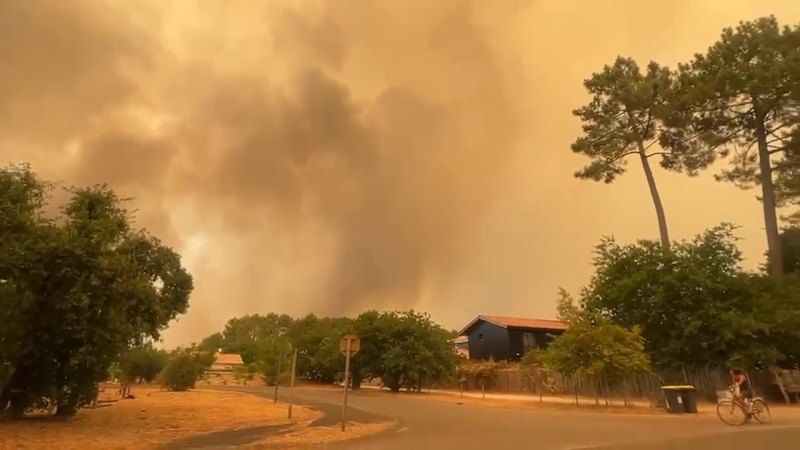
You pack your bags expecting wine tasting, dune climbing, and relaxing Atlantic ocean breezes. Instead, you wake up at two in the morning to police officers knocking on your cabin door, telling you that you have ten minutes to grab your belongings before a wall of flame swallows the campsite.
That isn't a hypothetical disaster movie plot. It's the reality for nearly 20,000 tourists and locals across France's Gironde department right now.
A massive wildfire starting near the small village of Saumos, just west of Bordeaux, rapidly tore through more than 3,700 hectares of pine forest near Arcachon Bay and Lège-Cap-Ferret. Over 18,000 people were forced out of campsites and holiday homes overnight as 10-meter-high flames swept through the dry timber.
This isn't an isolated stroke of bad luck either. From the French Atlantic coast down to Sicily and across central Spain, Southern Europe is suffering through one of the most brutal summer fire seasons in modern history.
If you're planning a trip to the Mediterranean or the French coast anytime soon, pretending these fires are rare anomalies is a mistake. The way we approach summer travel in Europe has fundamentally changed.
The Perfect Storm Behind the Atlantic Coast Fires
People often assume wildfires only happen in scrubby, Mediterranean desert climates like southern Greece or inland Spain. Seeing thousands of tourists evacuate seaside pine forests near Bordeaux confuses a lot of travelers.
The Gironde region is covered by the Landes de Gascogne, the largest man-made forest in Western Europe. It's essentially millions of acres of densely planted maritime pine. Pine trees are full of resin, highly flammable, and when a prolonged heatwave hits, they turn into a massive tinderbox.
+-------------------------------------------------------------+
|               HOW THE GIRONDE BLAZE SPREAD                  |
+-------------------------------------------------------------+
| 1. Prolonged Heatwaves  --> Soils and pine resin desiccate  |
| 2. Mechanical Spark     --> Undergrowth clearing ignites    |
| 3. High Atlantic Winds  --> 10m-high fire fronts created    |
| 4. Mass Evacuations     --> 18,800+ forced to flee        |
+-------------------------------------------------------------+
When you combine that dense pine with three back-to-back heatwaves pushing temperatures past 40°C, the soil completely loses its moisture. Add strong ocean winds to the mix, and a tiny spark transforms into an erratic, fast-moving wall of fire within hours. Local officials in Le Porge noted that the initial blaze appears to have been ignited by a clearing machine working in the dry undergrowth. It didn't take long for wind to fan those embers into ten-meter flames.
More than 800 firefighters and heavy water-bombing aircraft have been fighting to keep the flames away from residential areas in Lège-Cap-Ferret, a peninsula famous for its oysters and high-end holiday villas. Emergency crews literally stood line-by-line defending individual homes 300 meters from the advancing fire front.
Southern Europe Is Burning Far Ahead of Schedule
France isn't fighting this alone. The European Forest Fire Information System reported that the total land area burned across EU countries by late July was roughly double the 20-year average for this time of year.
- In Spain, a massive blaze in Guadalajara burned through more than 320 square kilometers of land, while smaller, intense fires near Madrid temporarily shut down high-speed rail lines to Barcelona.
- In Italy, firefighters in Sicily battled hundreds of active blazes amid blistering 49°C heat, tragically losing a veteran firefighter in Caltanissetta during emergency operations.
- In Portugal, vast swathes of pine and eucalyptus forests in the north have already been converted to ash, requiring international assistance to contain.
The issue isn't just that fires are happening. It's that they are happening earlier, spreading faster, and hitting regions that used to be considered low-risk. When the UNESCO-listed Fontainebleau forest just south of Paris caught fire earlier this month, it served as a wake-up call that wildland fire risks are creeping steadily northward.
What Most Travelers Get Wrong About Wildfire Risks
Most people check the 10-day weather forecast before booking a trip. If it says 32°C and sunny, they think they've hit the jackpot.
What they miss is the cumulative drought index and regional fire threat levels. A week of 30°C weather after a rainy spring is fine. Three consecutive heatwaves with zero rainfall by mid-summer mean the ground is bone dry, regardless of how nice the sky looks.
Another common mistake is assuming that staying near the water keeps you safe. Coastal towns like those along Arcachon Bay or Cap Ferret often have only one or two main access roads cutting straight through dense pine forests. When a fire breaks out, those roads get closed immediately by local authorities to preserve access for emergency vehicles. Thousands of campers can quickly find themselves stuck, relying on local mayors to open community gyms or organizing emergency boat evacuations along the coast.
Practical Steps for Traveling to High-Risk Zones
You don't necessarily have to cancel your European summer trip, but you do need to stop planning trips like it's 1995. The climate in Southern and Western Europe has shifted, and your prep needs to shift with it.
- Monitor Fire Risk Maps directly: Before arriving, check the national weather or forestry service apps of the country you're visiting. France uses the Météo des Forêts forecast system, which rates daily wildfire risks by department on a green-to-red scale.
- Map out secondary escape routes: If you're renting an Airbnb or booking a campsite in a heavily forested or rural area, check Google Maps for more than one way out. If a single pine-lined road is your only route to a main highway, keep your gas tank at least half full at all times.
- Keep an emergency go-bag ready: If you are staying in a high-risk department during an active heatwave, keep your passports, medication, cash, and essential electronics packed together near the front door or in your trunk. When local police bang on doors to clear an area, you won't have time to search under beds for chargers.
- Sign up for local alert systems: Ensure your phone has emergency location alerts turned on. In France, the FR-Alert system sends localized broadcast notifications directly to mobile phones in affected areas, even if you don't speak the language or have a local SIM card.
- Reconsider peak August bookings for forested regions: If you want a summer holiday without the looming threat of evacuations, shift your timing to late May or September, or pivot your geography toward cooler, non-forested regions. The high Mediterranean summer heat isn't just uncomfortable anymore—it actively disrupts travel infrastructure.
Check your travel insurance policy immediately if you have an upcoming booking near active fire zones in France, Spain, or Italy. Most standard policies cover cancellations due to mandatory government evacuations, but they rarely pay out if you simply decide to cancel out of fear before an official order is issued. Keep a close eye on local prefecture updates and keep your bags packed smart.