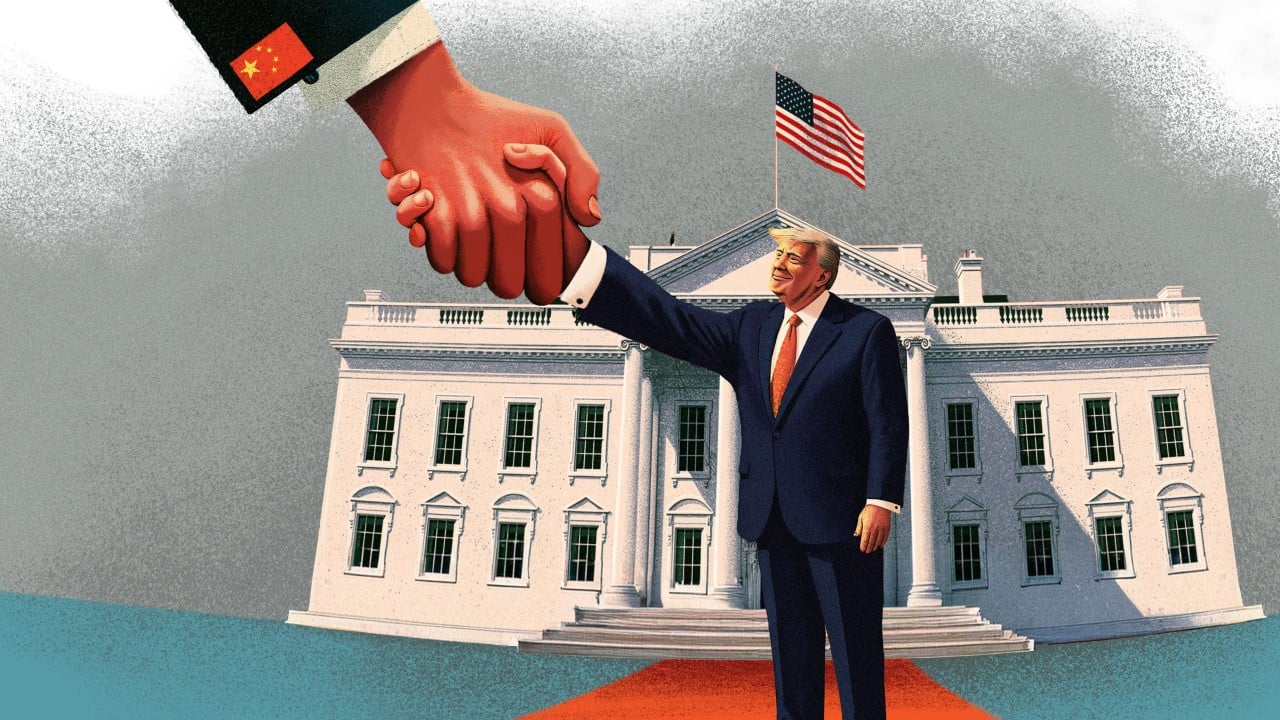
Every time a bilateral summit appears on the calendar, lazy commentary returns like clockwork. Wall Street pundits and foreign policy armchair generals line up to declare that Beijing holds a superior hand. They point to rare earth export controls, top-down industrial policy, and Xi Jinping's ironclad control over domestic messaging. It is a comfortable narrative. It sounds sophisticated. It is also entirely wrong.
The consensus view treats geopolitical negotiation like a game of Texas Hold'em where China has been quietly hoarding pocket aces while Washington is distracted by domestic political theater. This perspective fundamentally misunderstands the structural reality of modern statecraft. It confuses tactical posturing with strategic strength. When you strip away the polished press releases and the anxious commentary from trade associations, a very different picture emerges. Beijing does not hold a stronger hand. Beijing is managing a slow-motion structural contraction while Washington operates from a position of profound, if chaotic, economic resilience.
The Myth of State-Directed Omnipotence
For years, institutional commentators have fallen into the trap of admiring authoritarian efficiency. When a government can decree a new semiconductor plant into existence or redirect billions of dollars into green tech manufacturing overnight, observers mistake motion for momentum. They look at industrial output metrics and assume that state command equals economic invulnerability.
I have watched corporate boards and sovereign strategists misread state capacity for decades, falling for the illusion that centralized planning can repeal the laws of supply and demand.
The reality on the ground inside China tells a punishingly different story. The domestic economic engine is choked by structural imbalances that no high-profile summit can wish away. Real estate, long the primary store of household wealth and local government funding, remains mired in a multi-year debt hangover. Developers are insolvent. Local government financing vehicles are drowning in obligations they cannot service through normal municipal revenue. Consumer confidence is depressed because citizens do not trust the social safety net, choosing instead to hoard cash rather than spend their way out of a deflationary spiral.
When a nation faces an acute internal shortfall in domestic demand, its entire economic survival pivots on exporting its way out of trouble. That is not a position of strength. That is a vulnerability. When you produce far more electric vehicles, solar panels, and steel than your domestic population can absorb, you depend entirely on foreign markets remaining open to absorb your surplus. If those markets slam the door, your entire industrial model stalls.
The Zero-Sum Fallacy of Summit Diplomacy
The entire framing of a Xi-Trump meeting as a high-stakes showdown misses how both leaders actually function. Donald Trump views international relations through the lens of transactional deal-making, where the loudest public posture sets the baseline for domestic political victories. Xi Jinping views international relations through the lens of historical narrative, where national humiliation must be avoided at all costs and regime preservation trumps commercial efficiency.
Neither leader is arriving in Washington to negotiate a sweeping, technocratic trade treaty that solves supply chain fragmentation. That is not how modern great power competition works. Summits between leaders of this magnitude are theatrical events designed for domestic audiences. They are designed to project strength, secure favorable headlines in state-controlled or cable-news ecosystems, and kick difficult structural problems down the road.
To imagine that China can extract major concessions from Washington by threatening retaliatory sanctions or tightening supply lines is to ignore the asymmetry of economic pain. China needs access to Western consumer markets, foreign direct investment, and advanced technological inputs far more than the United States needs another round of bilateral communiqués. American capital markets are deep, liquid, and innovative in ways that state-directed credit allocation cannot replicate.
When analysts argue that Beijing holds the stronger card because it can inflict short-term pain on specific American agricultural sectors or tech supply chains, they are confusing tactical nuisance with strategic leverage. Inflicting a bruise is not the same as winning a war.
Institutional Chaos as a Strategic Shock Absorber
Foreign commentators looking at American politics often mistake democratic dysfunction for terminal decline. The endless cycle of congressional polarization, election drama, and policy reversals looks messy from the outside. Analysts in Beijing and European capitals watch Washington tear itself apart every two years and conclude that the American system is brittle.
This is a dangerous miscalculation.
The chaotic, decentralized nature of the American system is precisely what makes it resilient. Power is distributed across courts, states, independent corporations, venture capital ecosystems, and a restless media. When a bad policy is implemented, thousands of private actors route around it, adapt, innovate, or sue the government to block it. There is no single point of failure. A mistake by an administration can be cushioned by the sheer dynamism of private enterprise and institutional friction.
Conversely, a centralized autocracy has a single point of failure: the supreme leader's perception of reality. When information flows upward through a hierarchy that punishes bad news, policy blind spots become catastrophic. The decision-making apparatus cannot course-correct quickly because admitting an error threatens the legitimacy of the regime itself.
Therefore, when Xi faces Trump across a negotiating table, he is constrained by a rigid political architecture that cannot afford to look weak, yet is operating an economy that desperately needs external relief. Trump, for all his unpredictability, answers to an electorate that cares far more about immediate pocketbook issues and national security posture than diplomatic decorum.
The Real Indicators Nobody Is Watching
If you want to understand who holds the cards in Washington, stop listening to what trade representatives say in press briefings. Stop tracking the number of bilateral working groups or joint communiqués. Those are cosmetic.
Instead, look at capital flows. Look at where global venture capital is deploying its dry powder. Look at where high-net-worth individuals are moving their wealth. Look at demographic aging curves and total factor productivity growth.
On every single one of those fundamental metrics, the structural advantage rests firmly with the West, despite its political headaches. China's working-age population is shrinking at an accelerating rate. Its pension system faces severe shortfalls. Its youth unemployment rate became so politically sensitive that the government simply stopped publishing the data. These are not the hallmarks of a rising power holding a dominant hand; they are the classic symptoms of an emerging superpower hitting the middle-income trap.
Washington knows this. Even when American politicians posture publicly as if the sky is falling, economic strategists understand that time is working against a structurally imbalanced competitor. The United States does not need to "win" a summit showdown through clever brinkmanship. It simply needs to maintain export controls on critical technologies, secure its critical supply chains through allied nearshoring, and let demographic and economic gravity do the heavy lifting.
Dismantling the Grand Bargain Illusion
The most persistent delusion in international economics is the belief that a grand bargain is always just around the corner if only leaders would sit down and talk. We hear this before every major summit: that the two superpowers are primed to forge a new framework for global trade, resolve currency disputes, and carve out spheres of influence.
This is a fairy tale for financial journalists.
The structural divergence between Beijing and Washington is ideological, technological, and economic. China's model relies on state capitalism, industrial subsidization, and domestic market controls. The Western economic model relies on open capital markets, rule of law, and private enterprise sovereignty. These two systems cannot merge into a harmonious framework. They are competing for primacy in the industries that will define the next century: artificial intelligence, quantum computing, biotechnology, and advanced aerospace.
You cannot negotiate away a fundamental security and economic competition with a handshake photo-op. Believing that a summit can harmonize these irreconcilable differences is like expecting two rival tech giants to merge their engineering roadmaps while actively trying to put each other out of business.
Stop Playing the Wrong Game
For businesses, investors, and strategists trying to navigate this geopolitical storm, the takeaway is simple: stop reacting to summit headlines.
When the media screams that China has gained the upper hand because of a temporary export restriction or a diplomatic photo opportunity, ignore the noise. Look at the balance sheets. Look at the demographic data. Look at the underlying velocity of innovation.
The next time you read an analysis claiming that Beijing is holding all the aces ahead of a Washington summit, ask yourself a simple question. If you had to swap demographic profiles, domestic debt burdens, and consumer confidence levels with either economy for the next twenty years, which side would you actually choose?
The answer has never been in doubt. Stop confusing a good poker face for a winning hand.