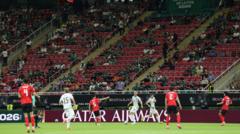
You can't hide thousands of empty bright red plastic chairs, no matter how hard you try.
Yet, soccer's governing body expects everyone to look at a stadium with gaping, unoccupied blocks in the middle of the stands and believe that everything is completely fine. Thursday night's World Cup Group A clash in Guadalajara between South Korea and the Czech Republic was supposed to be a showcase of global soccer passion. Instead, it became a glaring demonstration of what happens when corporate greed meets reality. For an alternative perspective, check out: this related article.
The match ended in a thrilling 2-1 victory for South Korea. The energy from the supporters who actually made it inside the Estadio Akron was undeniable. But the broadcast cameras didn't lie. Whole sections in the lower and upper bowls sat entirely vacant.
FIFA quickly went into damage control mode. The official statement blamed the ghost-town appearance not on unsold tickets or priced-out locals, but on the concourses. According to the suits in Zurich, ticketed fans simply preferred standing by concession stands and roaming the stadium hallways rather than sitting down to watch a World Cup match they paid hundreds of dollars to see. Related insight on this trend has been shared by CBS Sports.
It is a comical defense, and frankly, nobody is buying it.
The Math Just Does Not Add Up
Let's look at the actual data from the Guadalajara match. Estadio Akron has an official capacity of 45,664. FIFA released an official attendance figure of 44,985 for the game. If you trust those official operational metrics, only 679 seats were empty.
Anyone with working eyes who watched the game knows that's a mathematical fantasy.
The organization defended its numbers by clarifying that official attendance figures reflect the number of tickets scanned at the stadium footprint gates, rather than a visual assessment of seating occupancy at any given moment. They claimed that a significant number of fans spent the match on the concourses.
Sure, some fans grab tacos or beer during a match. Some might stand around the concourse to chat. But thousands of fans don't willingly shell out massive amounts of cash to stand under a concrete roof staring at a television monitor when they have a live view waiting for them. The visual evidence showed massive, systematic blocks of empty space, particularly in the prime, center-stand areas.
Guadalajara wasn't an isolated incident either. The very next day, Toronto Stadium saw similar anomalies. For Canada’s opening match, the stadium was mostly full, but noticeable pockets of empty seats cropped up in the expensive lower bowl sections close to the field and in the high corners of the temporary seating built specifically to meet the minimum capacity requirement of 43,036. The announced attendance was 43,002, leaving just 34 empty seats on paper.
Again, the visuals painted a very different story.
The Real Problem Is Dynamic Pricing
The empty seats in Mexico and Canada aren't a consequence of concourse culture. They are a direct result of FIFA pricing ordinary soccer fans completely out of the market.
Leading up to the tournament, President Gianni Infantino aggressively defended the implementation of a dynamic pricing policy. He even compared the tournament to the NBA Finals, attempting to justify tickets that quickly scaled into astronomical territory. For the Guadalajara match, standard tickets were priced at $400 for the upper bowl and $500 for the lower tier.
Think about that for a second. Asking locals in Guadalajara to drop $500 on a group-stage match between two neutral countries is completely out of touch. Soccer is historically a working-class sport, but the ticketing strategy treats it like an exclusive corporate retreat.
When you look at the economics, the reality becomes glaringly obvious.
- High entry costs: Ticket prices started at multiple hundreds of dollars for the worst seats in the house.
- Secondary market flood: Ahead of the opening games, a reported 180,000 tickets remained unbought on official resale portals.
- Unreachable peaks: The cheapest standard ticket to the final has reached a staggering $5,785, with premium spots hitting five figures.
When tickets cost that much, corporate sponsors buy them up in bulk. They pass them out to executives or clients who may or may not show up on a Thursday afternoon. If those corporate ticket holders stay home, the seats stay empty, even if the ticket technically counts as "scanned" or sold in the official ledger.
Fans and Politicians Are Striking Back
The backlash to this pricing structure is growing rapidly outside the stadiums. In New York and New Jersey, politicians have launched formal investigations into the ticketing process. Complaints focus on a total lack of transparency regarding online waiting queues and sudden, massive price inflation once fans finally get through to buy.
On fan forums and social media, the anger is palpable. Fans are pointing out the irony of celebrating "500 million booking requests" while showing wide-open seating sections during the opening week of the tournament. You can't brag about unprecedented global demand when your actual venues look half-empty on television.
If the goal was to maximize short-term matchday revenue from ultra-wealthy attendees and corporate entities, the strategy worked. But if the goal was to create a vibrant, accessible celebration of global soccer, the empty seats show exactly where the organizers failed.
Navigating the Rest of the Tournament
If you are a fan trying to attend games without draining your life savings, you need to navigate the ticketing landscape strategically. Don't fall for the initial panic pricing on primary platforms.
Keep a close eye on official resale portals roughly 24 to 48 hours before kickoff. As corporate sponsors realize their guests aren't traveling and speculative resellers panic over unsold inventory, prices for these group-stage matches will likely drop significantly.
The opening matches proved that the demand at these exorbitant price points simply isn't there. Look for late ticket drops from fans desperately trying to recoup their costs, and avoid buying premium lower-bowl seats that carry the heaviest corporate markups.
Organizers can keep claiming that fans prefer standing in concourses over sitting in the seats they paid for. They can keep releasing near-capacity attendance figures based on gate scans. But as long as the television cameras keep showing rows of empty red chairs, the sports world will keep laughing at the excuses.