"Let them take out Los Angeles. Let them take out San Diego."
Those eleven words, spoken from a rally stage in Grand Island, Nebraska on October 5, 2026, set off an immediate political firestorm across Southern California and Washington. Within hours, California Governor Gavin Newsom called President Donald Trump "deranged and dangerous" and put the state's intelligence center on alert. Los Angeles Mayor Karen Bass accused him of inviting a foreign attack on American soil. Even local Republicans in San Diego broke ranks.
Most news coverage stopped right there. Cable panels argued over whether the president meant it literally or was just riffing off-script. That's the surface story, and honestly, it misses the real points.
If you actually look at the transcript, the military reality of Iran's arsenal in 2026, and the political geography of why he picked those two exact cities, a much clearer picture emerges. Here is what happened, what the White House claimed afterward, and whether Tehran can even reach the California coast.
What Donald Trump Actually Said in Nebraska
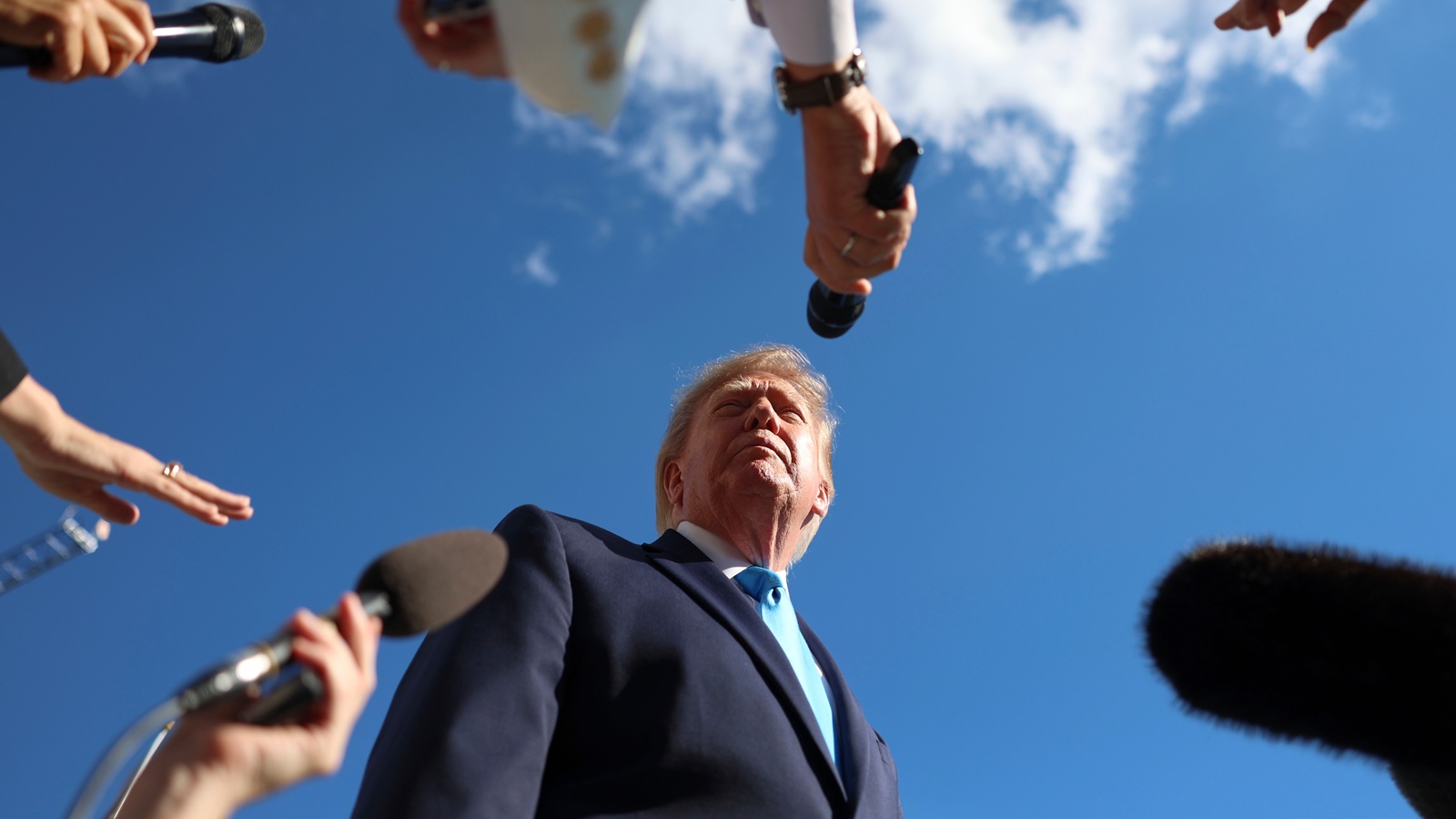
Context changes how a quote reads, even when the words themselves are jarring. Trump wasn't delivering a formal national security address when he made the remark. He was speaking at a midterm campaign rally at the Pinnacle Bank Expo Center in Grand Island, Nebraska, trying to defend the economic pain caused by the ongoing U.S.-Israel war with Iran.
Voters were angry about high fuel costs. Trump argued that elevated gas prices were temporary and minor compared to the stakes of stopping Tehran's nuclear ambitions.
"Remember, with the war, it's just artificial. It's a little bit high," Trump told the crowd, referring to energy prices. "It's a small price to pay for keeping the world safe, keeping our country safe. They could take out a city. Let them take — let it — let them take out Los Angeles. Let them take out San Diego. This is a very small price to pay, and it's going to be over with very soon."
The crowd cheered.
Read that sequence again. He started by talking about gas prices being a small price to pay, stumbled into a hypothetical about Iran destroying a major U.S. city, and wrapped the whole thought back into "a very small price to pay."
Was it sloppy phrasing from a speaker notorious for wandering off-teleprompter? Yes. Does sloppy phrasing matter differently when it comes from the Commander in Chief during an active shooting war? Also yes. When you hold the nuclear codes, off-the-cuff remarks don't get graded on a curve.
How the White House Tried to Walk It Back
The damage control started almost immediately, and it followed a familiar pattern. First, administration officials blamed the press. Then, Trump rewrote his own framing at his very next rally.
White House Communications Director Steven Cheung took to social media to argue that reporters were willfully misreading the president. "He was clearly stating U.S. cities would have been threatened if a nuclear Iran hadn't been stopped," Cheung wrote, insisting that Iran had been left with "no nuclear, no navy, no air force, and no money."
When reporters pressed Trump directly the next day on October 6, he waved the question off without answering. By the night of October 7, speaking to a crowd in San Antonio, Texas, he brought up Los Angeles and San Diego again—this time flipping the logic completely.
"You want to see a horror show? You want to see problems? Let them hit San Diego. Let them hit Los Angeles, and you want to see some bad things happen, you want to see a country that would be in freefall," Trump said in San Antonio. "We're not going to let that happen. We protect our cities. We protect our country."
In an interview with News 4 San Antonio that same day, he claimed he mentions those two cities "all the time" because of their Pacific coastline location and vulnerability to missile strikes. It was a classic rhetorical pivot. Instead of admitting he misspoke in Nebraska, he reframed the quote as a warning about what would have happened without his military campaign.
Why the Backlash Crossed Party Lines in California
Political outrage in Sacramento is predictable. Governor Newsom and Trump have spent years trading insults, so Newsom calling the president "deranged and dangerous" on X didn't surprise anyone. Neither did Democratic Senator Adam Schiff questioning why the president seemed unbothered by the theoretical destruction of two California metros.
What made this controversy stick was the reaction from people who actually live and serve in Southern California—including Republicans.
San Diego isn't just a beach town or a Democratic punching bag. It's one of the heaviest concentrations of U.S. military power on Earth. Naval Base San Diego is the principal homeport of the Pacific Fleet. Tens of thousands of active-duty sailors, Marines, defense contractors, and military families live there.
Jim Desmond, a Republican naval veteran running for Congress in the San Diego area, didn't hide his disgust. "I served to protect Americans, not write off American cities as an acceptable price of war," Desmond said in a pointed rebuke. Local residents interviewed by reporters in both cities echoed that exact frustration—feeling like 10 million Americans had been treated as disposable props in a campaign speech aimed at Midwestern voters.
Meanwhile, Newsom didn't stop at social media posts. He formally directed California's State Threat Assessment Center to step up monitoring for potential foreign threats, warning that hostile actors might treat presidential rhetoric as an invitation. Mayor Karen Bass issued a similar statement from Los Angeles, stressing that a president's job is to shield American cities rather than paint targets on them.
Can Iran Actually Hit Los Angeles or San Diego
Here is the question most political commentators skipped entirely. Strip away the campaign rhetoric and look at the hardware. Does Iran actually have the military capability to "take out" Los Angeles or San Diego?
In short, no. Not with ballistic missiles.
Let's look at the numbers and geography. Tehran sits roughly 7,500 miles (over 12,000 kilometers) away from Southern California. Even accounting for the 2026 conflict—where Iranian forces surprised some defense analysts by firing modified intermediate-range ballistic missiles roughly 4,000 kilometers to strike the U.S.-U.K. base at Diego Garcia in the Indian Ocean—4,000 kilometers is nowhere near California.
Ballistic Missiles vs. Reality
For years, Tehran claimed a voluntary range cap of 2,000 kilometers on its missile program, though U.S. defense officials confirmed in May 2026 that Iranian systems had pushed past that threshold. Existing Iranian missiles can reach Israel, U.S. bases across the Middle East, and parts of Europe.
Reaching the West Coast of the United States requires an Intercontinental Ballistic Missile (ICBM) with a range exceeding 10,000 kilometers, paired with a reliable re-entry vehicle capable of surviving atmospheric heat. A 2025 assessment by the Pentagon's Defense Intelligence Agency concluded that Iran possessed zero ICBMs. That same intelligence report estimated Tehran wouldn't be able to field an operational ICBM force until at least 2035, even if it launched a crash development program.
On the nuclear front, International Atomic Energy Agency Director General Rafael Mariano Grossi stated in March 2026 that U.N. inspectors had found no structured program to build a nuclear weapon in Iran prior to the outbreak of hostilities. Without a nuclear warhead or an ICBM, the scenario of Iran wiping out a California metropolis via missile strike simply doesn't exist in the physical world.
The Asymmetric Threats That Actually Matter
Does that mean California faces zero risk from Iran? Not at all. Experts in homeland security point to two very real, non-missile threats that often get overshadowed by talk of giant rockets:
- Cyberattacks on critical infrastructure: The U.S. Cybersecurity and Infrastructure Security Agency (CISA) has repeatedly warned that groups tied to Iran's Islamic Revolutionary Guard Corps actively probe and target industrial control systems—the operational computers running water utilities, power grids, and port logistics. The Ports of Los Angeles and Long Beach handle a massive share of U.S. Pacific trade, making them high-value digital targets.
- Unmanned drones and covert plots: While Iran can't launch a drone from Tehran to San Diego, federal authorities have long tracked the risk of short-range commercial or modified drones launched from vessels off the coast, alongside state-sponsored plots targeting dissidents or military personnel on U.S. soil.
When Governor Newsom activated state threat monitoring, he wasn't looking at the sky for incoming ICBMs. He was worrying about cyber intrusions, lone-wolf sympathizers, and asymmetric retaliation.
The Bigger Lesson About Wartime Rhetoric
Why did Trump pick Los Angeles and San Diego instead of Miami, Houston, or Chicago?
Part of it is basic geography—if you're standing in Nebraska imagining an attack from the Pacific, California is the first coast you picture. Part of it is political muscle memory. Trump has spent years portraying California's major cities as badly run, hostile political territory. Casual phrasing comes easy when you're talking about places where you don't expect to win electoral votes.
That habit carries real consequences during wartime. Public trust in national security relies on a simple, non-negotiable baseline: the federal government treats every American zip code as equally worth defending, regardless of how that state votes in November.
When you follow news cycles like this one, don't stop at the ten-second viral clip on your feed. Pull up the full rally transcript to see what was said before and after the soundbite, check the Pentagon's actual intelligence assessments on foreign weapons capabilities, and pay attention to whether local officials from both parties are pushing back. That habit alone will keep you miles ahead of cable news spin.