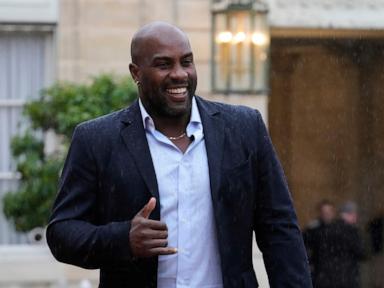
Did France's greatest Olympic judoka just throw his hat into the ring for the Élysée Palace? Yes, and most political commentators are completely misreading why it matters.
When Teddy Riner announced his intention to run for the French presidency, the immediate reaction across Paris was predictable. Pundits laughed it off as a publicity stunt, while sports fans wondered how a man standing 6-foot-8 and weighing over 300 pounds fits into the rigid, suit-and-tie world of French constitutional politics. Here's the thing. Dismissing Riner as just another celebrity athlete chasing headlines ignores decades of political history, his massive cultural capital, and the sheer exhaustion French voters feel toward career politicians.
I've watched French politics closely through multiple election cycles, and one pattern never fails. Whenever traditional parties fracture and trust in the establishment hits rock bottom, an outsider steps into the vacuum. Riner isn't a career bureaucrat trained at the École Nationale d'Administration, and honestly, that's his biggest selling point right now.
Why Teddy Riner Running for President Actually Makes Sense
To understand why this announcement landed like a bombshell, you have to look at who Teddy Riner is to the average French citizen. He isn't just a guy who wins gold medals. He's arguably the most universally liked public figure in France, consistently topping national popularity polls year after year.
Born in Les Abymes, Guadeloupe, and raised in Paris, Riner represents a version of France that actually works. While politicians spend months arguing over national identity on television panels, Riner spent twenty years wrapping himself in the tricolor flag on the world stage. He captured Olympic gold in London 2012, Rio 2016, and Paris 2024, alongside a staggering eleven World Championship titles. When he lit the Olympic cauldron alongside Marie-José Pérec during the Paris 2024 opening ceremony, the entire country watched in silence. You can't buy that kind of symbolic weight with a billion-euro campaign budget.
Political insiders love to argue that sports achievements don't translate to legislative competence. They're right about the mechanics of governing, sure. Running a nuclear-armed G7 nation requires far more than athletic discipline and mental toughness. Yet elections aren't won on policy white papers alone. They're won on trust, charisma, and the ability to unite voters who despise each other's politics.
The Reality of Getting on the French Presidential Ballot
Ambition is easy. Qualifying for a French presidential election is a brutal logistical nightmare designed specifically to crush outsiders.
Before Teddy Riner can debate anyone on national television, he has to clear the parrainages hurdle. Under French law, every presidential candidate must collect at least 500 signatures from elected officials—mayors, regional councilors, members of parliament, or senators—spread across at least 30 different departments. No more than ten percent of those signatures can come from a single department.
Think about what that means in practice. France has roughly 42,000 eligible elected officials, most of whom belong to established political machines or fear losing regional funding if they back a rogue candidate. And there's a catch that trips up outsiders every five years. Since 2016, the Constitutional Council publishes the full list of who signed for whom. Mayors can't hide behind secret ballots anymore.
If Riner wants to survive the spring filing deadline ahead of the 2027 election cycle, he needs an army of ground organizers immediately. Fame gets you on the evening news. Only a disciplined political machine gets 500 mayors to put their names on a public form.
What Riner Brings to the Table That Career Politicians Don't
If you listen closely to how Riner talks when he steps off the tatami mat, you'll notice he rarely speaks in abstract ideological slogans. He talks about work ethic, youth mentorship, overseas territories, and economic opportunity.
Consider his connection to France's overseas departments, known as the Outre-mer. Having been born in Guadeloupe, Riner carries genuine credibility in territories that routinely feel ignored by Paris until riots break out or hurricanes hit. Voters in Guadeloupe, Martinique, Réunion, and French Guiana have long complained about high living costs and inadequate public infrastructure. A candidate who actually comes from that world changes the conversation overnight.
Then there's his business background. Unlike athletes who go broke three years after retirement, Riner spent a decade building a serious commercial portfolio. He's managed major sponsorship deals with global brands like Under Armour, Accor, and Carrefour, invested in startups, and navigated corporate boardrooms without scandals. Does running a personal brand equal managing France's massive national debt or negotiating European Union trade rules? No. Not even close. Still, it shows he understands contracts, budgets, and delegation far better than critics give him credit for.
The Celebrity Candidate Trap in Global Politics
We've seen athletes trade stadiums for statehouses before, and the results are a mixed bag.
Look at Liberia, where former Ballon d'Or winner George Weah won the presidency in 2017 on a wave of popular euphoria, only to struggle with economic stagnation and corruption allegations before losing his re-election bid in 2023. Look at Manny Pacquiao in the Philippines, whose 2022 presidential run stalled in third place because voters admired his boxing legacy but questioned his readiness to lead during an economic crisis. On the flip side, Vitali Klitschko transitioned from heavyweight boxing champion to Mayor of Kyiv, proving an athlete can hold serious executive power under extreme pressure.
France, however, has a very specific political culture. French voters expect their president to master complex domestic reforms—pensions, labor laws, healthcare deficits—while simultaneously acting as commander-in-chief and Europe's diplomatic heavyweight. When comedian Coluche launched a satirical presidential bid in 1980 and briefly hit 16 percent in the polls, the political establishment panicked until he withdrew under immense pressure. Riner isn't running as a joke, which makes the establishment's reaction even sharper.
Three Massive Obstacles Standing in His Way
Even if Riner secures his 500 signatures and builds a credible campaign team, he faces three brutal realities that could sink his candidacy before the first round of voting even begins.
First, he has zero legislative track record. In a French presidential debate, opponents will hammer him on specifics within thirty seconds. What is his exact plan for France's pension deficit? How will he bring the national budget deficit back below the European Union's three percent threshold? Where does he stand on nuclear energy expansion versus renewables, or military aid to Ukraine? Saying "we need to work together" sounds great in a locker room, but it gets shredded on live television against seasoned debaters from the left and the far right.
Second, France's political landscape is deeply polarized. Voters today tend to cluster around strong ideological poles—Jean-Luc Mélenchon's hard left, Marine Le Pen and Jordan Bardella's nationalist right, or the fractured center-right and Macronist remnants. A unifying, non-partisan sports hero sounds appealing in theory, yet when people actually step into the voting booth, they often retreat to ideological tribes. Trying to please everyone usually leaves a candidate with no solid base at all.
Third, scrutiny will turn ruthless fast. As an Olympic champion, Riner enjoyed sympathetic media coverage because his victories brought national pride. As a presidential candidate, investigative outlets like Mediapart and Le Canard Enchaîné will examine every tax return, every offshore endorsement structure, every business partner, and every offhand remark he's made over the last fifteen years. Nobody survives a French presidential campaign with their halo intact.
How Voters Should Evaluate an Outsider Candidacy
If you're watching this unfold and trying to figure out whether Teddy Riner is a serious contender or just a temporary disruptor, stop paying attention to early popularity polls. Popularity ratings measure affection, not voting intention. People love Riner as a champion; that doesn't automatically mean they want him holding the nuclear codes.
Instead, watch three concrete indicators over the coming months:
- Who joins his inner circle. An outsider candidate lives or dies by their advisors. If respected economists, former ministry officials, and experienced campaign strategists quietly sign on to write his platform, take him seriously. If he surrounds himself solely with sports agents and PR handlers, his campaign won't survive the first major policy debate.
- His stance on major economic reforms. Pay attention to whether he takes clear, potentially unpopular positions on taxes, retirement age, and public spending. A candidate who refuses to pick a lane on France's fiscal crisis isn't ready for the Élysée.
- The pace of his parrainages. Track how quickly mayors outside major cities endorse him. Grassroots municipal support is the true barometer of whether a movement exists beyond Paris media bubbles.
Whether Teddy Riner actually makes it to the second round of a French presidential election or forces established parties to rethink how they connect with ordinary people, his entry exposes a massive nerve in modern democracy. Voters are tired of polished careerists who have never worked outside politics. Riner might lack the policy resume, yet by stepping onto the political mat, he just forced every traditional candidate in France to prove they actually deserve the job.