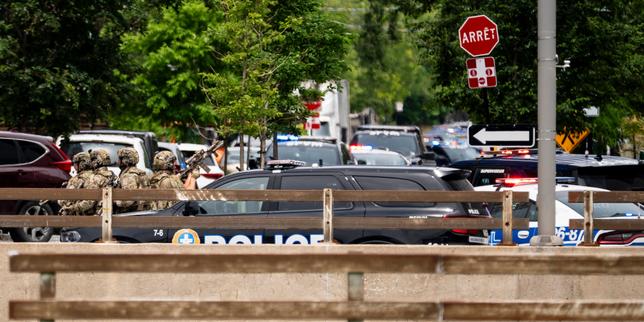
Standard media outlets follow a predictable, lazy script whenever a mass shooting shatters a Canadian city. The headlines following the recent shootout in Montreal—which left a suspect, an innocent bystander, and a responding police officer dead—are textbook examples. They focus heavily on the tragedy, the shock, and the immediate calls for tighter gun control or generic "mental health resources."
They are asking all the wrong questions. For a different look, consider: this related article.
The media focuses on what happened. The real problem is how our emergency institutions respond, and the deeply flawed tactical doctrine that keeps costing lives. For decades, North American policing has relied on a reactive containment model that prioritizes protocol over immediate, overwhelming neutralization. If we want to stop burying police officers and innocent citizens, we have to dismantle the myth of the flawless tactical response.
The Illusion of Containment
When an active shooter incident occurs, the public assumes that the arrival of flashing lights means safety is imminent. It isn't. Related analysis on this trend has been shared by BBC News.
I have spent years analyzing urban security frameworks and crisis response metrics. The data reveals a brutal truth: the traditional police hierarchy is structurally incapable of handling dynamic, rapidly evolving chaotic violence without suffering casualties.
The standard operating procedure usually dictates:
- Establish a perimeter.
- Wait for specialized tactical units (like the Groupe d'intervention or SWAT).
- Gather intelligence before breaching.
This delay is fatal. In active shooter scenarios, every single second equals blood. By the time a specialized unit spins up, puts on heavy kit, and deploys, the primary damage is already done. The Montreal shootout proved once again that patrol officers—the first line of defense—are often forced into chaotic, close-quarters engagements without the tactical superiority required to survive them.
Why More Gun Laws Wont Solve Tactical Failure
The immediate knee-jerk reaction from politicians after any high-profile shooting is to promise tighter firearm legislation. This is a distraction from operational incompetence.
[Traditional Focus: Gun Restrictions] ──> Focuses on supply, ignores immediate threat.
[Critical Focus: Tactical Superiority] ──> Focuses on rapid neutralization, saves lives.
Canada already possesses some of the most stringent firearm classification systems among G7 nations. Criminals do not source their weapons through legal retail channels; they utilize deeply entrenched cross-border smuggling networks. Passing another piece of legislation does absolutely nothing to alter the reality of an active firefight on a metro street.
The focus must shift from the tool to the timeline.
The OODA Loop in Urban Chaos
In tactical theory, the OODA Loop (Observe, Orient, Decide, Act) dictates who wins an engagement. A lone gunman has a tight, fast loop. They know their target, they know their intent, and they are already acting.
A responding police officer faces an incredibly cluttered loop:
- Observe: Assess a chaotic crowd, identify the shooter among civilians.
- Orient: Navigate unfamiliar urban architecture while taking fire.
- Decide: Weigh strict bureaucratic rules of engagement against immediate survival.
- Act: Deploy force.
Because the system burdens the officer with immense legal and administrative weight during the "Orient" and "Decide" phases, the suspect maintains the initiative. We are sending patrol officers into high-velocity combat environments while forcing them to think like risk-management attorneys.
The Hard Truth About First Responder Casualties
We routinely hear the phrase "died in the line of duty" used to romanticize what is fundamentally a systemic failure. When a police officer dies in a shootout alongside civilians, it means the tactical system failed to provide them with the necessary advantages to win.
Let's look at the operational reality. Patrol officers are typically equipped with standard-issue sidearms and soft body armor. They are routinely outgunned by suspects carrying semi-automatic long guns or illegally modified pistols.
| Responder Tier | Typical Weaponry | Protection Level | Response Time |
| :--- | :--- | :--- | :--- |
| *Patrol Officer* | Handgun / Shotgun | Soft Armor (Handgun rated) | 2–5 Minutes |
| *Tactical Unit* | Carbine / Submachine gun | Hard Plates (Rifle rated) | 15–45 Minutes |
Expecting a patrol officer to enter a hot zone and neutralize a rifle-wielding suspect with a standard-issue 9mm pistol is not a strategy; it is a sacrifice.
If municipal governments actually cared about protecting their officers and citizens, they would stop spending millions on public relations campaigns and start decentralizing tactical gear. Every single patrol vehicle needs to be an autonomous tactical platform, equipped with rifle-rated plates and patrol carbines, backed by high-frequency, reality-based stress inoculation training.
Dismantling the De-escalation Myth
The current cultural zeitgeist demands that police prioritize de-escalation above all else. This works beautifully when dealing with a non-violent individual experiencing a mental health crisis in a controlled environment.
It is completely useless during an active shootout.
When rounds are flying, attempting to de-escalate or establish a dialogue is a form of passive suicide. You cannot reason with a kinetic threat. The only way to stop a human being determined to kill is to apply immediate, catastrophic physical force.
The downside to this contrarian approach is obvious: it looks brutal on camera. It alienates a public conditioned by Hollywood to believe that a skilled officer can simply shoot a weapon out of a suspect's hand or talk them down with a heartfelt speech. But reality does not care about optics.
Stop Asking for Peace, Prepare for the Firefight
The public consensus surrounding urban violence is broken. People want absolute safety without acknowledging the uncomfortable, violent measures required to secure it. They want police officers to be social workers until a gunman opens fire on a crowded avenue, at which point they wonder why the response wasn't faster.
We need to stop treating these incidents as isolated anomalies that can be legislated away. They are predictable breakdowns of a defensive system that is too slow, too timid, and too bureaucratic.
Stop looking to Ottawa for new restrictions. Stop expecting a press conference to fix a training deficit. If you want to survive the next inevitable escalation in an urban center, demand that your local department stops waiting for SWAT, stops hesitating out of fear of administrative blowback, and starts training every single uniform on the street to hunt the threat immediately.
The next time an incident like this happens, the body count won't be determined by the shooter’s grievance or the weapon they chose. It will be entirely determined by how many seconds it takes for a first responder to put a round through the target. Everything else is just noise.