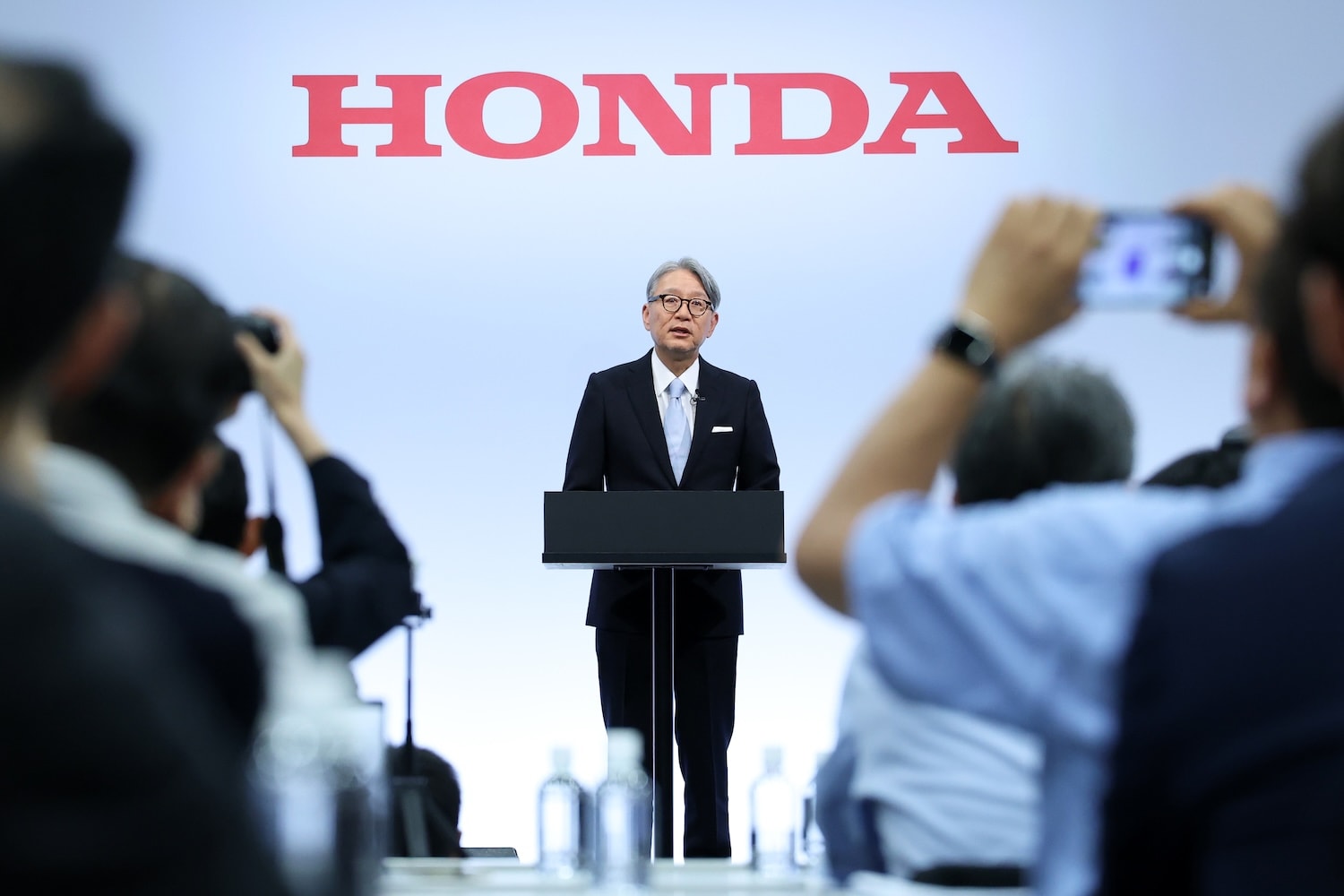
Financial journalists love a good resurrection narrative. Honda prints its first annual operating loss since the late 1940s—a stinging $2.6 billion deficit driven by a massive ¥2.5 trillion write-down on miscalculated EV bets—while Nissan limps back into the black with a modest annual operating profit. Immediately, the spreadsheet-gazing commentariat begins salivating. The mainstream consensus is already locked in: now that Honda is bruised and Nissan has clawed its way to temporary stability, the failed 2025 merger talks should be revived on "even terms."
This is lazy, dangerous groupthink. It treats industrial strategy like a game of corporate dating, where two insecure halves magically create a healthy whole.
I have spent years watching automotive boardrooms torch billions in capital pursuing the holy grail of "scale." Let me say it bluntly: smashing Honda and Nissan together right now would be one of the greatest corporate disasters in modern industrial history. The argument that their newly balanced financial pain makes them perfect partners is fundamentally broken. It is not an opportunity; it is an industrial suicide pact.
Two Drunk Men Cannot Hold Each Other Up
The core premise of the pro-merger crowd relies on classic textbook theory. They point to the threat of Chinese electric vehicle titans like BYD and SAIC. They argue that pooling resources for research and development is the only way to fund the punishingly expensive shift toward software-defined vehicles and autonomous platforms.
This completely misdiagnoses why these companies are struggling. Scale is not their problem. Execution is.
Honda did not drop into a ¥414.3 billion crater because its factory footprint was too small. It bled cash because it fell into the trap of over-engineering an EV strategy that the consumer market flatly rejected, forcing five consecutive quarters of losses in its core automotive unit. Nissan’s supposed "recovery" under its current slimmed-down strategy is a fragile, short-term margin adjustment built on deep headcount cuts and manufacturing rollbacks. It is a corporate patient stabilized in the ICU, not an athlete ready to run a marathon.
Merging two legacy organizations that are simultaneously undergoing severe operational crises does not create a powerhouse. It creates an internal civil war.
Consider the mechanics. Honda’s corporate culture is driven by fiercely independent engineers who historically view outside collaboration with deep suspicion. Nissan, scarred by two decades under Renault and the explosive downfall of Carlos Ghosn, is highly defensive of its remaining autonomy—which is precisely why the initial merger discussions collapsed last year when Honda demanded full subsidiary control.
If you force these two cultures into a room today, you will not get joint R&D. You will get five years of paralyzing political infighting over which engine architectures to kill, which dealerships to close, and whose executive team gets the corner offices. While their middle managers spend 60-hour weeks arguing over component standardization in Tokyo, BYD will iterate its battery tech three more times.
The Mythical Synergy of Overlapping Portfolios
When the initial memorandum of understanding was signed back in late 2024, executives dangled a fascinating thought experiment: what if we combined Honda’s masterclass hybrid drivetrains with Nissan’s robust body-on-frame truck platforms to build a killer hybrid pickup?
It sounds brilliant on a pitch deck. In the real world, platform integration between two entirely different engineering heritages is an absolute nightmare.
I have seen automotive teams try to standardize something as simple as a braking module between two legacy platforms, only to realize the electrical architectures were so fundamentally incompatible that they ended up spending more money redesigning the interface than they would have saved by just buying the parts separately.
Look at the geographic reality. Both Honda and Nissan derive roughly 37% of their sales from the North American market. They are fighting for the exact same consumer dollars in the exact same segments. A merger does not open up new markets for either brand; it simply forces them to rationalize a massive network of redundant dealerships and competing product lines.
To find actual cost savings, the combined entity would have to aggressively axe historic nameplates and shut down massive factories. Yet, the moment a corporate entity tries to execute deep, systemic plant closures in Japan or restructure highly unionized operations in Western markets, the political and social blowback completely erases the projected financial gains.
The False Idol of Scale
The investment community is addicted to the example of Stellantis—the mega-merger of Fiat Chrysler and PSA Group—as proof that consolidation works. But they ignore the critical downside: massive, multi-brand conglomerates frequently become bureaucratic monsters where product identity goes to die.
When you ask people why they buy a Honda Civic, they talk about engineering reliability, high resale value, and a specific driving dynamic. When people buy a Nissan, they are often chasing value, aggressive financing, or distinct truck capability. You cannot blend these distinct brand equities into a single holding company platform without diluting the exact attributes that keep their remaining loyal customers showing up.
If Honda wants to fix its business, the solution is not to absorb Nissan’s legacy liabilities and structural overhead. The solution is brutal internal focus:
- Fast-track the correction of their North American product mix.
- Lean heavily into their wildly profitable motorcycle division, which has single-handedly kept the lights on.
- Stop overfunding speculative, long-horizon EV platforms that don't match current market adoption rates.
For Nissan, the path forward is to finish the grueling restructuring engineered over the past year, preserve its cash, and continue targeted, nimble software partnerships—like its recent work with Red Hat—rather than giving up the ghost to a massive corporate marriage.
The Right Question to Ask
The public keeps asking: Can a Honda-Nissan merger save the Japanese auto industry from China?
That is entirely the wrong question. The real question is: Why do we assume that a bigger, slower, more bureaucratic company will run faster than a lean, focused one?
History proves that industrial consolidation born out of mutual weakness is almost always a lagging indicator of structural decline. When two bleeding companies embrace in the middle of a storm, they don't swim better. They just sink faster. Honda and Nissan need to fix their own houses before they even think about sharing a roof.