Dust settles quietly over the discarded objects of human ambition.
At a flea market in Phoenix, beneath the baking Arizona sun, rows of folding tables groan under the weight of orphaned silverware, chipped pottery, and tangled costume jewelry. It is a purgatory of things. Items that once mattered intensely to someone now wait in the stifling heat for a new custodian who values them at pocket-change prices. Most people walk past with glazed eyes, immunizing themselves against the clutter, shielding their senses from the sheer exhaustion of uncollected debris.
Then came the afternoon in 2005.
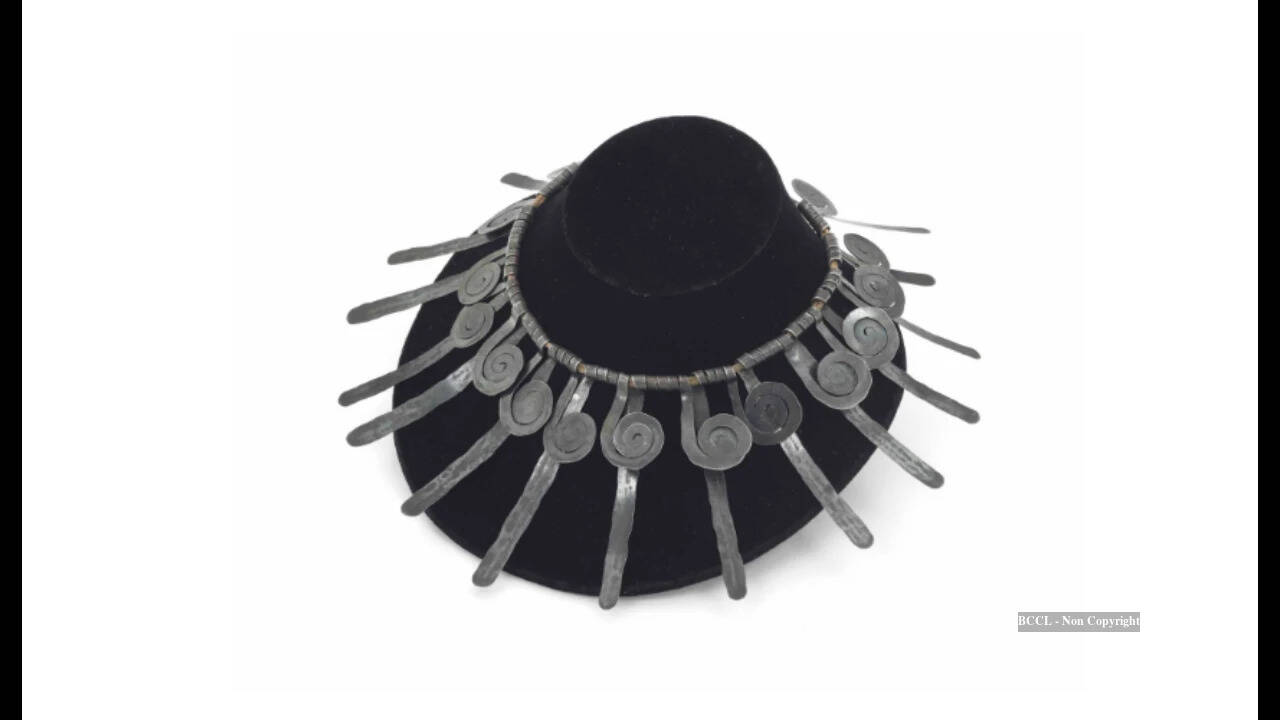
A woman—let us call her the seeker, though she was simply looking for something interesting to wear to an upcoming weekend gathering—bent down to inspect a dusty cardboard box filled with miscellaneous baubles. Amidst the tarnished brass buttons, plastic beads, and broken watch parts lay a necklace. It was unusual. It was striking. It felt surprisingly heavy in the palm, constructed of hammered silver wire and flat brass plates twisted together with an unmistakable organic asymmetry. It looked old. It looked intentional. It carried the unmistakable gravity of something made by human hands that knew exactly what they were doing, hands that understood tension, balance, and negative space.
Fifteen dollars.
That was the price. No negotiation required. No hesitation. She handed over a crisp green bill, slipped the cool metal loops around her neck, and walked away into the blinding desert glare, completely unaware that she had just carried off a stolen moment of art history.
She did not know. How could she? To her, it was simply an intriguing adornment, a wearable piece of sculpture that caught the light whenever she turned her head. For years, that necklace became a quiet, unassuming fixture of her wardrobe. It went to the grocery store. It sat against her collarbone during quiet family dinners. It absorbed the heat of summer afternoons and the cool draft of air-conditioned offices. It was touched by ordinary life. Thousands of hours ticked by while a quarter-million-dollar work of art rested casually against her skin, witnessing laundry days, midnight worries, and morning coffees.
Value is a phantom. We spend our entire lives chasing it through spreadsheets, stock tickers, and luxury boutiques, convinced that worth is something stamped by an authority figure or certified by a shiny certificate of authenticity. We are conditioned to believe that true value announces itself with velvet boxes, security guards, and exorbitant price tags. We are taught to look for logos and provenance documents, assuming that genius always wears a uniform of exclusivity.
We are profoundly wrong.
Consider how history actually treats its treasures.
Art does not always arrive in a gilded gallery with armed guards standing at attention. Sometimes it arrives in a cardboard box next to a stack of cracked paperback books. It sits in the sun on a folding table. It gets ignored by hundreds of knowledgeable collectors. It waits quietly for the one pair of eyes capable of seeing past the grime of decades, past the indifference of the crowd, past the illusion that greatness always looks expensive.
Years passed before the veil lifted.
The necklace eventually caught the attention of someone who knew. Not a casual admirer, but an eye trained in the subtle signatures of mid-century modernism. There was a rhythm to the wirework. There was a distinct, unyielding honesty to the hammered brass. Every twist of the pliers spoke of a specific hand, a legendary hand that had spent a lifetime bending metal into floating universes.
It was an original Alexander Calder.
Calder. The man who revolutionized sculpture by making it dance in the air. The titan of modern art whose giant red stabiles anchor public plazas from Chicago to Paris, whose delicate mobiles turn the slightest breath of wind into a ballet of shadow and form. Before he was hanging monumental steel plates from museum ceilings, he was sitting at his workbench with ordinary pliers, wire, and sheet metal, bending precious and semi-precious materials into wearable poetry for artists, patrons, and close friends.
He made these pieces by hand. No factory molds. No mass production. Just copper, brass, silver, and wire manipulated by a genius who saw form where others saw only scrap. Calder did not use solder for many of his wire creations; he bent, looped, and clinched the metal together mechanically, treating a necklace with the same spatial architectural rigor he brought to his massive monumental works. To wear a Calder necklace was to wear a kinetic sculpture directly against the pulse of the body. He crafted these objects not for the commercial market of high-end jewelry stores, but as gifts of affection, tokens of intellectual exchange exchanged among bohemians, painters, and sculptors who inhabited the avant-garde circles of Paris and New York.
When the truth of the necklace finally surfaced, the mundane reality of the flea market vanished. The fifteen-dollar transaction dissolved into art history. The piece was consigned to Phillips, a prestigious auction house in New York, where collectors of modern masterpieces gather to trade fortunes.
The air in the auction room was thick with quiet tension. Bidders leaned forward, their catalogues resting on velvet-trimmed ledges. Telephone lines buzzed with anonymous wealth from across the globe. When the lot came up, the bidding did not start slow. It escalated rapidly, fueled by the fierce, competitive hunger for a rare, undocumented artifact from a giant of twentieth-century art. Paddles flashed in the dim light. Numbers climbed with every breath.
The hammer fell.
Two hundred and sixty-seven thousand, seven hundred and fifty dollars.
Let that number sink in.
Fifteen dollars became a quarter of a million. A return on investment that defies every rational financial model, not because of clever stock picking or algorithmic trading, but because of pure, unadulterated serendipity intersecting with historical genius.
Yet, the true magic of the story is not the money.
Money is loud. Money demands attention, security systems, insurance policies, and armored glass. But the real story lives in the quiet years before the auction. Think of the necklace resting against skin while folding laundry. Think of it catching the evening light during a quiet dinner at home. For nearly a decade, an owner walked through the ordinary friction of daily existence carrying a museum-grade sculpture, completely unaware of the heavy historical weight resting on her chest.
Most of us live our lives surrounded by invisible wealth.
We look at our days and see only routine. We walk past extraordinary potential in our relationships, our creative pursuits, and our quiet moments of introspection, dismissing them as ordinary because they lack an immediate price tag. We wait for permission to value our lives, our work, and our surroundings based on external validation.
The flea market necklace whispers a different truth.
It tells us that masterpiece and mundane are separated only by perception. The metal did not change when the experts spoke. The wire was just as brilliant when it sat in the plastic bin for fifteen dollars as it was when it commanded six figures under the auction house chandelier. The only thing that changed was the observer's capacity to see.
We scour catalogs when invention is sitting on our own kitchen tables. We wait for an expert to tell us what matters, forgetting that true worth is often forged in quiet workshops, away from the applause, by creators who simply loved the resistance of the material.
Look closer.
At your work. At your home. At the stray thoughts that cross your mind during a Tuesday morning commute. There is art in the cracks of your routine. There is genius hidden in the mundane transactions of your days.
The world is full of fifteen-dollar necklaces waiting for the light to catch them just right.
The question is not whether they are there.
The question is whether you are paying attention.