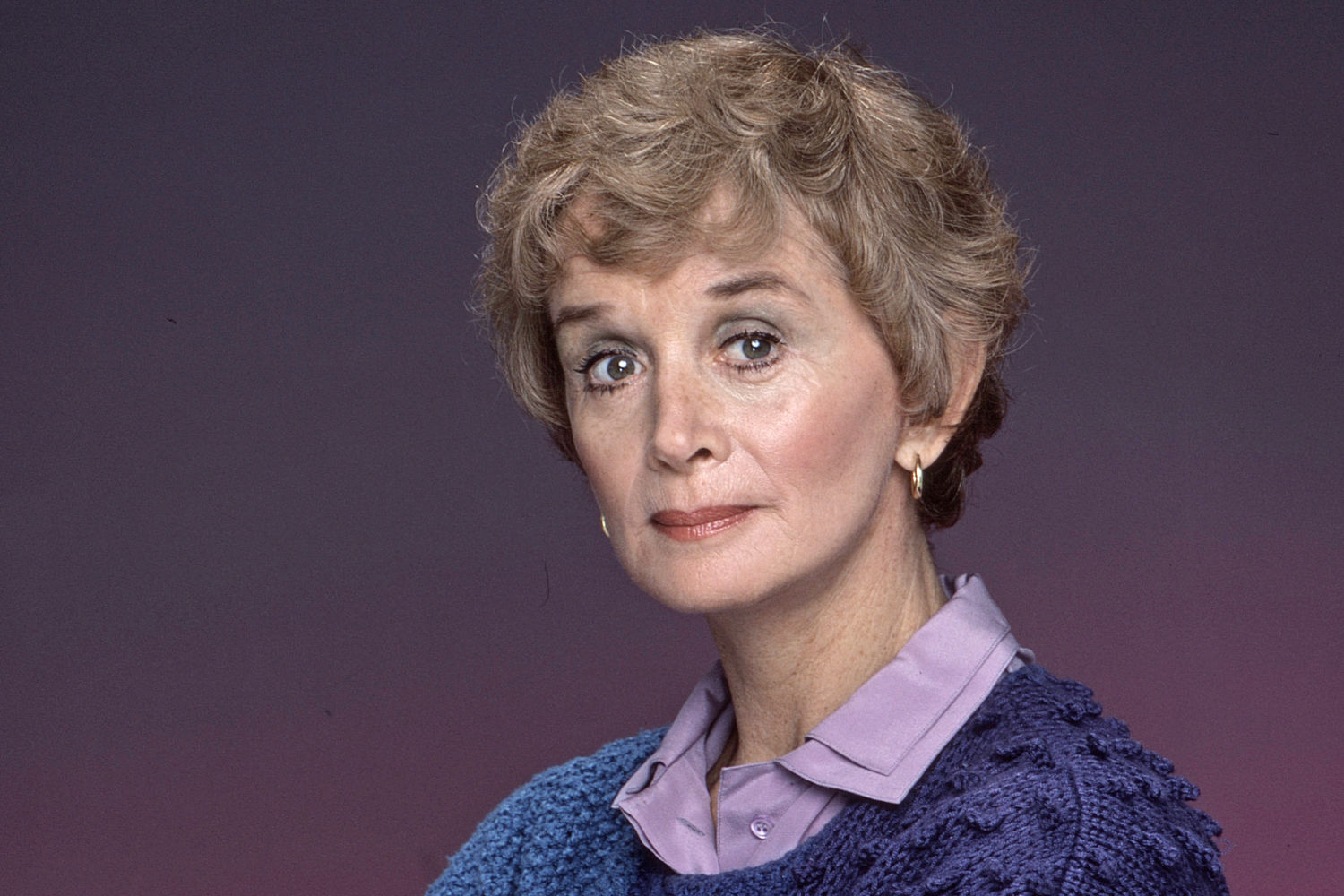
Silence.
That is what an actor fears most—not the sudden, sharp intake of breath from a stunned audience, nor the rustle of programs during a slow second act, but the heavy, suffocating quiet of a stage after the house lights have gone dark and the doors have been bolted for the night. For seven decades, Barbara Barrie lived inside the electric hum of that room, turning small, seemingly ordinary moments into something the rest of us couldn't look away from.
She was ninety-five when she died.
If you only read the wire reports, the story fits neatly into a single, sterile sentence: Barbara Barrie, the Oscar-nominated actor known for Breaking Away and Barney Miller, has died with medical assistance at ninety-five. It is clean. It is factual. It is also entirely bloodless, stripping away the fierce, uncompromising woman who spent her life refusing to play a victim—both under the hot lights of Broadway and in the quiet, sunlit room where she finally decided the play was over.
To understand why her death matters—and why the manner of it is sending a quiet shockwave through the culture—you have to look past the obituary dates and examine the invisible architecture of a life lived entirely on her own terms.
The Woman Who Refused to Fade
Most people remember her face before they remember her name.
Maybe you see her standing in an Indiana kitchen in 1979, wearing a sensible apron, trying to make sense of a son who has suddenly decided he is an Italian bicycle racer. That was Evelyn Stoller in Breaking Away. In the hands of a lesser performer, Evelyn would have been a caricature—the nagging, bewildered suburban mother. Barrie gave her steel, warmth, and an ache so recognizable it earned her an Academy Award nomination. Or maybe you hear that distinct, slightly raspy cadence from the late 1970s, playing Elizabeth Miller, the sharp-tongued, grounded wife holding together the chaotic world of Barney Miller.
She was never the Hollywood ingenue. She didn't want to be. Born Barbara Ann Berman in Chicago in 1931 and raised in Texas, she arrived in New York with a theater-kid’s obsession with truth over glamour. In 1964, she won Best Actress at Cannes for One Potato, Two Potato, playing a white woman fighting for custody of her daughter after marrying a Black man—a role that required immense courage in an era when polite society preferred to look the other way. Six years later, she originated the role of Sarah in Stephen Sondheim’s Company, trading marital barbs on a Broadway stage with a precision that earned her a Tony nomination.
Watch her in any of those roles, and you notice a specific physical trait. She never wasted a gesture. While other actors begged for the camera's attention, Barrie stood still, listened intently, and made the room come to her.
Aging in Hollywood usually means watching that room slowly empty out. The scripts get thinner. The characters become passive. You are relegated to the grandmother in the corner, nodding benignly while the younger cast members drive the plot. Barrie rejected that script entirely. Even into her eighties and nineties—appearing in Law & Order: Special Victims Unit, Suddenly Susan, and The Good Fight—she played women who were sharp, observant, and fully present. She treated old age not as a slow retreat, but as another character study requiring rigor and wit.
Yet, behind the scenes, she had already survived things that would have broken most people. In the 1990s, she was diagnosed with rectal cancer, an experience she later wrote about with brutal, unflinching candor in her memoir Second Act. She endured a colostomy, radiation, and the profound physical humiliation that modern medicine often demands as the price of survival. She survived it. She came back to work. She lived another thirty years.
Which brings us to the question that hangs over the final chapter of her life, the detail tucked into the headlines like a footnote when it is actually the entire thesis: she died with medical assistance.
The Invisible Room
Let’s step away from the marquee for a moment. Consider a hypothetical scenario—a composite of thousands of real families sitting around kitchen tables across North America right now.
Picture an eighty-eight-year-old retired architect named Arthur. His mind is a steel trap; he still reads two newspapers a morning and corrects his grandson’s geometry. His body, however, is a collapsing building. A progressive neuromuscular disease has stolen his ability to swallow solid food, to walk ten feet without gasping for air, to dress himself without help. Every morning begins with forty minutes of painful respiratory therapy just to clear his lungs enough to speak. His doctors tell him, with well-meaning clinical precision, that they can keep him alive for another two years. A feeding tube here. A ventilator support there. More hospital stays under fluorescent lights that never turn off.
Arthur looks at his daughter and asks a question that no medical textbook knows how to answer: Why?
For decades, modern medicine operated on a single, unyielding rule: delay death at any cost. Every intervention was treated as a victory, even when the person inside the body had long since ceased to inhabit a life they recognized. We built miraculous machines to keep hearts beating and lungs inflating, yet we left families stranded in a terrifying limbo, watching the people they love slowly dissolve into pain and confusion while everyone pretends this is "fighting."
Medical aid in dying—often referred to as MAID or physician-assisted death—changes the fundamental equation of that room.
To strip away the political noise and fear-mongering that often surrounds the phrase, think of it like this: imagine you are reading a book you have loved deeply for nine hundred pages. The prose is rich, the characters are unforgettable, and the story has meant everything to you. Then, at page nine hundred and one, the pages turn blank, jagged, and impossible to read—nothing left ahead except ninety pages of tearing paper and ink smudges. Medical aid in dying does not force anyone to close the book early. It simply allows the person holding the book, while they are still lucid enough to understand the story, to place a bookmark at the end of a complete sentence and close the cover with dignity.
In jurisdictions where the practice is legal—including New York, following the passage of its Medical Aid in Dying Act, as well as states like Oregon, California, Washington, and across Canada—the guardrails are rigorous. It is never an impulsive act, nor is it something a doctor administers to an unwilling patient. The individual must be an adult, mentally capable of making their own healthcare decisions, and facing a terminal illness or an irremediable, grievous physical decline. They must make repeated, voluntary requests, undergo independent evaluations by multiple physicians, and ultimately self-administer the prescribed medication.
Nobody is pushed toward the door. The door is simply unlocked from the inside.
The Courage of the Exit
I remember sitting in a hospital waiting room several years ago, watching an older relative navigate the final weeks of congestive heart failure. The air smelled of industrial bleach and stale coffee. Every four hours, a nurse would come in to take vitals, waking a man who hadn't slept peacefully in a month just to record numbers on a chart that everyone knew were heading in only one direction. He wasn't afraid of dying. He told me that plainly on a Tuesday afternoon while the television muted itself in the corner. He was afraid of the process—of losing his mind to narcotics, of becoming a burden his children couldn't lift, of having his final memory on earth be panic rather than peace.
That fear is universal, even if we rarely admit it at dinner parties. We spend thousands of dollars planning weddings, carefully selecting the music, the lighting, the exact words spoken before witnesses. Yet when it comes to the only event guaranteed to happen to every single one of us, we leave it entirely to chance, bureaucracy, and emergency room trauma.
When a public figure like Barbara Barrie chooses medical assistance at ninety-five, she disrupts that silence.
She didn't slip away in the dark, hiding the nature of her passing behind euphemisms like "a long illness" or "died peacefully at home" while the family whispers the truth behind closed doors. By allowing the reality of her medically assisted death to be part of the public record, she offered one final, masterclass performance in honesty.
Think about the symmetry of it.
In Company, Sondheim wrote a song for the central character called "Being Alive"—a fierce, desperate plea to feel everything, the pain alongside the joy, rather than drifting through existence numb and protected. Barrie spent ninety-five years embodying that ethos. She survived cancer. She outlived her husband, the theater director Jay Harnick, who died in 2007. She wrote children’s books, acted into her tenth decade, and cherished her two children and her grandchildren. She squeezed every drop of marrow out of the time she was given.
When that time reached its natural, undeniable boundary—when the body at ninety-five could no longer sustain the vibrant, fiercely independent woman inside it—she applied the exact same standard to her exit that she had applied to her work.
She didn't linger past the final beat. She didn't allow her life to dwindle into an endless, agonizing encore that served only to satisfy everyone else's discomfort with letting go.
What We Actually Fear
Of course, the conversation around medical aid in dying remains deeply complicated, and pretending otherwise would be dishonest.
Religious traditions teach that life is a sacred trust not ours to end. Disability advocates rightly warn that society must never make vulnerable people feel as though their lives are less valuable or that death is a "cheaper" alternative to proper palliative care and support. Doctors themselves often struggle with the tension between their oath to preserve life and their duty to relieve suffering. These are not trivial objections; they sit at the very heart of what it means to be a compassionate civilization.
Yet look closely at what happens in places where these laws actually exist. The data tells a story far quieter and more human than the ideological battles suggest.
In Oregon, which has tracked its Death with Dignity law for nearly three decades, roughly one-third of the patients who go through the rigorous process to obtain the medication never even take it. Let that sink in. They go through the waiting periods, the psychiatric clearances, the second opinions, and they fill the prescription—and then they put the bottle in a drawer and never open it.
Why? Because the relief comes not from the act itself, but from the agency.
Knowing that you hold the key to the exit removes the terror of being trapped in a burning building. Paradoxically, having the option to end suffering often gives people the courage to endure a little longer, to enjoy one more Sunday afternoon with their grandchildren, one more cup of coffee on the porch, secure in the knowledge that they will never be forced to cross their own line of intolerable pain.
Barbara Barrie understood timing better than almost anyone in her profession. In comedy, a half-second too early ruins the laugh; in drama, a beat too late ruins the heartbreak. Throughout her career, she knew precisely when to deliver the line, when to hold the silence, and when to walk offstage while the audience was still leaning forward in their seats.
In a sunlit room, surrounded by the life she built and the people she loved, she simply took her final cue. The house lights came up. The stage was clear. And for the first time in ninety-five years, the room went completely, peacefully quiet.