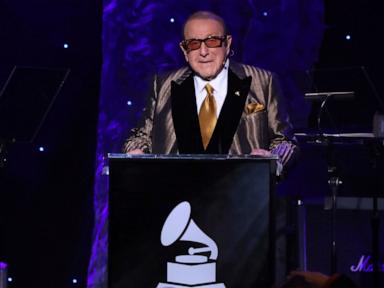
The Beverly Hilton ballroom is going to feel entirely different this February. For decades, the air inside that room smelled of heavy perfume, expensive scotch, and the unmistakable, intoxicating scent of absolute power. Clive Davis sat at the center of it all. He was the undisputed monarch of the music industry, holding court over superstars, moguls, and presidents. When the Grammy weekend gala rolls around for 2027, it will mark the first time the black-tie tradition continues without its founding architect at the head table.
Clive passed away, leaving a gaping vacuum in the upper echelons of the entertainment business. Yet, the show goes on. The machinery behind the pre-Grammy gala confirmed that the 2027 edition is officially locked in, proving that the institution Clive built has achieved a momentum entirely independent of its creator. But staging this massive, star-studded affair without the man who personally handpicked every seat and vetted every performance changes the fundamental nature of the night.
The Anatomy Of An Empire Builder
To understand why this upcoming gala matters so much, you have to look at how Clive constructed his empire. He did not merely throw a party. He engineered the most effective networking ecosystem in modern pop culture history. Long before streaming algorithms dictated taste and social media handlers managed every public utterance of an artist, Clive operated as the ultimate filter. He discovered Janis Joplin, signed Whitney Houston, resurrected Carlos Santana, and guided the careers of Alicia Keys and Barry Manilow.
The annual pre-Grammy gala served as his victory lap and his war room combined. Executives shook hands on multi-million dollar deals over salmon entrees. Young artists watched legends perform three feet away from their tables, understanding instantly the stakes of the business they had entered. Clive stood at the podium year after year, speaking for twenty minutes too long, sharing hyper-specific anecdotes about track sequences and studio sessions that kept billionaires and teenagers equally enthralled.
Without Clive physically standing at the microphone, the 2027 gala faces a severe identity crisis. Who steps into that spotlight to introduce the surprise performances? Who carries the institutional memory that made artists weep when he praised them? The corporate sponsors and the Recording Academy want the prestige and the media cycle dominance that the night guarantees. However, replacing the gravitational pull of the man himself is mathematically impossible.
Behind Closed Doors In The Music Business
The corporate landscape of the modern music industry looks nothing like the era when Clive ruled Arista and J Records. Today, private equity firms own massive catalogs of legacy songs. Silicon Valley distribution platforms dictate which independent artist goes viral on TikTok. Major label offices operate like lean financial portfolios rather than bohemian incubators.
In this sterile environment, the pre-Grammy gala remained a rare anchor to the old world of glamor and gut instinct. Clive represented a time when a single executive could hear a demo tape in a parked car and change global culture. The decision to press forward with the 2027 event is a calculated gamble by the stakeholders holding the keys to his legacy. They need to signal stability. They need the world to see that the multi-billion-dollar machine does not wobble just because its patriarch is gone.
Behind the scenes, booking agents and publicists are already locked in a silent knife fight for the premier tables. The status symbol of sitting near the front of the room has only intensified now that scarcity has entered the equation. If you are not invited to the first post-Clive gala, your status in the industry drops a peg. That ruthless social hierarchy is precisely what Clive mastered. He understood that human vanity, combined with genuine love for recorded sound, could be forged into an unstoppable annual media event.
The New Guard Takes The Ropes
Running an event of this magnitude without its founder requires a collective committee approach, which runs counter to everything Clive stood for. Clive was an autocrat in the best possible sense. His taste was absolute. If he wanted a newcomer to share the stage with a Rock and Roll Hall of Famer, it happened. There were no focus groups or committee meetings.
Now, look at the producers and executives tasked with curating the 2027 lineup. They must balance the demands of legacy acts who expect reverence with modern streaming titans who demand total creative control. The risk is that the night turns into a sanitized corporate exercise, a hollowed-out corporate-sponsored concert devoid of the idiosyncratic eccentricities that made Clive's tenure so legendary.
We are likely to see a tribute format that spans the first hour, featuring emotional reels of Clive's greatest triumphs, followed by a frantic attempt to prove that the current musical landscape is vibrant and thriving. Yet, the tension will remain palpable. The ghosts in the Beverly Hilton ballroom are heavy. Every artist who takes the stage will know they are performing under the long shadow of a man who judged every note with terrifying precision.
The Ultimate Test Of Longevity
Institutions outlive their creators only when they adapt to a reality where nobody remembers the original rules. The 2027 pre-Grammy gala is not just another red carpet event on the calendar. It is a referendum on whether the music industry still knows how to honor its own history while stumbling into an uncertain future.
When the lights go down in the ballroom and the first chord strikes, the room will hold its collective breath for a second, expecting the familiar voice to boom through the speakers with a story about discovering a star in a smoky club in 1974. When that voice does not arrive, the industry will have to figure out how to clap for itself in the silence.