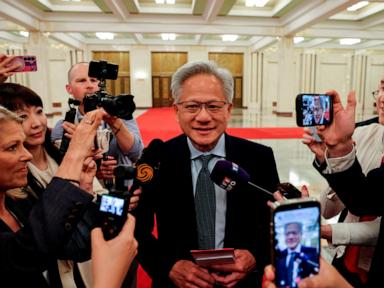
Wall Street’s armchair quarterbacks are screaming for blood again.
Whenever a mega-cap tech company hits a patch of turbulence, the financial press dusts off the exact same playbook. They find a boardroom whisper, slap "scandal deepens" onto a headline, and pretend that corporate governance works like a medieval guillotine. The prevailing lazy consensus floating around the institutional desks right now is simple: Nvidia has grown too big, too fast, and too messy for a founder-CEO, and the board needs to consider showing Jensen Huang the door to "restore stability."
That thesis isn't just wrong. It is economically illiterate.
Suggesting that Nvidia’s board should oust Jensen Huang to protect shareholder value is like suggesting the Chicago Bulls should have benched Michael Jordan in 1996 to improve team chemistry. It mistakes the engine for the exhaust. More importantly, it reveals a fundamental ignorance of how semiconductor monopolies actually function, how corporate boards operate when trillions of dollars are on the line, and why conventional CEO succession theory collapses when applied to architectural dictatorships.
The Governance Delusion
Let’s look at the premise of the "board weighs Huang's future" narrative. Financial journalists love to treat corporate boards like independent judicial panels carefully weighing moral and operational metrics on a balanced scale.
In reality, boards of directors at hyper-growth tech giants are risk-averse capital allocators terrified of one thing: breaking the golden goose.
I have sat in enough boardrooms and war rooms over the last two decades to watch companies blow hundreds of millions of dollars chasing "adult supervision." Every single time a board panics over a founder’s intensity, unorthodox management style, or external PR friction and brings in a polished, McKinsey-approved operational CEO, the exact same autopsy report gets written five years later. Margins compress. R&D slows to a crawl. Best engineers leave for startups. The stock flatlines.
Think back to Apple in 1985. The board ousted Steve Jobs because he was erratic, abrasive, and missing deadlines. They brought in John Sculley, a brilliant marketer from Pepsi, to bring "discipline." Within a decade, Apple was ninety days from bankruptcy.
Or look at Intel. For twenty years, Intel’s board prioritized financial engineering, supply chain optimization, and predictable quarterly beats under safe, traditional executives. They treated chip design like a commodity business. The result? They missed mobile entirely, fumbled foundry execution, and surrendered their crown to a guy in a leather jacket who spent thirty years betting his company on parallel computing before anyone even knew what a transformer model was.
When critics argue that Nvidia needs a "steady hand" to navigate regulatory scrutiny, supply chain bottlenecks, or internal friction, they are projecting traditional industrial logic onto a deep-tech monopoly. You do not manage an exponential architecture company with a caretaker.
Why Nvidia Is Not a Normal Company
To understand why replacing Huang is corporate suicide, you have to understand what Nvidia actually sells.
Most analysts still think Nvidia is a hardware vendor. They look at quarterly GPU shipments, data center capex budgets from Microsoft and Meta, and gross margins hovering in the mid-70s, and they assume the product is the silicon.
They are looking at the wrong layer of the stack.
Nvidia’s real moat is CUDA—its proprietary parallel computing platform and programming model—combined with an annual product cadence that forces competitors into a permanent state of catch-up. Hardware is just the delivery mechanism for an ecosystem that millions of developers have spent nearly twenty years writing code into.
Here is the organizational reality that the "replace the founder" crowd completely misses: Nvidia operates with zero traditional middle-management bloat.
Huang famously has dozens of direct reports—sometimes upwards of fifty or sixty vice presidents reporting straight to him. There are no divisional fiefdoms. There are no layers of protective vice presidents filtering bad news before it reaches the top. Information flows from the trench engineers directly to the CEO in real time, and strategic pivots happen in days, not fiscal quarters.
Imagine a scenario where Nvidia’s board actually pulls the trigger and replaces Huang with a seasoned semiconductor executive from outside the building.
Within forty-eight hours, that new CEO would look at an org chart with sixty direct reports, panic, and hire a consulting firm to reorganize the company into neat, accountable business units. They would install layer upon layer of middle management to "improve governance." They would slow down the one-year chip release cycle (Hopper to Blackwell to Rubin) to "de-risk execution."
In doing so, they would destroy the exact nervous system that allows Nvidia to outmaneuver AMD, Intel, and the hyperscalers' custom ASICs simultaneously. You cannot swap out the central nervous system of an organism and expect it to keep sprinting.
Dismantling the "Key Man Risk" Fallacy
Institutional investors love to harp on key man risk—the danger that a company is overly reliant on a single individual. When governance watchdogs see a founder holding too much sway, they immediately start demanding succession plans, independent lead directors, and guardrails.
Let’s be brutally honest about key man risk: it is a feature, not a bug.
Every generational tech monopoly in modern history was built by a benevolent dictator with unilateral decision-making authority. Bill Gates at Microsoft. Jeff Bezos at Amazon. Larry Page and Sergey Brin at Google. Mark Zuckerberg at Meta.
When a company is building infrastructure at a scale never before attempted, consensus-driven management is fatal. Committees do not take ten-billion-dollar bets on unproven architectures. Boards do not greenlight full-stack data center transitions five years before the market demands them. Only an empowered founder with massive skin in the game—and the institutional authority to ignore Wall Street’s short-term whining—can make those calls.
Ask yourself what happens to Nvidia’s talent retention the second Huang leaves.
Top-tier silicon architects and AI systems engineers do not work at Nvidia for the base salary. Most of them are already multi-millionaires many times over from stock grants. They stay because they are working at the absolute frontier of computing under a leader who speaks their technical language, understands the physics of interconnect bottlenecks, and refuses to compromise on engineering ambition.
If a corporate board ousts Huang over PR headaches or governance optics, half of Nvidia’s senior engineering leadership will cash out their vested RSUs and walk out the door before the press release hits the wire.
What Investors Should Actually Worry About
If you are holding Nvidia stock or running a fund with heavy exposure to the AI infrastructure trade, obsessing over boardroom drama is a massive distraction. You are asking the wrong question.
The real threat to Nvidia is not Jensen Huang’s leadership style. The real threat is architectural commoditization and hyperscaler vertical integration.
Right now, Nvidia’s biggest customers—Alphabet, Amazon, Microsoft, and Meta—are spending tens of billions of dollars on Nvidia clusters while simultaneously pouring billions into their own custom silicon (TPUs, Trainium, Maia, MTIA). They hate paying the "Nvidia tax." They hate being locked into a single vendor's proprietary networking stack (NVLink and InfiniBand).
Simultaneously, the open-source software community is working tirelessly to build translation layers—like OpenAI’s Triton and AMD’s ROCm—designed to strip away CUDA’s software lock-in so models can run seamlessly on alternative hardware.
Navigating that pincer movement requires ruthless, paranoid, founder-led execution. It requires someone willing to cannibalize their own existing product lines every twelve months so competitors never get a clean shot at a stationary target. It requires someone who can sit across the table from sovereign wealth funds, heads of state, and hyperscaler CEOs and dictate terms because they hold the keys to the compute supply chain.
A caretaker CEO doesn't win that war. A caretaker CEO negotiates a polite truce while watching market share erode two percentage points a quarter until the monopoly is gone.
The Uncomfortable Truth About Tech Leadership
There is a legitimate downside to keeping an all-powerful founder at the helm, and pretending otherwise would be dishonest.
Founder-led companies are messy. They create blind spots. When one person holds absolute strategic authority, internal dissent can get crushed, compliance guardrails can lag behind hyper-growth, and external PR crises can spiral because the leader refuses to play by traditional corporate diplomatic rules. If there are genuine operational, regulatory, or governance failures inside a company, those failures don't disappear just because the stock price is up.
But there is a massive difference between fixing operational guardrails and decapitating the company.
Smart boards don't fire irreplaceable founders to appease critics. They build an ironclad operational perimeter around them. They hire ruthless, world-class general counsels, chief compliance officers, and operational lieutenants to handle the regulatory friction, supply chain diplomacy, and governance optics—leaving the founder free to do the one thing nobody else on earth can do: steer the technological roadmap.
Look at how Google handled Larry Page and Sergey Brin in the early 2000s. They didn't boot the founders; they brought in Eric Schmidt to manage the board, Wall Street, and Washington while Larry and Sergey built the search and ads monopoly. Look at how SpaceX operates today: Gwynne Shotwell runs the commercial execution, government relations, and operational discipline, allowing Elon Musk to focus on Starship engineering.
That is how grown-up corporate governance works in high-stakes technology. You don't shoot the pilot because there's turbulence in the cabin; you reinforce the cockpit door and let him fly the plane.
Stop Reading Boardroom Fan Fiction
Financial media thrives on soap operas. A headline about an omnipotent CEO facing a palace coup generates clicks, sparks cable news debates, and gives analysts something to chatter about between earnings calls.
Do not fall for the noise.
Nvidia’s board members are not fools. They are staring at one of the most lucrative, defensible cash-generation machines in the history of capitalism. They know that the company’s valuation isn't backed by factories—Nvidia is fabless, TSMC makes the chips—and it isn't backed by fixed assets. It is backed by velocity, software lock-in, and the singular strategic vision of the man who founded it in a Denny’s booth in 1993.
Any board member who genuinely pushed to oust Jensen Huang wouldn't be saving Nvidia. They would be triggering the fastest destruction of market capitalization in Wall Street history—and getting sued into oblivion by institutional shareholders before the ink on the severance agreement was dry.