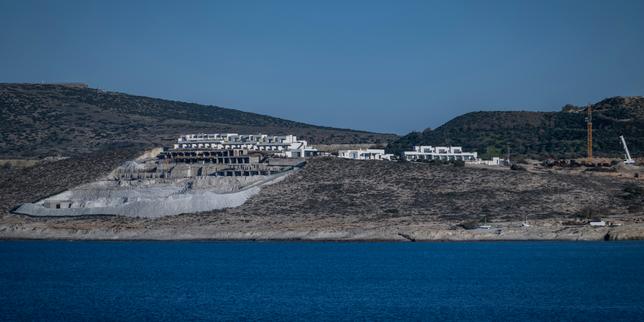
Walk down the sleepy waterfront of almost any Greek island today and you will notice a stark shift. The modest whitewashed buildings with hand-painted wooden signs, run by the same local family for three generations, are quietly vanishing. In their place stand sleek, fortress-like compounds wrapped in private security, featuring infinity pools that spill over cliff edges and private helipads. Greece is in the middle of a massive tourism boom, but it is rewriting its entire hospitality DNA. The five-star explosion is changing the country, and independent family-run hotels are paying the heaviest price.
For decades, the magic of a Greek holiday lived in the small details. You stayed in a simple room managed by Maria and her husband, who left homemade lemon jam on your doorstep and pointed you toward secret coves only locals knew. That version of travel is rapidly being priced out and squeezed out. International private equity funds and major hospitality brands are injecting billions into the Aegean and Ionian archipelagos, snapping up prime coastline and transforming quiet islands into exclusive luxury enclaves.
The Economics Behind the Five-Star Takeover
Big money follows big yields. When international alternative-investment heavyweights and global hotel chains look at Greece, they do not see a relaxed Mediterranean escape. They see a severely under-monetized institutional market. Recent multi-million-euro transactions across Athens, Crete, Rhodes, and Halkidiki prove that high-end resort groups are willing to pay massive premiums to control prime Greek real estate.
When global private equity platforms acquire regional properties, they immediately pump massive capital expenditure into rebranding them. A tired three-star or four-star beach hotel gets stripped down to its studs and emerges a year later as an ultra-luxurious five-star lifestyle resort. The rooms double in price, the clientele shifts from independent backpackers and mid-market families to high-net-worth individuals, and the surrounding local economy shifts entirely to service this wealthy tier.
This luxury pivot makes cold financial sense for developers. The average spend per trip for traditional mass-market travelers pales in comparison to the staggering revenue generated by top-tier luxury resorts. Yet, this transformation creates a severe economic imbalance on islands where municipal infrastructure—water supply, waste management, and energy grids—was never built to sustain massive luxury consumption.
Why Small Family Hotels Are Struggling to Survive
Running a small independent hotel in Greece used to be a tough but stable livelihood. Today, it is an uphill battle against impossible odds. Independent hoteliers face a triple threat that is slowly driving them out of business:
How Luxury Resorts Are Slowly Killing the Real Greece
travel
Walk down a narrow cobblestone lane on a Cycladic island today and you'll notice something missing. The scent of a Yiayia's frying zucchini balls drifting from a tiny courtyard kitchen is gone. In its place stands a sleek, minimalist concrete wall hiding a private infinity pool. Greece is changing fast. The massive surge in global tourism isn't just bringing crowds to the Acropolis. It's actively reshaping the coastline, and small family-run hotels are paying the price.
Money talks louder than tradition. Over the last few years, international hospitality brands and private equity funds have poured billions into the Greek hotel market. They aren't interested in buying a ten-room pension run by a retired couple named Nikos and Maria. They want sprawling five-star resorts with helipads, Michelin-starred tasting menus, and private beach access.
Independent hoteliers can't compete with this wave. They're trapped between rising property taxes, strict new environmental regulations that cost a fortune to implement, and massive booking platforms taking huge commissions. When a major chain moves in next door, the mom-and-pop hotel down the road usually ends up selling out to developers.
The economic shift is staggering. Tourism accounts for roughly a fifth of the Greek gross domestic product. Millions of travelers arrive every summer chasing the myth of authentic Mediterranean life. Yet the infrastructure fueling this boom is destroying the very thing people came to find.
The Economics of the Five Star Takeover
Let's look at the numbers. Greek tourism revenue shattered records recently, passing twenty billion euros annually. But where does that money actually go?
When you book a boutique family-run lodge in Naxos or Peloponnese, most of your euros stay local. The owner buys groceries from the village market, hires local cousins to work the front desk, and uses a local plumber when the pipes burst. The cash circulates within the community.
Global luxury chains operate differently. They import high-end ingredients from international suppliers, bring in corporate management teams from Athens or London, and funnel profits straight back to overseas shareholders. The local baker gets a fraction of the business, and the village loses its economic independence.
Real estate values tell the same story. Land prices on islands like Paros, Milos, and Crete have skyrocketed. Local families who have lived there for generations can no longer afford to buy homes. Property inheritance taxes force heirs to sell to foreign investment groups because keeping a heritage building has become a financial liability.
What Real Travelers Miss Out On
Staying at an ultra-luxury resort in Greece feels the same whether you're in Mykonos, Dubai, or the Maldives. You get the infinity pool, the white linen cabana, and the isolation. You also get completely disconnected from the actual culture.
The magic of traveling through Greece used to be the unexpected human moments. It was the owner of the small inn leaving a jar of homemade fig jam on your table. It was getting lost in a mountain village in Zagori and finding a stone guesthouse where the grandfather plays the lute on the porch.
Those experiences require a specific ecosystem. They need small businesses that can afford to run on tight margins because their livelihood is tied to their home, not a quarterly earnings report.
When those small hotels vanish, tourism becomes sanitized. It turns into a backdrop for social media content rather than a genuine cultural exchange.
The Environmental Cost of Mega Resorts
Building massive luxury compounds requires resources that fragile Greek islands simply don't have. Water scarcity is a ticking time bomb in the Aegean.
A five-star resort with lush green lawns, daily linen changes for hundreds of rooms, and private pools consumes thousands of gallons of water a day. On islands without natural rivers or steady rainfall, this puts immense strain on municipal water supplies. Locals are often subjected to water restrictions while resort guests enjoy endless showers.
Energy grids face the exact same pressure. Power outages during peak summer months are becoming normal as air conditioning units run twenty-four hours a day across sprawling new hospitality complexes.
How to Travel Responsibly in Greece
You don't have to stop visiting Greece to be part of the solution. You just need to change how you spend your money.
- Skip the major booking aggregators when you can. Look for independent booking platforms that support local properties, or contact family-run hotels directly through their websites.
- Venture beyond the hyper-popular hotspots. Mykonos and Santorini are entirely dominated by luxury conglomerates. Head instead to lesser-known islands like Amorgos, Kythira, or mountainous regions on the mainland like Epirus, where small hospitality still thrives.
- Eat at family tavernas instead of resort restaurants. Support local businesses that buy from regional farmers and fishermen.
The Greek landscape will keep evolving. Investors won't stop building luxury resorts anytime soon. But as a traveler, you hold the remote control. Keep the small places alive by choosing them over the corporate monoliths.