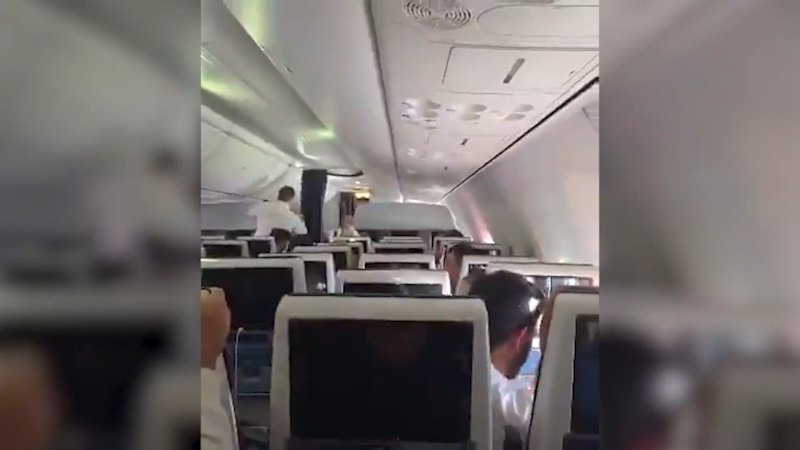
When an Omani co-pilot allegedly turned a flight deck axe against his own captain on a Flydubai aircraft, the shockwaves reached far beyond the Middle East. Among the passengers caught in the high-altitude panic were an Australian couple, Steven and Carol Moss, whose terrifying ordeal thrust international aviation security back into the headlines. While initial mainstream coverage fixated on the dramatic blow-by-blow accounts of passenger intervention and the immediate rescue, a more disturbing systemic question remains largely unexamined. How does an insider threat bypass modern commercial aviation vetting, and what does it reveal about the vulnerabilities hiding in plain sight on flight decks worldwide?
Modern aviation security has spent the last two decades obsessively fortifying the outer perimeter. Airports operate as fortress-like zones where passengers are stripped of liquids, electronics, and shoes, subjected to millimeter-wave scanners and behavioral detection protocols. Yet, this multi-billion-dollar security apparatus suffers from a fundamental paradox. It is heavily skewed toward external threats while treating the flight crew as trusted insiders.
This trust is generally well-placed. Millions of flights operate safely because pilots and co-pilots are among the most rigorously screened professionals on earth. However, when that single layer of internal trust fails, the reinforced cockpit doors designed to keep bad actors out suddenly work in reverse. They lock the chaos in.
The mechanics of a cockpit breach from the inside expose an architectural flaw in modern aircraft design. Following historical security directives, cockpit doors are heavily armored and bolted from within, operable only by code or flight crew discretion. If a rogue pilot decides to incapacitate their colleague—utilizing standard emergency tools like the flight deck crash axe—the physical barriers meant to protect the aircraft transform into a prison. Passengers and cabin crew are left entirely dependent on manual intervention, physical struggle, and extraordinary fortune.
Investigating the background of the Omani co-pilot, international authorities quickly expanded their scope, probing potential educational and residency links that extended all the way to Australia. This cross-border investigative trail highlights another structural weakness in global aviation oversight. Flight crews move fluidly across international jurisdictions, training at varied academies, holding licenses issued by different national authorities, and shifting employment between regional and legacy carriers.
A pilot's psychological fitness and background checks do not always translate seamlessly across borders. While civil aviation authorities maintain strict medical standards, real-time tracking of psychological deterioration, radicalization, or sudden financial and personal stressors remains rudimentary. Traditional medical renewals happen annually or semi-annually. A lot can happen to a human mind in six months at 35,000 feet.
When passengers like the Mosses booked their Flydubai journey, they purchased an implicit contract of safety backed by international regulatory bodies like the International Civil Aviation Organization. They expected that the human element in the cockpit had been vetted to the same microscopic standard as the baggage compartment. Instead, the incident proved that the weakest link in a modern twin-engine jetliner is not the titanium hull or the digital fly-by-wire system. It is the unpredictability of human behavior behind a locked door.
Aviation authorities now face an uncomfortable reckoning. Adding more heavy-handed security theatre for passengers will do nothing to mitigate insider threats. Random secondary psychological evaluations, more dynamic peer-review mechanisms during long-haul rotations, and re-evaluating the accessibility of emergency tools inside the flight deck are overdue conversations.
Until commercial aviation confronts the reality of internal bad actors with the same gravity it assigns to external terrorism, reinforced doors will remain a double-edged sword. Every flight continues to rely on the hope that the person sitting in the right-hand seat shares the same commitment to bringing the plane down safely as the person on the left.