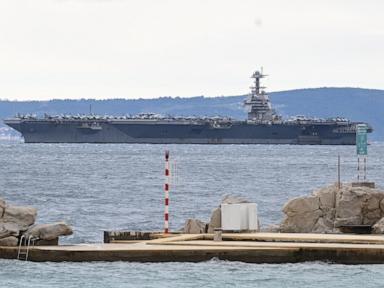
The United States Navy is currently paralyzing itself with a review process that smells of bureaucratic cowardice. Critics are salivating over the supposed "death of the carrier," citing the $13 billion price tag of the USS Gerald R. Ford as evidence of a white elephant. They point to Chinese DF-21D "carrier killer" missiles and drone swarms as the final nails in the coffin for large-deck aviation.
They are fundamentally wrong. In similar updates, take a look at: The Coming War for Apple Talent Under a New CEO.
The Navy’s internal hand-wringing over the future of the Ford-class isn't a sign of strategic foresight. It is a failure to understand that the aircraft carrier is not a "ship." It is a mobile, sovereign piece of territory that forces an adversary to solve a math problem they cannot afford to solve. Stopping the Ford-class program now wouldn't be "fiscal responsibility." It would be a unilateral disarmament of the only platform that keeps the Pacific from becoming a closed lake.
The Myth of the Vulnerable Behemoth
The loudest argument against the high-tech carrier is its perceived vulnerability. The "lazy consensus" suggests that a $20,000 drone or a $10 million missile can trade up against a $13 billion ship. This is a kindergarten-level understanding of kinetic warfare. ZDNet has provided coverage on this important topic in great detail.
A carrier strike group is the most densely defended patch of real estate on the planet. To even get a look at the Ford, an enemy has to penetrate a layered defense system consisting of Aegis-equipped destroyers, E-2D Hawkeye early warning sensors, and an air wing that can intercept threats hundreds of miles from the hull.
The critics talk about the DF-21D like it’s a magic wand. It isn't. It is a ballistic missile that has to find a moving target in a cluttered ocean environment, transmit data through a hardened electronic warfare bubble, and survive the SM-6 interceptors coming its way.
The Ford class isn't just a bigger runway. It’s an electrical powerhouse. With two A1B reactors capable of producing 600 megawatts of electricity—three times the power of the Nimitz class—the Ford is the only ship designed to house the next generation of directed energy weapons. If you want to shoot down hypersonic missiles with lasers, you need a Ford. If you want to run high-energy jamming suites that blind an entire coastal province, you need a Ford.
Stopping the program because "missiles exist" is like saying we should stop building offices because "fire exists." You don't quit; you build better sprinklers.
The Electromagnetic Catapult Panic
Let’s talk about the Electromagnetic Aircraft Launch System (EMALS) and the Advanced Arresting Gear (AAG). The media loves to cite the "reliability issues" of these systems as a reason to scrap the whole design. I have spent years watching defense contractors overpromise and underdeliver, but the teething pains of the Ford are standard for a generational leap in physics.
Steam catapults—the tech we’ve used since the 1950s—are at their physical limit. They are violent, they tear up airframes, and they can't launch the lightweight drones of the 2030s or the heavy, fuel-soaked tankers of the 2040s.
The Ford's electromagnetic system allows for "fine-tuned" launches. We can launch a 5,000-pound UAV and an 80,000-pound fighter back-to-back without blowing the seals on a piston. This isn't just a "nice to have" feature. It is the requirement for the future of the air wing. A ship that can’t launch the drones of the future is a floating museum.
The reliability numbers are climbing. The sorties are being generated. The Navy's "review" is essentially a group of people panicking because the new car had a check engine light during the first 10,000 miles. You don't return the car and go back to riding a horse.
The Cost Fallacy: $13 Billion is a Bargain
$13 billion sounds like a lot of money until you look at the alternative. The "Light Carrier" or CVL crowd wants us to build smaller, cheaper decks—perhaps based on the America-class amphibious ships.
Here is why that is a strategic trap.
A "light" carrier can carry maybe 20 F-35Bs. It lacks the organic early warning (E-2D) and the massive magazines of a supercarrier. To get the same strike power as one Ford-class ship, you would need four or five light carriers.
Now, do the math. You need four times the number of escort ships. You need four times the number of sailors. You need four times the number of refueling tankers. The "cheap" alternative ends up costing 50% more in operating expenses over a 50-year lifespan, and you end up with a fleet that can’t survive a high-intensity fight.
The Ford class is expensive because it concentrates power. It is an efficiency play disguised as an extravagance. By reducing the crew size by 600 to 1,000 people compared to a Nimitz-class ship, the Ford will save the taxpayer billions in personnel costs over its life. The "high-tech" features aren't gold-plating; they are the only way to keep the ship affordable in a world where manpower is the most expensive line item in the budget.
The Real Threat: Bureaucratic Inertia
The real danger to the US Navy isn't a Chinese missile. It’s the "Review" culture.
Every time we pause a major program to "study the future of the fleet," we signal to our adversaries that our industrial base is fractured. We lose the skilled labor required to weld nuclear-hardened steel. We lose the engineers who understand how to integrate a dual-band radar.
If the Navy cancels or scales back the Ford class now, they aren't saving money. They are destroying the supply chain. You cannot turn a nuclear carrier shipyard on and off like a light switch. Once those workers leave for the private sector, they don't come back.
We are currently seeing the results of this indecision in our submarine fleet. We stopped building Seawolf-class subs, tried to "re-evaluate," and now we are decades behind in attack sub capacity while the Virginia-class tries to fill the gap. We cannot afford to do this with the centerpiece of the fleet.
Dismantling the "Drone Swarm" Argument
The most common "gotcha" from the armchair generals is that a swarm of 1,000 cheap drones will overwhelm the carrier.
First, drones have limited range. To get 1,000 drones to a carrier, you need a launch platform. That launch platform—be it a ship, a plane, or a land base—is something a carrier air wing can find and destroy before the drones are even in the air.
Second, the Ford class is uniquely suited to survive a swarm because of its power margin. Kinetic defenses (bullets and missiles) are limited by magazine depth. Directed energy (lasers and high-powered microwaves) is limited only by the ship's fuel. The Ford's reactors make it the ultimate "anti-drone" platform.
The critics want to fight the last war. They see the success of drones in Ukraine—a land-locked conflict with clear lines—and assume the same logic applies to the Philippine Sea. It doesn't. The ocean is vast, and the Ford is fast. At 30+ knots, the carrier is not a sitting duck; it is a ghost that covers 700 miles in a single day. Finding a needle in a haystack is hard. Finding a needle that is actively jamming your eyes and moving at highway speeds is nearly impossible.
The Actionable Reality
The Navy needs to stop apologizing for the Ford and start doubling down on its capabilities. This means:
- Stop the "Light Carrier" distraction. It’s a budgetary mirage that provides no real-world tactical advantage against a peer competitor.
- Accelerate the Air Wing of the Future. The ship is ready; the planes aren't. We need the MQ-25 Stingray tanker and the Collaborative Combat Aircraft (CCA) drones on that deck yesterday.
- Weaponize the Power Margin. Immediately fund the installation of 300kW+ laser systems on the Ford-class hulls to render the "cheap missile" argument obsolete.
The Ford-class aircraft carrier isn't a relic of the past. It is the only reason the United States remains a global power. Every time a "review" puts its future in question, we are essentially asking if we would like to retire from the world stage.
The status quo is to fear the price tag and the "threat." The bold move is to realize that the carrier is the only thing the threat actually fears.
Build the ships. Launch the planes. Stop the reviews.