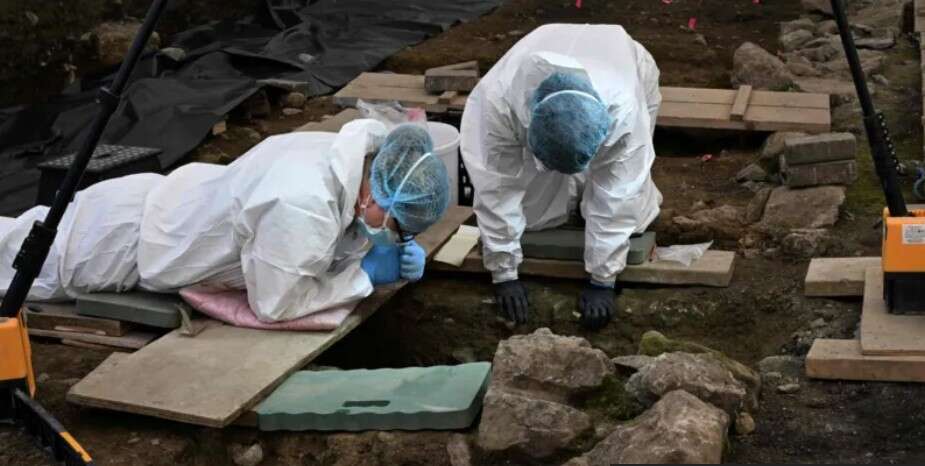
The physical recovery of human remains from the subterranean infrastructure of the former St. Mary’s Mother and Baby Home in Tuam, Ireland, marks a critical shift from archival investigation to large-scale forensic identification. The extraction of 99 infant remains from a decommissioned multi-chambered sewage system reveals the operational mechanics of state-sanctioned institutional neglect and highlights the technical parameters required to resolve large-scale human identification crises.
Resolving this historical failure requires evaluating the site through three distinct systems: structural isolation, biological degradation, and genetic matching limits.
Structural Frameworks of Institutional Mortuary Suppression
The presence of unrecorded infant interments at Tuam reflects an institutionalized system designed to minimize operational costs while hiding non-normative reproductive outcomes. Between 1925 and 1961, the Bon Secours order managed the facility under local authority contracts. The operational model relied on three distinct structural incentives:
- Fiscal Externalization: State capitation grants incentivized maximum occupancy with minimum resource allocation. Standard death registration protocols required municipal oversight, whereas domestic containment on-site eliminated burial expenditures and legal recordation fees.
- Systemic Stigmatization: Illegitimacy laws created legal and social exclusion, removing family protections for incoming mothers. This ensured families rarely demanded bodily return or verified cause of death.
- Sub-Sewer Mortuary Adaptation: Utilizing a multi-chambered concrete septic tank for waste management as an informal burial site avoided public graveyard entries. The underground chambers provided a hidden space that prevented external inspection.
This administrative structure led directly to missing public health metrics. Infant mortality at Tuam peaked at rates far exceeding national baseline averages, driven by rampant infectious disease, malnutrition, and structural neglect.
Taphonomic Constraints on Physical Recovery
Exhuming human remains from an industrial waste vault presents unique technical challenges. Taphonomy—the study of how organisms decay and become fossilized or preserved—dictates the current recovery timeline. The environment of the subterranean vault alters organic material across four key dimensions:
[Anaerobic Concrete Vault Environment]
       │
       ├─► High Moisture / Chemical Exposure ──► Rapid Demineralization
       │
       ├─► Bone Commingling ──────────────────► Spatial Disarticulation
       │
       └─► DNA Fragmentation ─────────────────► Low-Yield STR Sequence Risk
The concrete vault environment degrades bone through prolonged moisture exposure, fluctuate pH levels, and microbial activity. Because multiple juvenile remains were placed in the same space over decades, bone structures have become mixed and disarticulated. This commingling prevents standard morphological assembly.
Extracting usable profiles from juvenile skeletal remains requires targeting specific bone sites. Dense cortical structures, like the petrous part of the temporal bone, offer the highest resistance to environmental decay and yield superior endogenous DNA quantities compared to long bones.
The Quantitative DNA Resolution Pipeline
Transforming recovered bone fragments into verified individual identities requires a step-by-step genetic workflow. Standard Short Tandem Repeat (STR) profiling often fails on severely degraded infant remains. The forensic identification process uses three core analytical techniques:
[Bone Fragment Extraction]
       │
       ▼
[Targeted Next-Generation Sequencing (NGS)]
       │
       ▼
[Single Nucleotide Polymorphism (SNP) Panel]
       │
       ▼
[Kinship Analysis vs. Reference Family Database]
       │
       ▼
[Probabilistic Likelihood Ratio (Identity Match)]
First, analysts perform Targeted Next-Generation Sequencing (NGS). Traditional capillary electrophoresis struggles with fragmented DNA strands under 100 base pairs. NGS isolates short sequences, allowing researchers to analyze thousands of Single Nucleotide Polymorphisms (SNPs) simultaneously.
Second, workers build reference database capacity. Collecting reference DNA from 62 living relatives establishes the baseline needed to calculate kinship probability. Direct maternal or paternal samples are rare due to the age of the site, requiring analysts to rely on second- and third-degree relative profiles.
Third, teams calculate statistical match probabilities using likelihood ratios. High-density SNP panels generate statistical confidence even when comparing second-cousin reference samples against compromised historical DNA.
Bottlenecks in the Identification Workflow
The primary obstacle in the recovery effort is not the physical excavation, but the statistical bottleneck in matching genetic samples. The system faces two main operational limits:
- Reference Database Sparse Mapping: A biological database containing only 62 reference samples leaves significant gaps when matching an estimated 796 deceased infants. Without higher participation from living collateral relatives, genetic matching produces low confidence scores.
- Degradation-To-Coverage Yield Ratios: Severe demineralization in juvenile bones limits the usable DNA extracted per gram of bone tissue, forcing laboratories to run repeated, resource-intensive sequencing processes.
Establishing identity in historical mass-burial cases requires continuous reference sampling. The recovery operation must scale up relative profiling, expand database collection across former resident networks, and use high-density SNP array panels. These steps are essential to turn isolated skeletal fragments into verified individual profiles.


