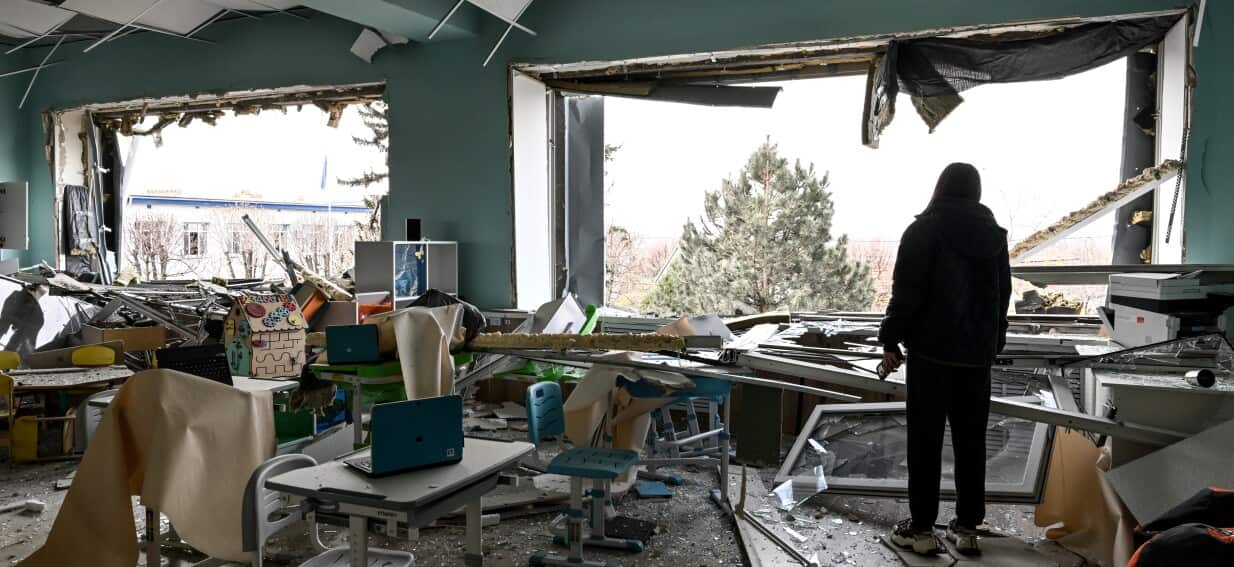
The mud in the Donbas doesn’t care about theology. It is a thick, primordial soup that clings to the treads of tanks and the soles of combat boots with equal indifference. For months, the sound of this landscape has been defined by the rhythmic, chest-thumping percussion of 155mm artillery and the high-pitched whine of FPV drones hunting for a heat signature. It is a symphony of industrial slaughter.
Then, a strange word began to circulate through the damp trenches and the shattered remains of village kitchens: Svyato. The Holiday.
Russia and Ukraine have reached an agreement. For forty-eight hours, the guns are supposed to go cold to honor the Orthodox Easter. It is a fragile, paper-thin promise carved out of a conflict that has forgotten how to blink. To the diplomats in leather chairs, this is a "bilateral cessation of hostilities." To a soldier named Mykola—let’s call him that, though his name changes in every dugout from Kharkiv to Kherson—it is something much more terrifying. It is the return of the silence.
The Weight of an Unfired Round
When you live in a world of constant noise, silence feels like an ambush.
Consider the mechanics of a ceasefire. It isn’t just the absence of shooting; it is the presence of an agonizing restraint. A sniper looks through his glass and sees a target. On Friday, that target is a threat to be eliminated. On Saturday, because of a date on a liturgical calendar, that target is a man holding a tin of meat. The sniper has to choose to let him live.
This two-day window is a ghost of the 1914 Christmas Truce, but stripped of the naive optimism. No one is expected to kick a soccer ball in No Man’s Land. Instead, the stakes are deeply internal. For forty-eight hours, the men on both sides are forced to remember they are human. That is a dangerous thing to remember when you have to go back to killing on Monday.
The agreement covers the period of the Orthodox Easter, a time when the "Christ is Risen" refrain usually echoes through gold-domed cathedrals. This year, many of those domes are jagged teeth of rusted metal. The logistics of the ceasefire were brokered through back channels, involving religious intermediaries and the kind of hushed negotiations that happen when both sides are exhausted but neither is ready to quit.
The Invisible Inventory
Why agree to this? If you look past the humanitarian veneer, you see the grim math of modern warfare.
A forty-eight-hour pause is a mechanical necessity masquerading as a moral gesture. In the rear, the mechanics are sweating. They are using these 2,880 minutes to swap out burnt-out barrels on howitzers. They are hauling crates of shells closer to the front lines under the cover of a "holy" peace. Medics are finally moving the wounded who were too risky to transport under the constant glare of reconnaissance drones.
But the most important inventory being taken isn't physical. It’s the psychological stock-taking that happens when the adrenaline drops.
Imagine a mother in Kyiv. For two years, her heartbeat has been synced to the air-raid siren. She knows the different pitches—the low moan of a distant strike, the sharp crack of the air defense systems. The ceasefire means she might sleep through the night. But sleep is where the nightmares catch up to you. When the sky goes quiet, the mind begins to tally what has been lost. The ceasefire doesn't bring back the dead; it just gives the living enough quiet to finally hear their names.
The Geography of Prayer
Religion in this conflict is not a unifying force; it is a front line. The split between the Ukrainian Orthodox Church and the Russian Orthodox Church is a schism written in blood.
On the Russian side, the rhetoric has often framed this as a "holy war," a defense of traditional values against a decaying West. On the Ukrainian side, faith is a shield against annihilation, a way to reclaim an identity that Moscow seeks to erase. When these two sides agree to a ceasefire for the same holiday, they are praying to the same God for opposite outcomes.
The agreement specifies that the pause begins at midnight. In the hours leading up to that deadline, the violence usually intensifies. It’s a frantic, cynical race to get the last word in. Commanders want to seize one more treeline, one more basement, one more inch of scorched earth before the clock hits twelve. They want to ensure that when the silence starts, they are the ones holding the high ground.
The Fragility of the Word
There is no "peace" in a two-day ceasefire. There is only a "not-war."
The skepticism on the ground is thick enough to choke on. Ukraine remembers previous pauses—during the Minsk agreements, during localized evacuations—where the shelling never truly stopped. Russia claims its intentions are purely spiritual, yet its missiles remain fueled on the launchpads.
Trust is a luxury that was sold off in the first weeks of the invasion. Now, the ceasefire is monitored not by international observers, but by the nervous fingers on triggers. If a single nervous nineteen-year-old in a trench hears a twig snap and fires a burst into the dark, does the ceasefire end? If a drone pilot sees a column of fuel trucks moving under the "protection" of the truce, does he hold his fire?
The "invisible stakes" are the precedents being set. If this works for forty-eight hours, can it work for four days? Could it work for a week? Or does the pause simply allow both sides to sharpen their knives for a more brutal Tuesday?
The Meal at the End of the World
In a small village near Bakhmut, an elderly woman named Olena prepares for the Easter meal. She has no eggs to dye. The power has been out since October. She has a single candle and a loaf of bread that is more sawdust than flour.
For her, the ceasefire is the difference between eating her bread in the cellar or sitting by the window where there is a sliver of spring light. That light is the only thing that matters. It isn't a "geopolitical shift." It isn't a "strategic pivot." It is the ability to sit in a chair and not feel the floor vibrate with the death of a neighbor.
We often talk about war in terms of "theaters" and "fronts," as if it’s a play we are watching from a safe distance. But a ceasefire reminds us that the theater is made of wood and bone. When the actors stop shouting their lines, you realize the stage is on fire.
The clock is ticking. Each second of silence is a gift, but it’s a gift given by the same people who spent the last year gift-wrapping shrapnel. The soldiers look at their watches. They check their safety catches. They listen to the birds, who are the only ones truly enjoying the lack of explosions.
The silence is heavy. It is expectant. It is the sound of a world holding its breath, knowing that eventually, it has to exhale. And when it does, the air will be filled with smoke once again. For now, there is only the mud, the bread, and the terrifying, beautiful absence of the roar.
Forty-eight hours.
Forty-seven.
Forty-six.
The light in Olena's window flickers, but for one night, it stays lit.


