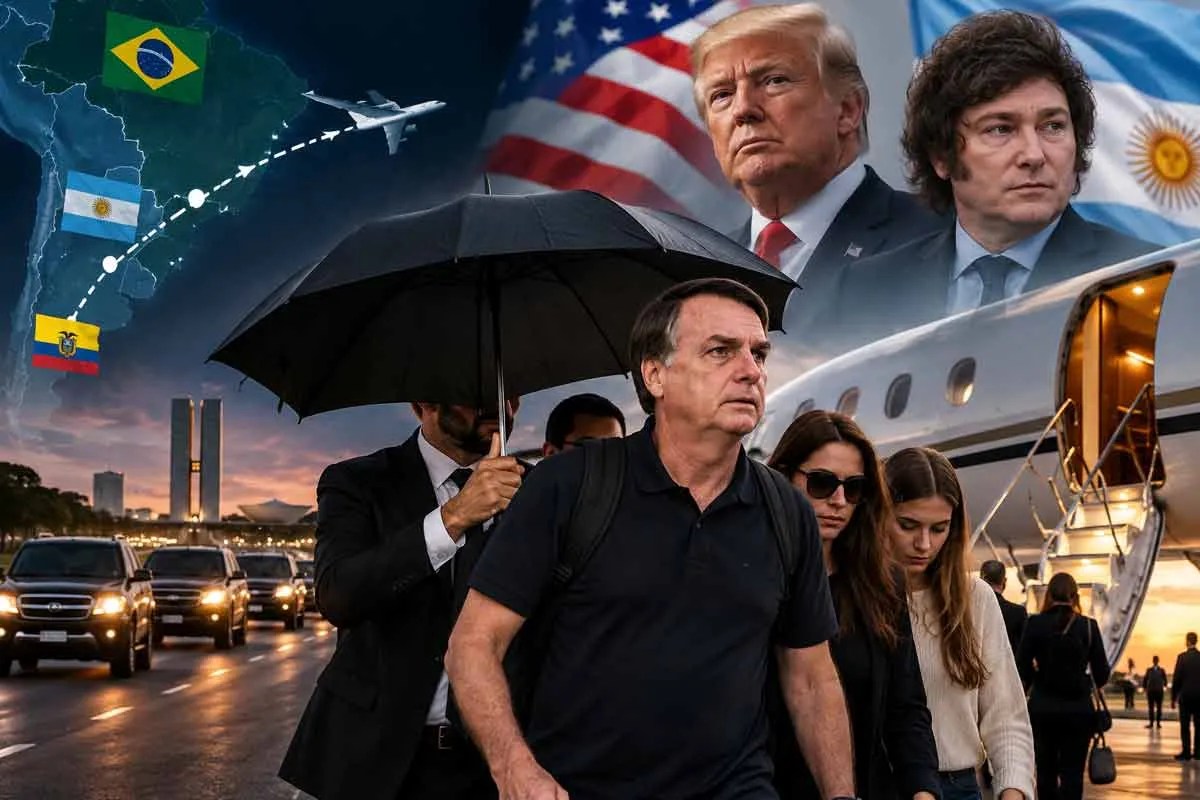
Midnight in Brasília rarely feels innocent when the sirens go quiet.
If you have ever sat in a parked car along the wide, monumental avenues of Brazil’s capital after dark, you know the strange weight of that silence. The concrete curves designed by Oscar Niemeyer look like white bones under the streetlamps. Decisions made behind tinted glass in these blocks do not stay local; they ripple outward into courtrooms, embassies, and exile communities thousands of miles away. According to the headline and premise of the competitor report—Flavio Bolsonaro US escape: चार गाड़ियां, गुप्त विमान और ट्रंप की मंजूरी: ब्राजील से अमेरिका तक कैसे पहुंचे बोल्सोनारो?—the story centers on a coordinated departure involving four vehicles, an unpublicized aircraft, and reported approval tied to Donald Trump that brought Senator Flávio Bolsonaro from Brazil to the United States. Meanwhile, you can explore similar stories here: Inside the White House War to Purge Federal Judges From Cases.
Cold bullet points make it sound like a movie script. Four cars. A secret plane. A political nod from Washington.
Look closer, though, and the real story is not about engines or flight plans. It is about what happens when political power collides with judicial pressure, and how a family that once commanded the Planalto Palace navigates the narrow corridor between defiance and departure. To understand the full picture, we recommend the recent report by The Washington Post.
The Architecture of a Quiet Departure
Anyone who has watched high-stakes political exits in Latin America recognizes the choreography before a single tire touches tarmac.
Consider a hypothetical observer—let us call him Rafael, a veteran aviation dispatcher working the night shift at a regional executive terminal outside Brasília. In a scenario like the one described in the Hindi-language report, Rafael does not see banners, press pools, or diplomatic motorcades with flashing red lights. He sees four ordinary vehicles arriving at staggered intervals, spaced just far enough apart to avoid triggering routine pattern alerts on traffic cameras.
Why four cars?
In security protocols, redundancy is the oldest shield in the book. One vehicle carries the principal; the others serve as decoys, sweepers, or contingency transport if a tail is spotted. To a casual bystander grabbing late coffee across the street, four dark sedans slipping through an industrial gate look like nothing more than corporate logistics. By the time anyone realizes which car held the passenger, the passenger is already through a private FBO—a fixed-base operator terminal where commercial crowds never tread.
I have spent years covering cross-border political crises, and the sensory detail that always stays with me is not the roar of the jet. It is the hum of the fluorescent lights in those empty private lounges at two in the morning. There is no applause there. No rallies. Just bottled water on a glass table, encrypted phones buzzing on silent, and the sudden realization that crossing a border changes the legal gravity around you.
Why the Destination Matters More Than the Flight
To understand why a journey from Brazil to the United States carries such voltage, you have to understand the political weather both countries have been living through.
In Brazil, the post-presidency era of Jair Bolsonaro has been defined by intense scrutiny from the Supreme Federal Court, federal police investigations, and fierce debates over democratic institutions, speech, and accountability. Supporters of the Bolsonaro family argue they face judicial overreach and political persecution; critics and judicial authorities maintain that investigations into January 8, 2023, financial dealings, and alleged abuse of power represent the rule of law functioning as intended.
And then there is the northern end of the flight path.
Florida—and the broader political orbit around Donald Trump—has become far more than a vacation destination for Brazilian conservatives. Over the past several years, it has functioned as an ideological sanctuary, a fundraising hub, and a symbolic stage. When Jair Bolsonaro himself traveled to Orlando at the end of December 2022, just days before Luiz Inácio Lula da Silva’s inauguration, that trip set the template. It showed that physical distance from Brasília could buy time, shift the narrative, and place key figures inside a friendlier political ecosystem.
According to the framing of the source report, Flávio Bolsonaro’s transit to the United States involved not merely logistical stealth—the four cars and unannounced aircraft—but also political clearance or approval linked to Trump’s circle. While the competitor headline presents these elements as established dramatic beats, it is worth pausing to separate confirmed patterns from unverified claims: international travel by a sitting Brazilian senator involves diplomatic passports, bilateral immigration rules, and U.S. Customs and Border Protection clearance, none of which operate purely on personal favor, even when political alliances run deep.
Yet perception in politics often hits harder than paperwork.
The Invisible Stakes Behind Tinted Glass
Think of a political dynasty like a suspension bridge built during a hurricane.
While the cables hold, traffic moves across it at full speed—laws pass, allies rally, media cycles bend to its rhythm. The moment tension snaps at one anchor point, every other cable absorbs twice the load. Flávio Bolsonaro, the eldest son of the former president and a sitting senator from Rio de Janeiro, has long stood at the intersection of the family’s legislative strategy and its legal vulnerabilities.
When a figure in that position leaves the country quietly rather than announcing an official parliamentary mission, two competing stories immediately collide in the public square:
- The narrative of strategic retreat: To allies, stepping out of Brasília’s immediate reach is a rational survival move—a way to regroup, consult international partners, and avoid becoming a symbolic target in an escalating domestic confrontation.
- The narrative of evasion: To opponents and skeptics, covert logistics—multiple vehicles, unscheduled aviation, sudden appearances abroad—look less like diplomacy and more like flight from accountability.
Both interpretations feed off the exact same set of facts. That is what makes stories like this so combustible. You do not need to invent drama when the very act of boarding a plane carries opposite meanings depending on which side of Brazil’s polarized divide you stand on.
I will admit something that analysts rarely say out loud: watching these cross-border maneuvers unfold in real time is disorienting. Information leaks in fragments—a tail number spotted on a flight-tracking forum, a blurry photo outside a terminal, a headline in Hindi or Portuguese summarizing sources that refuse to go on the record. Even seasoned observers have to sift carefully between verified flight logs, partisan rumor mills, and geopolitical theater.
The Long Shadow of Exile Politics
History shows that borders rarely end a political fight; they simply change its acoustics.
From Latin America in the twentieth century to modern populist movements across the hemisphere, moving a key actor from a domestic capital to Miami, Orlando, or Washington alters who gets to speak and how loudly. Inside Brazil, a senator answers to Senate ethics committees, Supreme Court inquiries, and domestic press corps waiting outside the plenary hall. On American soil, the same figure steps into an arena dominated by sympathetic podcasts, conservative conferences, and transatlantic messaging aimed at framing domestic legal battles as global struggles over freedom.
Consider what happens next in that environment.
A quiet arrival does not stay quiet for long. Once clear of Brazilian airspace, the strategic value of silence evaporates and the strategic value of visibility takes over. Every handshake in Florida, every photo near Mar-a-Lago or a conservative forum, sends a message back south: We are not isolated. We have powerful friends.
At the same time, every day spent abroad raises sharper questions at home. Constituents in Rio de Janeiro ask who is representing them in the Senate. Legal commentators examine whether travel restrictions existed or whether any judicial lines were crossed. Diplomatic observers watch quietly to see how Brasília and Washington manage the friction without turning a passenger manifest into a full-blown bilateral crisis.
The Runway Lights Behind Him
Strip away the thriller vocabulary—the four cars idling in the dark, the unmarked jet climbing through clouds over the Amazon basin, the whispers of approval from Mar-a-Lago—and what remains is a stark human truth about modern power.
Power feels permanent right up until the night you have to leave through a side gate.
Whether viewed as a calculated tactical maneuver or a troubling sign of democratic strain, the journey from Brasília to the United States captures a defining tension of our era: leaders who campaign on fierce national sovereignty still look across borders for shelter when the domestic storm turns against them.
Somewhere over the Caribbean, the cabin lights dim, the engines settle into a steady drone, and four dark sedans back in Brasília are already parked in separate garages, their drivers clocking out before dawn.


