The human mind is not built to comprehend a quarter of a million miles of nothing. We understand commutes. We understand flights across the Atlantic. But the distance between where you are sitting right now and the ancient, scarred rock orbiting our planet is a vastness so profound it swallows the imagination whole.
For more than half a century, that distance has remained entirely uncrossed by human life. The footprints left in the fine, lunar dust during the Apollo era are still there, perfectly preserved in a vacuum, static monuments to a fleeting era of frantic ambition. Since 1972, no human heart has beaten far from the warm, protective magnetic shield of Earth.
That long isolation is about to end.
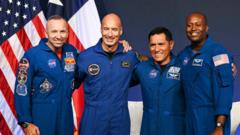
NASA recently announced the names of the four individuals who will climb inside a small capsule bolted to the top of a tower of controlled explosives. Their mission, Artemis II, is not to land on the Moon, but to break the gravity well of Earth, loop around the lunar far side, and prove that we can actually make it back alive.
It is easy to look at the press releases, the crisp blue flight suits, and the clean graphic design of modern space programs and see a bureaucratic milestone. But look closer at the names, the faces, and the sheer physics of what they are attempting. This is not a victory lap. It is an immense, terrifying gamble on human capability.
The Weight of the Blue Suit
When you assemble a crew for a voyage into deep space, you are not just selecting operators. You are building a microcosm of human resilience. The four astronauts selected for this journey represent a striking departure from the homogenous crews of the 20th century, bringing vast and varied lifetimes of intense preparation to a single, cramped cockpit.
Consider Reid Wiseman, the commander. He is a veteran navy aviator who has already spent 165 days in orbit on the International Space Station. His job is to steady the ship when the automated systems inevitably do something unexpected. Beside him sits Victor Glover, the pilot, who will become the first person of color to leave Earth's orbit. Glover previously piloted a SpaceX Crew Dragon, bringing the cold precision of military test piloting to a frontier that forgives zero mistakes.
Then there is Christina Koch, a mission specialist who already holds the record for the longest single spaceflight by a woman—328 days. She has spent months navigating the silent, floating world of the space station, adjusting to the strange reality of a world without a floor.
Rounding out the crew is Jeremy Hansen, a colonel in the Royal Canadian Air Force, representing a historic partnership. He is the first Canadian chosen for a lunar mission, carrying the weight of an entire nation's scientific aspirations on his shoulders.
These four people will share an internal volume roughly the size of a large SUV. For ten days, their entire universe will be bounded by metallic walls, wire looms, and the rhythmic, mechanical hum of life support systems.
The Long Loop into the Dark
The flight path of Artemis II is a monument to cosmic geometry. The crew will launch aboard the Space Launch System, a rocket capable of producing millions of pounds of thrust, pushing the Orion spacecraft faster and higher than any human-rated vehicle has traveled in decades.
But the real test begins when the engines cut out.
Once they break free from Earth's immediate grasp, the crew will enter a high elliptical orbit to test the spacecraft's handling. Think of it as a brief, intense trial run in the relative safety of the backyard before heading out into the open ocean. If everything checks out, a final engine burn will commit them to a lunar flyby.
They will travel a trajectory known as a free-return profile. The gravity of the Moon will act as a cosmic slingshot, catching the Orion capsule, swinging it around the hidden far side, and throwing it back toward Earth.
During that swing around the far side, the Moon itself will block all radio signals from home. For a period of absolute, heavy silence, the crew will be entirely cut off from every human voice, every piece of data, and every comforting sign of civilization. They will look out the small windows into the deep, unblinking blackness of the cosmos, seeing the stars not as twinkling lights through an atmosphere, but as piercing, eternal points of fire.
The Silent Hazard
We often romanticize the view of the Earth from space—the fragile blue marble hanging in the dark. But achieving that view requires crossing an invisible, treacherous gauntlet.
When the Apollo astronauts traveled to the Moon, they moved fast, slicing through the Van Allen radiation belts—zones of highly energetic particles trapped by Earth's magnetic field—in a matter of hours. The Artemis II crew will face an even more complex radiation environment as they venture out past the protective bubble that shields the International Space Station.
Deep space is flooded with galactic cosmic rays and solar particle events. To survive, the Orion capsule relies on advanced shielding and a carefully engineered interior layout. In the event of a sudden solar flare, the astronauts will have to construct a makeshift shelter inside the cabin using cargo boxes and equipment to block the invisible, cell-damaging bombardment.
It is a stark reminder that space exploration is fundamentally an act of survival against an environment that is actively hostile to biological life. We are soft, watery creatures trying to exist where there is no air, no pressure, and no mercy.
Why We Go Back
There is a valid question that arises whenever we discuss the immense cost and danger of deep space flight: Why do this now? We have rovers on Mars. We have automated telescopes peering into the dawn of time. Why risk four human lives to trace a loop around a moon we already visited decades ago?
The answer is not found in the rocks they will look at, but in the infrastructure we are building. Artemis II is the stress test for a grander, more permanent architecture. It is the prerequisite for Artemis III, which aims to place boots on the lunar south pole, a region of eternal shadows and hidden water ice.
If we want to learn how to live on another world—if we ever want to see human footprints in the red dust of Mars—we have to master the backyard first. We have to learn how to manage life support systems for weeks and months without the luxury of a quick supply drop from Earth. We have to understand how the human body adapts to deep space radiation over long durations.
The four individuals strapped into that capsule are the bridge between an era of brief visits and an era of permanent presence. They are going first so that others can stay.
When the Orion capsule finally plunges back into Earth's atmosphere, screaming through the air at twenty-five thousand miles per hour, its heat shield will endure temperatures reaching five thousand degrees Fahrenheit. It will drop into the waters of the Pacific Ocean under a canopy of massive parachutes, returning four travelers to the only world we have ever truly known.
They will step out onto the deck of a recovery ship, their muscles weak from microgravity, their eyes adjusting to the bright, familiar sun. They will have looked at the place where history ends and the future begins, reminding us that the sky is not a ceiling, but a road.