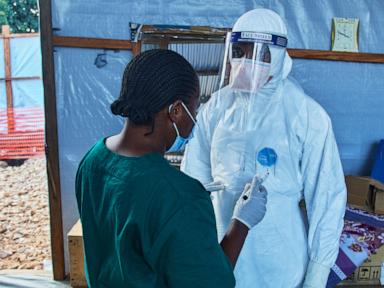
The rain in eastern Congo does not just fall. It pounds against the plastic sheeting of the isolation wards, a relentless, deafening rhythm that drowns out the whispers of the dying. For anyone who has stood inside the red zones of North Kivu, that sound is inseparable from the smell of chlorine. It is a sharp, chemical sting that burns the nostrils, a desperate attempt to scrub away an invisible predator.
Ebola.
To the outside world, the word is a headline. It is a statistic updated on a Geneva dashboard, a spike on a graph, a temporary panic that flares up and vanishes from the evening news. But in the red dirt of Beni and Butembo, it is a monster with a memory. It is the memory of a mother snatched away before she could say goodbye. It is the memory of a child buried in a body bag by strangers wearing terrifying, faceless white suits.
Now, the white tents are going up again. But this time, the atmosphere carries something unfamiliar. Not just terror. Something much heavier, much more complicated.
Hope.
A new clinical trial for an Ebola treatment is beginning in the eastern region of the Democratic Republic of Congo. On paper, it is a scientific protocol, a randomized evaluation of therapeutic efficacy, a cold sequence of data points designed to satisfy regulatory boards. In reality, it is a high-stakes gamble against the grave. It is the line between a family staying whole or fracturing forever.
The Long Shadow of the Red Zone
To understand why a new medical trial matters, you have to understand what it feels like to live in the shadow of the virus. Consider a woman named Alphonsine. She is not a statistic. She is a mother of three who sells cassava leaf in the local market. For Alphonsine, the arrival of health workers is not a comforting sight. Historically, it has meant the opposite.
For decades, an Ebola diagnosis in this part of the world felt less like a medical condition and more like a sentence of execution. You entered the treatment center, the doors closed, and often, you only came out in a coffin. This reality birthed a deep, agonizing distrust. Why trust the doctors when everyone who goes to them disappears? Rumors bred in the gaps left by fear. People whispered that the white tents were places where organs were harvested, that the foreigners brought the sickness with them.
You cannot blame them for the fear.
When a hemorrhagic fever rips through a community, it tears at the very fabric of human intimacy. It turns love into a vector of transmission. To wash the body of a deceased relative, a sacred cultural ritual, becomes a lethal act. To hug a crying child who is sweating with fever becomes a choice between comfort and contamination. The virus weaponizes our best human instincts against us.
But the science has been quietly shifting beneath the feet of this conflict-weary region. Years of grueling research, conducted amidst active militia warfare and community resistance, began to prove that Ebola did not have to be an absolute death sentence. Monoclonal antibodies showed that early intervention could dramatically flip the odds of survival. Yet, the victory was incomplete. The virus mutates. The current tools, while revolutionary compared to the dark days of the early outbreaks, still leave too many empty chairs at the dinner table.
That is why this new trial exists. The current treatments are good, but they are not perfect. In the relentless calculus of infectious disease, good is never enough.
The Chemistry of Faith
Inside the laboratories and the specialized treatment units, the language is precise. Researchers talk about viral loads, binding affinities, and efficacy margins. They speak with the cool neutrality required of objective science.
But talk to the local nurses, the ones who spend twelve hours a day suffocating inside layers of personal protective equipment, and the language changes. They talk about the eyes.
When a patient is wheeled into the high-risk zone, their eyes search the plastic visors of the medical staff. They are looking for a human face. They are looking for any sign that they will see the sun tomorrow. The new trial represents a new candidate molecule, a fresh weapon engineered to block the virus from entering human cells more effectively than its predecessors.
But how do you explain molecular biology to a father whose entire family is burning with fever?
You don't. You show him results.
The true challenge of this trial is not just biochemical; it is profoundly social. It requires building a bridge of trust over a chasm of historical trauma. Eastern Congo has survived decades of armed conflict, displacement, and neglect. The people here are survivors, but they are tired. They are skeptical of promises.
Medical teams are learning that the success of a drug depends entirely on the person delivering it. Local community leaders, traditional healers, and survivors are the true gatekeepers of this trial. If they do not believe in the science, the vials will sit unused in the sub-zero freezers, useless pieces of glass while the virus rages outside.
Consider the mechanics of the trial itself. It is a meticulous dance of logistics. The experimental treatments must be transported across roads plagued by ambush, kept at precise, freezing temperatures in a region where the electrical grid is a luxury, and administered by teams who must remain hyper-vigilant against both a lethal virus and unpredictable security threats. It is science operating under the conditions of a siege.
The Choices Made in the Dark
There is a profound vulnerability in participating in a clinical trial. Imagine being the first to say yes.
Imagine sitting in a clinic, your body aching, your skin burning, knowing that inside your blood, a war is being fought. A doctor offers you an experimental option. It might save you. It might not work better than what already exists. It is an uncertain path. To sign that consent form is an act of extraordinary bravery. It is a gift given by the people of Congo to the rest of the world.
Every piece of data gathered in these mud-slicked towns will eventually protect someone in a future outbreak, whether that happens in a neighboring province or across an ocean. The world owes its defenses against Ebola to the patients of North Kivu who choose to trust science in their darkest hours.
The stakes are invisible but monumental. If this trial succeeds, it means a shorter course of illness. It means less strain on a fragile healthcare system. It means that when a person develops a fever, they will run toward the clinic instead of hiding in their home. That shift in behavior is what ultimately breaks the chain of an epidemic.
But the real problem lies elsewhere, far beyond the design of the drug itself.
A cure is only a cure if it reaches the skin. The finest medicine created in a Western laboratory is worthless if it cannot navigate the final mile to a rural village in the Congo. The true test of this new era of treatment is not just whether the molecule can kill the virus in a petri dish, or even in a controlled clinical environment. The test is whether the global health infrastructure can sustain the supply chains, honor the local dignity, and maintain the presence required to make these interventions permanent.
Beyond the Statistics
The white tents will eventually come down. This outbreak will wane, as the others did, leaving behind a trail of grief and a collection of binder folders filled with clinical data.
But for the residents of eastern Congo, the end of an outbreak is never the end of the story. The virus lingers in the reservoirs of nature, waiting for the right moment to spill over again. The hope that is currently clinging to the new trial is not a naive optimism. It is a fierce, stubborn determination to survive.
Look at the hands of the medical staff as they adjust an intravenous line. Look at the faces of the families waiting outside the orange plastic barriers, holding containers of food, waiting for news. They are not passive victims in a tragedy. They are active participants in a scientific frontier.
The rain eventually stops, leaving the red earth heavy and thick. Inside the wards, the monitoring equipment hums, tracking the vitals of those who have volunteered to test the future. Each heartbeat recorded is a defiance against the virus, a small, stubborn declaration that despite everything this region has endured, life intends to win.