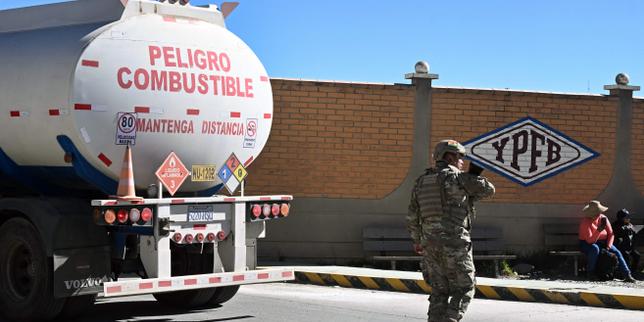
The Bolivian government recently deployed state-of-exception powers to clear the crippling highway blockades that choked the nation's economy for weeks. While official reports celebrate the progressive reopening of major transport arteries, this aggressive state intervention fixes nothing. The cleared roads mask a deeper, unresolved institutional collapse driven by a bitter factional war within the ruling party. Bolivia is not returning to stability; it is entering a highly volatile phase where economic exhaustion and political desperation dictate the national trajectory.
For nearly a month, supporters of former President Evo Morales barricaded the central highways connecting the agricultural lowlands to the administrative highlands. The government of President Luis Arce responded by declaring a state of exception in flashpoint regions, unlocking emergency executive authorities and mobilizing combined military and police units. This clearing operation represents a tactical success for the current administration, yet it leaves the structural catalysts of the unrest completely untouched.
The Economic Underpinnings of Direct Action
Road blockades are not a novel protest mechanism in the Andes. They serve as the traditional veto power of rural and indigenous movements when formal political channels fail or close. In this instance, the blockades targeted the vital economic corridor of Cochabamba, effectively severing the supply lines for food, fuel, and export goods.
The immediate damage to the domestic economy exceeds hundreds of millions of dollars. Perishable agricultural goods rotted in stationary trucks. Fuel shortages, already a chronic issue due to dwindling foreign exchange reserves, intensified to a critical degree in major urban centers like La Paz and Santa Cruz. By targeting transport routes, the protestors weaponized the country's unique geographic vulnerabilities to force a political showdown.
The government's heavy-handed response managed to displace the physical barriers, but it cannot fix the macroeconomic rot fueling the broader discontent. Bolivia faces a severe shortage of US dollars, declining natural gas production, and rising inflation. The blockades merely accelerated a financial crisis that has been gathering momentum for years. Removing the boulders and burning tires from the asphalt does not restock the central bank's depleted reserves.
A Ruptured Ruling Party and the Battle for Survival
To view this conflict purely as a dispute over economic grievances is to misread the entire situation. This is a cold war between two men who once shared the peak of political power. The division between President Luis Arce and his former mentor, Evo Morales, has shattered the Movement for Socialism, the party that dominated Bolivian politics for two decades.
The Legal Net Closes around Morales
The timing of the protests matches a series of legal escalations against Morales. The former president faces serious criminal investigations, including allegations of human trafficking and statutory rape, charges he claims are entirely fabricated by the Arce administration to disqualify him from the upcoming presidential election.
Morales remains determined to run for office again despite constitutional rulings that restrict consecutive terms. His loyalists see the blockades as a defensive shield. By paralyzing the country, they sought to force the government to drop the criminal charges and recognize Morales as the legitimate, singular leader of the political left.
Arce's Tactical Calculation
President Arce found himself cornered. Allowing the blockades to persist meant accepting the slow-motion collapse of the national economy and demonstrating terminal weakness. Yielding to Morales's demands would mean political suicide and the surrender of judicial independence to street pressure.
The declaration of the state of exception was a calculated gamble. By framing the clearance operations as an essential defense of public order and economic survival, Arce sought to win back the support of urban middle classes and business sectors weary of perpetual instability. The strategy worked mechanically, but the political cost is immense. The administration now relies heavily on the security apparatus to maintain everyday governance, a position that historically precedes deeper democratic erosion in Latin American history.
The Illusion of Clearance and the Shift to Underground Resistance
Clearing a highway with tear gas and armored vehicles provides a convenient photo opportunity for state media. It creates the impression of an authoritative government reasserting control. That control is profoundly superficial.
The security forces cannot occupy every kilometer of the national highway network indefinitely. The moment the troop presence thins, the capacity for disruption returns. The social organizations loyal to Morales have not disbanded; they have retreated to reassess their methods.
Reports from the interior indicate that rural syndicates are shifting from permanent, mass blockades to hit-and-run tactics. Small groups can obstruct key choke points within minutes, scatter upon the arrival of police, and reassemble elsewhere. This decentralized disruption creates a permanent state of logistical anxiety for businesses and transport logistics, rendering long-term planning impossible.
Furthermore, the deployment of the military to assist police forces risks escalating the violence. When the state uses live ammunition or excessive force against rural populations, it creates martyrs. In Bolivia, historical memory is long and unforgiving. Past governments collapsed precisely because a heavy-handed security response resulted in civilian casualties, uniting disparate social movements against the executive branch. Arce is walking an incredibly thin line.
International Repercussions and Regional Instability
The crisis inside Bolivia does not stop at its borders. As a key land transport hub in South America, its internal paralysis disrupts regional supply chains, affecting trade routes between Brazil, Argentina, Chile, and Peru.
- Mercosur Integration: Bolivia's recent entry into the Mercosur trade bloc was intended to signal regulatory alignment and economic maturity. The prolonged domestic chaos suggests otherwise, undermining foreign investor confidence at a moment when the country desperately needs capital.
- Contraband Economies: The scarcity of basic goods and fuel within Bolivia accelerates illegal cross-border smuggling. Artificially subsidized fuel frequently leaks out to neighboring countries, draining national coffers while organized criminal networks exploit the institutional distraction created by the political infighting.
Neighboring governments view the situation with growing apprehension. A prolonged collapse of state authority or a descent into prolonged civil strife in Bolivia would trigger migratory pressures and disrupt energy agreements, particularly gas supplies to Brazil and Argentina, although those exports have already shrunk significantly due to production failures.
The Deadlock with No Clear Exit
The fundamental problem facing Bolivia is that neither faction can deliver a decisive blow to the other. Arce controls the machinery of the state, the judiciary, and the formal military leadership. Morales retains deep-seated loyalty among the indigenous peasantry of the Chapare region and parts of the high altiplano, alongside an unparalleled ability to mobilize mass civil disobedience.
This equilibrium of force guarantees a prolonged period of instability. There is no appetite for genuine compromise. For Morales, political retirement or facing trial means the end of his legacy and potentially his freedom. For Arce, backing down means validating a parallel authority and guaranteeing an ignominious exit from office.
The upcoming electoral cycle will only intensify this friction. Without a credible, neutral arbitration mechanism, every judicial ruling, electoral registration decision, and economic policy measure will be treated as an act of war by the opposing side. The clearing of the roads is a temporary intermission, not the final act. The asphalt is clear for now, but the political terrain remains entirely broken.