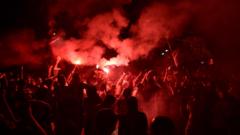
The global media landscape follows a predictable, lazy script every time a major football tournament wraps up in Paris. A French club loses a Champions League final, or a national team wins a semifinal, and cue the inevitable headlines: "Hundreds Arrested After Wild Celebrations." Editors splash images of burning cars, tear gas canisters bouncing off cobblestones, and riot police marching in phalanxes. The narrative is set before the first brick is even thrown. The public nods along, blaming "hooliganism" and tribal savagery for the chaos.
They are looking at the wrong culprit.
The mainstream press wants you to believe that football fandom is inherently pathological, a ticking time bomb that requires heavy-handed policing to contain. This is a fundamental misunderstanding of crowd dynamics and urban security. The real story behind those hundreds of arrests in France isn't a sudden spike in fan criminality. It is the predictable result of an outdated, adversarial policing strategy designed to manufacture statistics rather than maintain public order.
When you see mass arrests on the streets of Paris or Marseille, you aren't witnessing a crackdown on crime. You are witnessing a systemic failure of state crowd control.
The Mirage of the Football Hooligan
Mainstream reporting treats thousands of fans celebrating in a public square as a monolithic, dangerous entity. This is sociological illiteracy. Decades of research by crowd psychologists—most notably the Elaborated Social Identity Model (ESIM) developed by scholars like Stephen Reicher—demonstrate that crowds are not inherently irrational or violent. They are highly sensitive to perceived legitimacy.
When tens of thousands of people gather to celebrate, the vast majority have a single shared identity: joy. However, French policing doctrine traditionally treats these gatherings not as celebrations to be facilitated, but as riots waiting to happen.
Imagine a scenario where thousands of ecstatic, drinking fans are packed into a tight urban corridor. Instead of directing traffic and managing flow, the state deploys the CRS (the French riot police) in full combat gear—shields up, batons drawn, faces obscured. The psychological message sent to the crowd is immediate: We view you as an enemy.
This adversarial stance creates a self-fulfilling prophecy. When police use indiscriminate force, such as firing tear gas into a dense crowd to disperse a small group of troublemakers, they transform the psychology of the entire gathering. The average fan, who was just singing moments ago, suddenly finds themselves choked by gas and shoved by police. The crowd's identity shifts from "celebrators" to "victims of state aggression." At that precise moment, the minority looking for a fight gains the backing of the majority. The police do not quell the riot; they curate it.
The Metric That Lies: Decoding Mass Arrest Numbers
The media uses arrest counts as a proxy for the severity of a riot. "Three hundred arrested" sounds like a war zone. But anyone who has spent time embedded in European sports culture or working within municipal security frameworks knows that arrest numbers are an entirely fabricated metric of success.
In France, the legal framework allows for preventive detention and mass roundups under broad charges like "participation in a group formed for the purpose of committing violence." This creates a perverse incentive for police commanders on the ground.
When a celebration turns chaotic due to poor crowd management, commanders face immense political pressure to show results. The easiest way to show results is to sweep an entire street, arresting anyone who couldn't run fast enough.
- The Reality of the Data: Check the judicial outcomes of these mass arrests forty-eight hours later. The vast majority of those detained are released without charge, or given minor fines for non-violent offenses like public intoxication or defying an order to disperse.
- The Cost of the Metric: Real criminals—the coordinated groups running targeted looting operations or assaulting individuals—easily slip away in the chaos. The police nets catch the slow, the drunk, and the innocent bystanders.
To judge the security of an event by the number of arrests is like judging the quality of a hospital by the number of body bags it buys. It is a metric that rewards failure.
The Euro-Centric Blindspot in Modern Security
European football authorities and local prefectures consistently ignore the evolution of crowd management happening right across the English Channel and in the Nordic regions. For years, the UK faced the worst reputation for football violence in the world. They didn't solve it by deploying military-grade hardware against their own citizens. They solved it through the "Skånland approach" and specialized liaison policing.
In progressive crowd management frameworks, police do not wear riot gear by default. They wear high-visibility jackets. They walk among the crowd, chat with fans, identify leaders, and actively de-escalate tension before it boils over. They use "soft policing" to maintain a dialogue. If an individual commits a crime, targeted extraction teams remove that specific person without disrupting the wider collective.
French authorities routinely reject this methodology, preferring a philosophy of containment and overwhelming force. They rely heavily on nassement—kettling—a tactic where police surround a crowd and prevent anyone from leaving.
Think about the physics of a liquid under pressure. If you compress a fluid into a confined space with no outlet, the pressure skyrockets until the container bursts. Kettling human beings experiencing high emotional states does the exact same thing. It forces peaceful fans into direct physical contact with riot police, generating friction that inevitably sparks violence. The resulting arrests aren't a victory for law and order; they are the direct consequence of a tactical blunder.
The Real Cost of the Status Quo
There is an undeniable downside to challenging this policing model. Shifting away from mass intervention requires a level of tactical patience and institutional humility that modern political structures rarely tolerate. It means accepting that minor infractions, like a fan climbing a lamppost or setting off a flare, do not require a tactical response. It requires allowing the crowd to self-regulate.
For a politician or a police prefect, that looks like weakness on camera. Tear gas and mass arrests look like control, even if they actually cause the very destruction they claim to prevent.
The current system serves everyone except the public. The media gets their sensational footage, politicians get to act tough on prime-time television, and police unions get to demand higher budgets for armored vehicles and chemical agents. The only casualties are the fans, the local shopkeepers whose windows are smashed in the engineered chaos, and the tax-paying public funding this theater of violence.
Stop reading the headlines that blame the sport, the clubs, or the vague concept of "wild celebrations." The next time you see hundreds arrested in a French city after a match, understand exactly what you are looking at: an outdated bureaucratic machine turning a party into a battlefield just to prove it owns the weapons.


