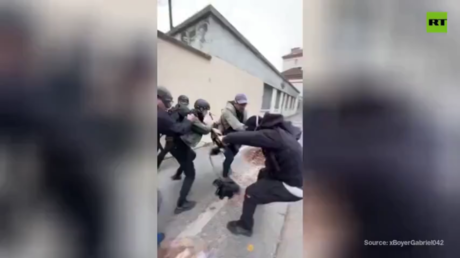
French television news crews covering street protests are increasingly targeted for violent robberies because their visible broadcast gear, predictable live-shot routines, and lean field footprints make them easy marks in volatile crowds. What used to be an occupational hazard limited to stray tear gas canisters or verbal hostility has hardened into a calculated street crime problem, where opportunistic thieves and organized groups strip reporters and camera operators of high-end cameras, transmission backpacks, and personal valuables while the cameras are rolling.
The footage looks the same every time. A reporter stands under a streetlamp a few blocks away from the main clash, mic in hand, waiting for the cue from Paris. Then someone steps out of the periphery, yanks a tripod or a smartphone rig, and vanishes into an alley before the private security guard—if one was even hired for the shift—can close the distance. For a different view, check out: this related article.
This is not just an isolated string of bad luck on the boulevards of Paris, Lyon, or Marseille. It is the collision of shrinking broadcast budgets, lightweight mobile journalism gear, and a street-level political climate where mainstream French media outlets are viewed by segments of the crowd not as neutral observers, but as hostile institutions.
The Anatomy of a Live Broadcast Ambush
To understand why a French TV crew gets mugged during a demonstration, you have to look at how modern television news operates on the ground. Twenty years ago, covering a major protest meant rolling out a heavy satellite truck. That truck was a fortress of sorts—parked behind police lines, staffed by a driver, an engineer, a camera operator, a sound technician, and a reporter. There was safety in numbers and bulk. Similar insight on the subject has been shared by The New York Times.
Today, that footprint has collapsed. Networks rely on cellular bonding backpacks—compact units that combine multiple SIM cards to transmit high-definition video over commercial mobile networks. A two-person crew, and frequently a single video journalist working solo, can now go live from anywhere in a city center.
That agility is a blessing for news directors watching the bottom line. On the street, it is a massive vulnerability.
A solo video journalist or a two-person team carrying twenty thousand euros worth of broadcast cameras, lenses, and transmission packs cannot watch their own backs while framing a shot. When the red tally light comes on, the camera operator's depth perception is locked inside a three-inch viewfinder. The reporter's attention is split between the lens and the producer speaking into their earpiece. For three to five minutes during a live hit, both people are functionally blind to their immediate surroundings.
Thieves know this. In major French cities, crews operating near protest perimeters—often around transit hubs like Gare du Nord, République, or the outskirts of demonstrations where police presence thins out—have become prime targets for snatch-and-grab robberies. Unlike war zones, where journalists wear ballistic vests and move in convoy formations, domestic street protests lull assignment editors into treating the assignment like routine local news.
Why Mainstream Media Became a Target in France
The physical vulnerability of the gear only explains half the equation. The other half is cultural and political, and it has been building in France for nearly a decade.
During the Yellow Vest protests that erupted in late 2018, something broke between the French public and the twenty-four-hour news channels. Protesters accused outlets like BFM TV and CNews of framing demonstrations exclusively around broken shop windows and clashes with riot police while ignoring economic grievances. The hostility was immediate and physical. Crews had their equipment smashed, their tires slashed, and their reporters chased down avenues.
That hostility never fully dissipated. Instead, it mutated.
Through the pension reform protests, urban riots following police shootings, and ongoing social unrest, the presence of a branded microphone cube became a lightning rod. In dense, agitated crowds, attacking a TV crew carries almost zero social penalty among the surrounding demonstrators. Bystanders rarely intervene to help a reporter who is being robbed. Worse, smartphones come out immediately—not to call police, but to film the humiliation for social media clout.
For opportunistic criminals who shadow large protests to loot stores or pickpocket commuters, a news crew represents the perfect intersection of high-value electronics and zero crowd sympathy. If you mug a regular pedestrian in a packed square, fifty people might tackle you. If you rob a television crew wearing the logo of a major Paris network, the crowd might part to let you run.
The Hidden Economics of Stolen Broadcast Gear
A common misconception is that thieves only steal phones and wallets from reporters. While personal electronics are certainly taken, professional camera bodies, broadcast lenses, and transmission units have a thriving, if specialized, gray market.
Let us look at a hypothetical example of how this plays out after a street theft. Imagine a thief snatches a compact broadcast camera and a cellular transmission backpack from a crew covering an evening demonstration in Marseille. The transmission unit itself is useless without an active network subscription and can be remotely bricked by the manufacturer once reported stolen. The thief dumps the backpack in a trash bin three streets away.
The camera body, the broadcast battery plates, the wireless audio receivers, and the glass lenses are a different story. Those components carry no GPS tracking. Within forty-eight hours, serial numbers can be scratched off or ignored entirely by buyers operating on encrypted messaging apps or informal overseas resale channels. A cinema-grade lens or compact broadcast camcorder worth eight thousand euros retail can move quickly for two thousand euros in cash.
Because the gear is portable enough to fit inside a standard gym bag, a single thief on an electric scooter can execute the entire robbery in under ten seconds.
Where Network Security Protocols Fail
Following the wave of assaults during the Yellow Vest demonstrations, major French broadcasters began hiring private bodyguards—often former military or police personnel—to accompany crews into volatile assignments. On paper, this solved the problem. In practice, the execution has major blind spots.
First, private security guards in France operate under strict legal constraints. Unlike law enforcement officers, they have no special authority to use force, carry weapons, or detain suspects beyond the standard citizen's right of self-defense. Their primary value is deterrence and spatial awareness—standing behind the camera operator, scanning the crowd, and pulling the crew out before a situation turns violent.
Second, budget realities dictate who gets protection. A flagship evening news crew broadcasting from the center of a high-profile Paris march will almost certainly have one or two close-protection agents attached to them. A freelance stringer or a regional bureau crew filing a morning update from a quieter neighborhood—or wrapping up their gear an hour after the main march has dispersed—usually gets nobody.
Yet the periphery and the aftermath of a protest are precisely when most muggings occur.
During the peak of a demonstration, riot police units like the CRS maintain rigid cordons. Criminals tend to stay away from heavy concentrations of armored vans and tear gas launchers. Once the march breaks up, the crowd fractures into smaller groups drifting toward metro stations and side streets. Police units redeploy. Crews linger behind to record stand-ups or pack their gear into unmarked sedans. That transitional window is where security collapses.
The Logo Dilemma and Operational Blind Spots
Veteran conflict journalists have known for decades that visibility is a double-edged sword. In some environments, marking your vehicle and clothing clearly as press offers protection. In others, it paints a bullseye on your back.
French television networks have struggled to adapt to this reality on home soil. Marketing departments want the network logo on the microphone flag, on the windscreens, and sometimes even on the crew's outerwear. During a live broadcast, that branding is non-negotiable for executives back in the control room.
On the street, however, crews have started stripping off every identifying mark the second the live segment ends. Experienced camera operators no longer carry padded bags emblazoned with manufacturer names like Sony or Sennheiser; they pack expensive lenses into battered, generic hiking backpacks. Microphone flags go straight into inside jacket pockets.
Even so, the gear gives them away. A three-axis gimbal, a shotgun microphone with a furry windjammer, or a tally light glowing in the dusk acts as a beacon from fifty yards away.
The Trap of the Static Live Shot
Another operational failure lies in how producers structure live television coverage. News directors love dynamic backdrops. They want the reporter standing in front of burning barricades, surging crowds, or flashing police strobes.
To get that shot, the crew has to plant themselves in one spot for twenty or thirty minutes—setting up lighting, establishing a clean cellular signal, waiting through commercial breaks, and then delivering the report.
In street-level security terms, staying static in a fluid, hostile environment is the worst possible tactic. It gives anyone watching from the sidelines plenty of time to assess the crew, count how many people are in the team, check whether a bodyguard is present, and plan an exit route.
What Actually Keeps Crews Safe on the Street
Fixing this problem does not require reinventing journalism, nor does it require turning domestic reporters into war correspondents. It requires abandoning the illusion that covering urban unrest in Western Europe is a routine desk assignment.
- Eliminate solo deployments near demonstrations. Sending a single video journalist into an active protest zone to save labor costs is an invitation for theft and assault. A minimum two-person team—one person filming, one person strictly dedicated to watching the surroundings—is the baseline for street survival.
- Extend security coverage past the main event. Private security details cannot be dismissed the moment the primary live broadcast wraps. Crews are most vulnerable while walking back to parked vehicles or transit hubs with packed gear cases. Security must stay with the team until the equipment is locked inside a secure building or vehicle.
- Abandon static live positions. Broadcast producers need to accept lower production values in exchange for mobility. Shooting on the move using stabilized compact cameras, pre-recording stand-ups in secure locations, and cutting live hits down to sixty seconds drastically reduces the window of opportunity for ambush thieves.
- De-brand everything until the exact second of broadcast. Microphone cubes, press armbands, and branded jackets should remain concealed until the countdown begins, and go back out of sight the instant the floor manager signals clear.
None of these measures will eliminate crime on the streets of major cities, and private security guards cannot stop an armed group determined to take a camera by force. Insurance policies will always cover the hardware.
The real damage is what happens to the reporting itself. When camera operators spend half their shift looking over their shoulders instead of through the lens, and when newsrooms quietly decide to skip neighborhoods after dark because the risk of losing gear is too high, entire sections of a city simply disappear from the public record.


