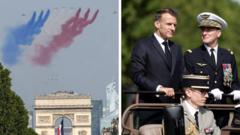
The heat on the Avenue des Champs-Élysées does not rise from the asphalt; it radiates directly from the bodies of eighty thousand people packed shoulder-to-shoulder behind metal police barriers. It is barely eight in the morning, but the Parisian summer sun is already heavy, cooking the stone facades and turning the air into a thick, dry soup.
Consider Marc, a retired high school history teacher from Lyon, who has been standing at the edge of the curb since dawn. He does not have a VIP ticket. He has a canvas tote bag containing two lukewarm bottles of water, a battered wool flat cap, and a plum-colored bruised shin from when a folding stool slipped in the crowd. His knees ache with a dull, rhythmic throb. To his left, a tourist family from Munich tries to quiet a toddler who is rapidly losing interest in French republican symbolism. To his right, a young woman in a denim jacket stares intently at the sky, her ears tuned to a frequency only she seems to hear. Also making headlines lately: The Anatomy of Marine Incident Response: A Brutal Breakdown of the Phu Quoc Speedboat Capsize.
Most news reports will summarize this day with a neat, sterilized sentence: “France celebrated its national holiday with a traditional military parade down the Champs-Élysées.” They will list the numbers—thousands of marching troops, hundreds of military vehicles, dozens of aircraft, and the routine presence of international dignitaries on the platform at the Place de la Concorde.
But lists do not explain why a retired teacher would stand in the baking heat for five hours just to watch a line of helmets pass by. They do not capture the strange, fragile friction of July 14th—a day that tries to stretch a canvas of national unity over a country that often feels like it is tearing at the seams. Further information regarding the matter are covered by Associated Press.
The Weight of the Seven-Thousand-Step March
Every French schoolchild knows the story of the Bastille. They know of the damp medieval fortress, the seven bewildered prisoners who were freed, and the bloody, chaotic birth of the modern Republic in 1789. But the parade itself is a different beast, born not of revolutionary triumph, but of deep, aching defeat.
When the military procession was officially bound to the national holiday in 1880, France was a wounded nation, still reeling from a crushing loss to Prussia. The parade was not designed to brag; it was designed to heal. It was a visual proof of life, a collective reassurance that the country still possessed a shield.
For the soldiers standing at attention near the Arc de Triomphe, that weight is not metaphorical. It is measured in grams and Celsius.
A young lieutenant named Jean-Baptiste—a hypothetical composite of the academy cadets who lead the procession—stands in his stiff wool dress uniform. The collar chokes his neck. A bead of sweat has formed behind his left ear and is slowly making its agonizing journey down his spine. He cannot scratch it. He cannot blink. His eyes must remain fixed on the horizon, ignoring the fly that has landed on his sleeve.
Beneath his boots are the cobblestones of Paris. They are uneven, slick with a microscopic sheen of morning dew and diesel exhaust. If he trips, the video will be on global social media feeds before he even hits the ground. The pressure is not just physical; it is historical. He is walking the same path where victory parades marched after the devastation of World War I, where Allied soldiers celebrated liberation in 1944, and where generations of citizens have projected their hopes, fears, and anger.
When the signal finally comes, the silence of the avenue is shattered by the deafening, mechanical roar of the Patrouille de France.
Nine Alphajets tear through the blue sky at five hundred miles per hour, incredibly low, leaving behind thick, velvety ropes of blue, white, and red smoke. The sound does not just hit your ears; it punches you in the chest. It vibrates through the soles of your shoes, rattling the ancient windowpanes of the luxury boutiques lining the boulevard.
For a single, fleeting second, eighty thousand heads tilt back in unison. The toddler stops crying. The German tourists stare upward. Marc forgets his aching knees. For three seconds, there is no left or right, no economic anxiety, no political division. There is only the sky, painted in the colors of a shared promise.
The Slowest Men on the Boulevard
The rhythm of the parade is a living thing, shifting from the frantic speed of the jet flyover to the steady, rumbling crawl of armored personnel carriers and tanks. The heavy diesel engines fill the air with a hot, metallic smell, a stark contrast to the scent of croissants and coffee wafting from the side streets.
But the true emotional anchor of the parade arrives when the machinery clears, and the foot soldiers return to dominate the space.
Among them, one group always commands a distinct, heavy silence: the French Foreign Legion.
They do not march like the others. While the rest of the army moves at a brisk pace of 120 steps per minute, the Legionnaires march at a slow, deliberate 88 steps per minute. They are the traditional rear guard of the infantry, a position they maintain because their pace is too steady to be rushed. Wearing their iconic white kepis, leather aprons, and carrying axes over their shoulders, they move with the gravity of a slow-moving glacier.
There is an eerie, hypnotic quality to their march. It feels less like a celebration and more like a warning. They represent the paradox of the nation: an elite force composed of foreigners who have sworn allegiance not to France, but to the Legion itself, yet who shed their blood for the tricolor flag.
As they pass the official grandstands at the Place de la Concorde, where the President of the Republic sits surrounded by international guests, the crowd does not cheer with the wild enthusiasm reserved for the Paris Fire Brigade. Instead, they applaud with a quiet, respectful solemnity. It is a acknowledgment of the invisible stakes—the recognition that the peace enjoyed on this sunny morning is bought with currency minted in far-off, dangerous places.
When the Smoke Clears
By early afternoon, the formal spectacle is over. The metal barriers are dragged away, leaving behind a battlefield of crushed plastic water bottles, discarded flyers, and the occasional lost shoe. The Metro stations, closed for hours due to security protocols, slowly creak back to life, swallowing the exhausted crowds and dispersing them back to the quiet corners of the city.
The official narrative of the day will conclude with the spectacular fireworks display at the Eiffel Tower later tonight, where bursts of light will illuminate the iron monument against the dark Parisian sky.
But the real pulse of the holiday moves away from the grand boulevards and into the neighborhoods.
In the courtyards of local fire stations, the Bals des Pompiers—the Firemen’s Balls—are being set up. String lights are hung between fire engines, plastic cups are stacked by the thousands, and speakers begin to hum with the sound of cheap accordions and bass-heavy pop music. Here, the rigid hierarchy of the morning dissolves into sweat, laughter, and cheap beer. The same firefighters who marched in pristine uniforms hours ago are now pouring drinks for the neighbors they rescued from flooded basements the week before.
Marc sits on a green metal bench in the Jardin des Tuileries, nursing the last of his warm water. His cap is in his lap, and his forehead is marked with a red, sunburned band.
He watched the parade. He saw the planes, the tanks, and the slow, heavy march of the Legion. He knows that tomorrow, the news will return to inflation, political gridlock, and social tension. The smoke from the Patrouille de France has already drifted away, leaving the sky over Paris perfectly, blankly blue.
Yet, as he watches a young boy run across the gravel path, holding a cheap paper tricolor flag that hums in the warm wind, you realize the parade is never actually about the weapons or the airplanes. It is a grand, expensive, beautiful stubbornness. It is a nation standing on a hot curb, squinting into the sun, trying to convince itself that despite everything, they are still marching together.