Strategic Imperative: The Structural Mechanics of Eurasian Overland Trade
Beijing's aggressive capital allocation toward Central Asian trade infrastructure is not a mere search for marginal export growth. It is a systematic buildout of structural redundancy designed to insulate China's real economy from maritime containment and supply chain weaponization.
Approximately 80% of China's crude oil imports and roughly 60% of its total trade value pass through the Strait of Malacca. This creates an existential choke point—historically termed the "Malacca Dilemma"—where a naval blockade by hostile powers could paralyze Eastern seaboard manufacturing within weeks.
By scaling overland transport corridors across Kazakhstan, Kyrgyzstan, Uzbekistan, Turkmenistan, and Tajikistan, China converts vulnerable open-ocean logistics into controlled continental routes. The economic rationale relies on three interconnected mechanics: structural risk mitigation, time-value arbitrage, and industrial capacity balancing.
The Three Pillars of Continental Transit Strategy
China's Eurasian infrastructure playbook operates across three specific strategic dimensions:
                  +-----------------------------------+
                  |   CONTINENTAL TRANSIT STRATEGY    |
                  +-----------------------------------+
                                    |
        +---------------------------+---------------------------+
        |                           |                           |
        v                           v                           v
+---------------+           +---------------+           +---------------+
| Geostrategic  |           | Operational   |           | Economic      |
| Redundancy    |           | Arbitrage     |           | Asymmetry     |
+---------------+           +---------------+           +---------------+
| • Maritime    |           | • Time-cost   |           | • Market      |
|   decoupling  |           |   optimisation|           |   capture     |
| • Energy      |           | • Rail vs sea |           | • Raw material|
|   security    |           |   trade-offs  |           |   monopoly    |
+---------------+           +---------------+           +---------------+
1. Geostrategic Redundancy and Energy Security
Overland pipelines and rail networks establish direct, non-maritime conduits for hydrocarbons and critical raw materials. The Central Asia–China gas pipeline system and cross-border rail connections eliminate maritime middle-men and bypass contested waters in the South China Sea and Indian Ocean.
2. Operational Arbitrage: Time vs. Cost
Ocean shipping offers lower cost per Twenty-Foot Equivalent Unit (TEU), but maritime transit between coastal China and Northern Europe averages 35 to 45 days. Standard rail transit along the Northern and Middle Corridors delivers goods in 12 to 18 days. For high-value, time-sensitive cargo—such as automotive components, consumer electronics, and high-end textiles—the velocity of capital turnover on rail outpaces the raw freight-cost savings of ocean vessels.
3. Regional Economic Asymmetry and Industrial Rebalancing
China's inland western provinces, particularly Xinjiang, face severe transport penalties when routing exports back through eastern ports like Shanghai or Ningbo. Developing direct overland gateways transforms Xinjiang into an upstream logistics hub, rebalancing China's domestic economic geography while establishing trade dominance over Central Asian markets.
Tradeoff Cost Matrix: Eurasian Transit Channels
Evaluating land corridors against conventional routes reveals the clear trade-offs between speed, volume, and vulnerability:
- Primary Ocean Routes (via Malacca & Suez)
- Transit Time: 35–45 days
- Relative Cost Per TEU: Baseline (1.0x)
- Volume Capacity: Uncapped (20,000+ TEU vessels)
- Primary Risk Factor: Naval blockade, maritime chokepoint congestion, geopolitical conflict
- Northern Rail Corridor (via Russia & Kazakhstan)
- Transit Time: 12–15 days
- Relative Cost Per TEU: 2.5x–3.5x
- Volume Capacity: Moderate (80–100 TEU per train)
- Primary Risk Factor: Western sanctions exposure, political instability along Russian links
- Middle Corridor / Trans-Caspian (via Central Asia & Caucasus)
- Transit Time: 18–22 days
- Relative Cost Per TEU: 3.5x–4.5x
- Volume Capacity: Low to Moderate (Multimodal bottlenecks)
- Primary Risk Factor: Multi-border customs delays, Caspian Sea vessel capacity restrictions
- China-Kyrgyzstan-Uzbekistan (CKU) Route
- Transit Time: 10–14 days (Southern Europe / Middle East branch)
- Relative Cost Per TEU: 3.0x–4.0x
- Volume Capacity: Scaling (Under construction)
- Primary Risk Factor: Mountainous terrain engineering, gauge-break delays
Operational Bottlenecks and Structural Limitations
Despite massive capital deployment, land corridors cannot completely replace maritime logistics due to key physical and institutional friction points.
The Railway Gauge Discontinuity
China operates on standard gauge (1,435 mm), whereas post-Soviet Central Asian states operate on broad gauge (1,520 mm). Every train crossing the Chinese border at Khorgos or Dostyk must undergo a mechanical bogie exchange or transfer containers between chassis. This physical constraint adds significant time, labor, and capital expenses to every TEU moved.
Multimodal Caspian Bottlenecks
The Trans-Caspian route requires offloading rail containers onto feeder ships at Kazakh or Turkmen ports, crossing the Caspian Sea, and reloading onto rail networks in Azerbaijan. Weather volatility, insufficient port crane capacity, and a lack of standardized vessel schedules create unpredictable delays that degrade the core value proposition of rail speed.
Cross-Border Institutional Friction
Unifying trade customs across multiple non-EU jurisdictions remains complex. Differences in tariff structures, digital manifest integration, and border-clearance protocols routinely cause multi-day delays at border checkpoints, eroding the speed advantage gained on open track.
+--------------------------------------------------------------------------+
|                      CROSS-BORDER TRANSIT FRICTION                       |
+--------------------------------------------------------------------------+
|  [China Standard Gauge] ---> [Gauge Break / Transfer] ---> [Broad Gauge] |
|                                                                          |
|  [Rail Freight] -------> [Port Staging] -------> [Caspian Feeder Ship]   |
|                                                                          |
|  [Multi-Jurisdiction Customs] -> [Manual Manifest Audits] -> [Delay]    |
+--------------------------------------------------------------------------+
Infrastructure Monetization and Trade Capture
Beijing's capital strategy employs debt-for-infrastructure financing models and state-backed equity joint ventures to cement long-term economic dominance across Central Asia.
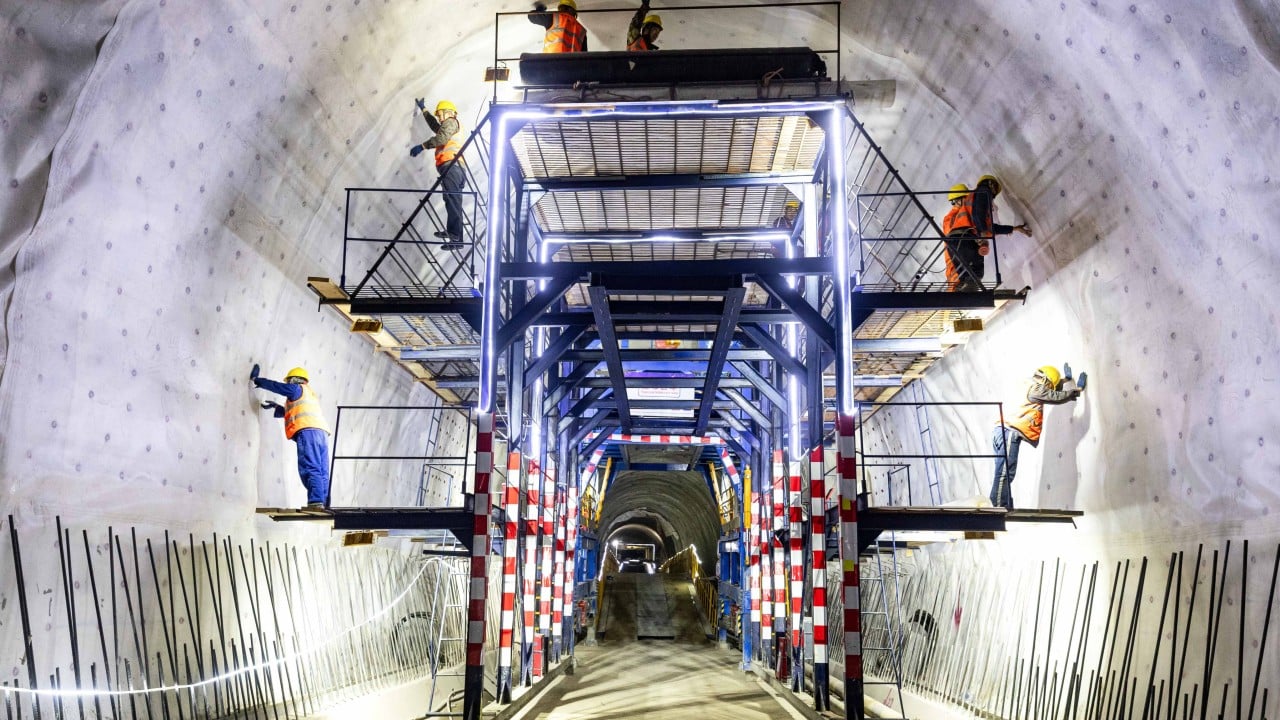
The construction of the China-Kyrgyzstan-Uzbekistan (CKU) railway demonstrates this dynamic clearly. By providing the capital and technical expertise to build a 520+ kilometer line through complex alpine topography, Chinese state-owned enterprises secure long-term engineering contracts while establishing a directly influenced trade artery that cuts transit distances to the Middle East and Southern Europe by roughly 900 kilometers.
+-----------------------------------------------------------------------+
|                    CKU RAILWAY PROJECT METRICS                        |
+-----------------------------------------------------------------------+
|  • Total Length: ~523 km                                             |
|  • Transit Distance Reduction: ~900 km to Europe / Middle East        |
|  • Transit Time Reduction: 7 to 10 Days                              |
|  • Key Infrastructure: 81 Bridges (26.1 km), 41 Tunnels (120+ km)     |
|  • Capital Investment: ~$4.7 Billion                                  |
+-----------------------------------------------------------------------+
This infrastructure development creates a self-reinforcing economic loop:
- Capital Injection: Chinese state banks extend loans to regional governments for rail, dry port, and road construction.
- Resource Extraction: Upgraded freight infrastructure accelerates the flow of critical minerals—such as copper, zinc, and rare earths—directly to Chinese processing facilities.
- Market Capture: Lower inbound transport costs allow cheap Chinese manufactured goods, electric vehicles, and heavy machinery to flood local markets, displacing regional competitors.
- Institutional Alignment: Regional reliance on Chinese logistics technology, customs software, and track standards locks these economies into Beijing's economic sphere for decades.
Strategic Playbook: Corporate Supply Chain Adaptation
Multinational corporations and logistics operators cannot treat Eurasian land trade as a simple substitute for ocean freight. Execution requires a segmented, dual-track supply chain architecture.
1. High-Value SKU Velocity Layer
Map product catalogs by value-to-weight ratio. Products exceeding $50 per kilogram—such as automotive control units, specialized industrial components, and high-margin electronics—should be allocated to Central Asian rail corridors. The higher freight cost per TEU is offset by reduced working capital lockup and lower inventory carrying costs.
2. Multi-Sourced Transit Route Hedging
Do not rely on a single land corridor. Split overland volumes between the Kazakh Northern Route for high-volume Russian/European transit, and the Middle Corridor (via Azerbaijan and Türkiye) to insulate operations from geopolitical sanctions. Maintain active ocean freight contracts to preserve baseline cost structures for bulk, low-margin inventory.
3. Buffer Integration at Technical Chokepoints
Factor a mandatory 48-to-72-hour buffer into delivery schedules at major gauge-break stations like Khorgos. Establish forward-operating warehouses or cross-docking facilities at key border hubs to process cargo sorting, customs re-manifesting, and safety inspections before trains reach the transshipment point.