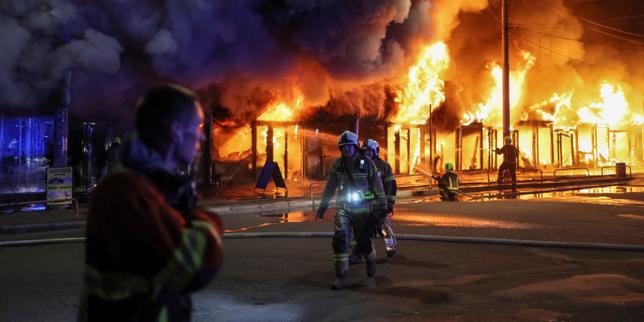
Dawn in Kharkiv does not arrive with birdsong. It arrives with the wet, metallic slap of damp air shifting against soot.
I remember the smell of an old radiator turning on for the first time in autumn—the faint, toasted dust. Here, the equivalent smell is pulverized drywall mixed with the copper tang of discharged high explosives. Nineteen bodies. That is the ledger written across the map of Ukraine and Russia in a single twenty-four-hour rotation of the earth. Numbers printed in neat, sterile columns on foreign news feeds, flattened by the screen's glass. But numbers do not bleed. Numbers do not leave behind a single red mitten on a staircase where the concrete floor has pancaked into the cellar below. If you found value in this piece, you might want to check out: this related article.
We have grown terrifyingly fluent in the vocabulary of kinetic impact. Drone. Missile. Interception. Shrapnel. These words roll off our tongues like shipping manifests, sanitized by distance. Yet behind every acronym of destruction lies a domestic choreography instantly shattered.
Consider a hypothetical kitchen in a residential suburb north of Kyiv, though it could just as easily be in Belgorod. The kettle has just clicked off. A woman reaches for the handle of her ceramic mug—the one with the chipped blue glaze her daughter brought home from art camp. Her wrist is fractionally turned. In three seconds, the sound barrier over her street will buckle. The windows will not merely break; they will atomize into a billion diamond teeth that scour the air. For another angle on this event, see the recent update from NBC News.
Physics cares nothing for politics. A blast wave is simply high-pressure air looking for low-pressure voids to fill. It expands at supersonic speeds, rushing through hallways, tearing doors from their hinges, seeking out the soft, fragile architecture of the human lung. When a Shahed-136 drone buzzes overhead—that distinct, lawnmower-like drone that survivors compare to a persistent mechanical wasp—it carries a payload designed to turn living rooms into burial mounds.
The strikes hit both sides of an arbitrary line on a map. Nineteen lives extinguished in a heartbeat. Air defenses flare like angry neon flowers against the velvet night, casting violet shadows over basements packed with shivering children clutching damp blankets. Each interception is a victory celebrated in a command bunker; each missed interception is a funeral scheduled for tomorrow.
We talk about escalation dominance and strategic attrition as if these were abstract chess moves played by grandmasters in quiet rooms. They are not. They are the smell of cordite hanging in the curtains of a kindergarten. They are the silence of an empty chair at a dining table where the soup is slowly growing cold.
We look away because the weight of it is too heavy to carry through a Tuesday afternoon. We scroll past the wreckage to find lighter amusements, craving the comfortable numbness of routine. But the debris remains. It settles on the leaves of chestnut trees, on the shoulders of winter coats, on the quiet, exhausted faces of people who simply want to sleep through the night without calculating whether the whistle in the dark is passing overhead or diving toward their roof.
The geometry of modern conflict is merciless. It reduces cities to coordinates and human beings to collateral calculations. But beneath the falling concrete and the electronic hum of approaching death, the human pulse persists, stubborn and unyielding, refusing to be turned into mere statistics.
The last echo fades. The dust begins to drift down, coating the floorboards like gray snow. Somewhere in the dark, a stray dog barks at the smoke.