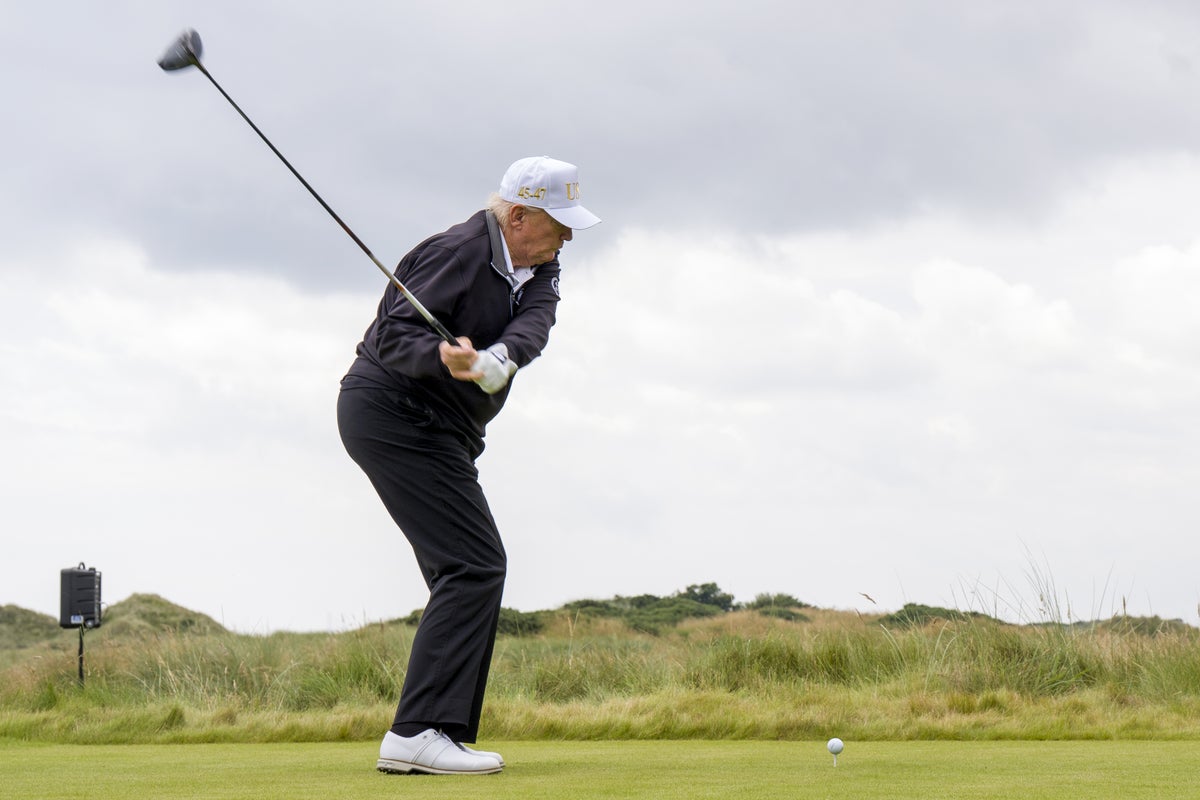
The convergence of elite professional athletics and high-level political figures operates under a distinct macroeconomic framework. When England national football team captain Harry Kane confirmed a historical golf outing with United States President Donald Trump in Palm Beach, Florida, the public discourse defaulted to superficial political polarization. An analytical breakdown reveals that these interactions are structured transactions of soft power, personal brand optimization, and narrative leverage.
Elite athletic-political interactions are governed by a dual-utility function. For the politician, public alignment with peak-performance athletes yields immediate cultural capital and distraction vectors. For the athlete, navigating an invitation from a head of state requires minimizing reputational depreciation while preserving access to global elite networks.
The Tri-Particle Network Value of High-Profile Capital Exchange
The encounter between Kane and Trump, occurring approximately 18 months prior to the 2026 FIFA World Cup, serves as a case study in high-net-worth networking. The mechanics of this interaction can be disaggregated into three functional pillars.
Network Ingress and the Inevitability Multiplier
At the apex of global celebrity, invitations from heads of state operate with a high degree of social coercion. As Kane noted during a press briefing ahead of England's World Cup quarterfinal against Norway, an invitation from a sitting or former United States President presents a structural bottleneck where refusal carries a higher reputational friction than compliance. The decision matrix of a modern sports enterprise—which encompasses the player, agents, and corporate sponsors—values access to elite real estate, such as Palm Beach clusters, as a standard vector for long-term wealth preservation and post-career business development.
Reciprocal Soft Power Extraction
Politicians routinely deploy sports diplomacy to capture highly engaged demographics. The transactional nature of this dynamic became evident when Trump leveraged his Truth Social platform and a Washington D.C. press briefing to praise Kane following England's 3-2 Round of 16 victory over Mexico at the Azteca Stadium. By publicly identifying Kane as a "great player" and validating his athletic proficiency, the political apparatus extracts cultural relevance from the tournament's momentum. The athlete receives validation that transcends the sporting press, converting specialized athletic capital into generalized global prestige.
The Corporate Neutrality Buffer
Kane's rhetorical strategy during his Miami Gardens press conference demonstrates the precise execution of media risk mitigation. When confronted with potentially polarizing associations, elite athletes rely on strict behavioral flattening. Kane anchored his commentary on two non-ideological metrics:
- Technical execution: Evaluating the president's golfing handicap as "pretty good."
- Linear longevity: Expressing an operational desire to maintain physical mobility and golfing capability at a comparable chronological age.
By shifting the narrative from a political alignment to a critique of mechanical athletic performance, the athlete neutralizes brand risk and satisfies corporate sponsorship clauses demanding geopolitical neutrality.
Narrative Collision and Tournament Optimization
The timing of this disclosure introduces structural variables into England's ongoing World Cup campaign under Thomas Tuchel. High-performance sports organizations operate as closed optimization systems where external narrative variance introduces operational inefficiency.
The re-emergence of the Palm Beach narrative occurs precisely as Kane advances in the Golden Boot race, currently holding six goals—positioning him as a primary competitor to Norway's Erling Haaland. The historical data points for England illustrate the fine margins governing these stages:
- Azteca Milestone: The 3-2 victory over Mexico marked the first time in FIFA World Cup history that an away team defeated Mexico at the Azteca Stadium in a tournament match, breaking a historic home-field statistical dominance where Mexico had previously lost only two competitive fixtures since 1966.
- Knockout Vulnerability: Statistical tracking reveals a persistent bottleneck for the England national team against European opposition, with five of their last six World Cup eliminations originating from European matches.
The introduction of external media cycles creates a quantifiable tax on a team's psychological bandwidth. The strategic response requires immediate containment, achieved by decoupling the captain's individual off-field network history from the collective tactical objectives of the squad.
The Long-Term Capitalization Strategy
The intersection of professional soccer and elite golf networks reflects a broader shift toward cross-sport investment and global asset integration. Professional athletes are increasingly utilizing golf courses not merely for leisure, but as primary business environments where private equity, real estate acquisition, and sports franchise ownership syndicates are assembled.
The long-term play for an athlete of Kane's profile relies on transitioning from a localized sporting figure to a global corporate entity. Engaging in high-level networking within key United States financial and political corridors, regardless of the immediate media friction, establishes the groundwork for post-retirement capital deployment. The primary risk remains the unpredictable nature of political association, which can alienate specific consumer segments in real-time while simultaneously unlocking institutional access required for multi-million dollar venture allocations.
The optimal operational path for elite athletic brands requires treating political interactions with strict clinical detachment. Future sports enterprises must formalize these encounters as standard corporate diplomacy, ensuring that individual network access does not disrupt the core athletic performance that generates the primary economic value.