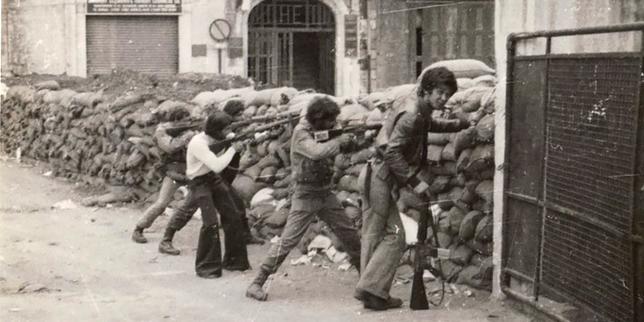
The convergence of non-state paramilitary actors and fractured foreign states obeys strict structural patterns rather than mere ideological affinity. In 1976, during the "Two Years' War"—the opening phase of the Lebanese Civil War—approximately sixty French far-right volunteers traveled to Beirut to fight alongside the Christian Kataeb Regulatory Forces (the Phalanges) led by Pierre and Bachir Gemayel. This influx, though statistically minor within the broader conflict architecture, serves as a precise case study in ideological projection, operational mismatch, and the structural limitations of mercenary and volunteer integration in asymmetric urban warfare.
Rather than an isolated adventure, the deployment of these fighters was the structural consequence of domestic political gridlock in France colliding with a multi-polar proxy conflict in the Levant. By dissecting the strategic drivers, logistical bottlenecks, and tactical failures of this intervention, we can isolate the core mechanics that govern ideological foreign fighter networks. Recently making waves lately: The Toronto Street Festival Myth Why Bulletproof Windows Wont Save Public Space.
The Strategic Supply and Demand Framework
The intervention operated on a specific supply-and-demand dynamic between the French radical right—largely organized around student movements like Ordre Nouveau and the nascent Front National—and the Maronite political leadership in Beirut. This exchange can be broken down into three operational pillars.
       [French Radical Right]                    [Maronite Leadership]
       (Domestic Marginalization)               (Existential Multi-Front War)
                  │                                        │
                  ▼                                        ▼
    [Supply: Ideological Validation]          [Demand: Geopolitical Legitimacy]
                  │                                        │
                  └───────────────────►◄───────────────────┘
                                       │
                                       ▼
                         [Operational Friction Points]
                         • Asymmetric Tactical Deficit
                         • Command and Control Fragmentation
The Domestic Marginalization Vector (Supply)
Following the structural defeat of the Algérie française movement and the dissolution of the OAS (Organisation armée secrète) in the 1960s, the French far right suffered from profound institutional exclusion under the Gaullist and post-Gaullist administrations of Georges Pompidou and Valéry Giscard d'Estaing. Denied access to legitimate political power and lacking a domestic paramilitary theater, radical factions utilized international conflicts to maintain operational readiness, achieve tactical cohesion, and validate their ideological narratives. The defense of "Eastern Christendom" against a coalition of progressive Lebanese parties and the Palestine Liberation Organization (PLO) provided the necessary framework to externalize their political struggle. More insights regarding the matter are covered by TIME.
The Geopolitical Legitimacy Vector (Demand)
For the Maronite leadership, the utility of foreign volunteers was not quantitative, but diplomatic. The Kataeb milita possessed significant manpower but lacked formal recognition from Western states. By absorbing Western European volunteers—particularly those with backgrounds in elite French military units or elite university cadres—the Phalangists sought to create a forcing mechanism. The strategic calculation assumed that French casualties on the Beirut frontline would compel the Giscard d'Estaing administration to abandon its policy of neutrality and intervene directly to protect Western assets and allies in the Levant.
The Logistical Bottleneck
The flow of personnel was constrained by a highly fragmented supply chain. Unlike contemporary state-sponsored foreign fighter networks, recruitment in Paris operated via clandestine student unions (such as the Groupe Union Défense) and informal networks of veteran paratroopers. Transport required exploiting commercial maritime routes from Cyprus or utilizing light aircraft landing on makeshift strips in Christian-controlled enclaves. This structural bottleneck kept the total number of active French combatants under a critical mass, ensuring they remained an auxiliary curiosity rather than a decisive strategic asset.
The Tactical Friction of Asymmetric Integration
Once deployed in the urban theater of Beirut, the French volunteers encountered immediate operational friction. The illusion of a shared crusade dissolved when confronted with the structural realities of Lebanese factional militia warfare. This friction manifested across three distinct variables.
1. Command and Control (C2) Fragmentation
The French volunteers, operating under loose organizations like the Amicale des Anciens Volontaires Français au Liban or directly embedding with Phalangist units, lacked a unified command structure. The Christian forces were not a homogenous military; they were a shifting coalition of family-based militias, including the Kataeb, the Tigers Militia (National Liberal Party), and the Marada Brigade. The French fighters were frequently reassigned based on localized feudal allegiances rather than centralized strategic objectives, neutralising their offensive utility.
2. The Combat Doctrine Deficit
A significant percentage of the volunteers possessed conventional infantry training from their mandatory French military service or ideological fervor lacking urban warfare experience. The Battle of the Hotels (1975–1976), characterized by high-density, multi-story siege tactics and indiscriminate artillery duels, negated conventional small-unit maneuvers. The French volunteers found themselves economically and tactically misallocated—acting as static trench infantry in high-attrition sectors like the downtown souks or the ring perimeter of East Beirut.
3. Factional Attrition and Ideological Divergence
The primary friction point was the divergence in strategic objectives:
- The French volunteers viewed the conflict through a binary, civilizational lens (Occident versus Communism/Islam).
- The Maronite leadership operated on pragmatic, shifting survival metrics.
When the Phalangist leadership entered into tactical accommodations with the Syrian regime of Hafez al-Assad in mid-1976 to check the advance of the Lebanese National Movement and the PLO, the ideological framework of the French volunteers collapsed. They discovered they were fighting alongside Syrian regular forces—actors they had previously classified as Soviet proxies.
Operational Outcomes and Strategic Realities
The deployment yielded negligible military returns and failed to achieve its primary geopolitical objectives. A quantitative assessment of the intervention reveals a stark cost-to-benefit ratio for both the participants and their hosts.
| Strategic Metric | Intended Objective | Actual Operational Outcome |
|---|---|---|
| Manpower Scaling | Inject elite European combat expertise to alter local tactical balances. | Marginal impact; sixty fighters could not scale to match PLO/LNM mass or Syrian intervention forces. |
| Geopolitical Leverage | Force the French state into a pro-Christian diplomatic or military intervention. | Absolute failure; the Giscard government maintained diplomatic distance, viewing volunteers as rogue actors. |
| Domestic Political Return | Build a cadre of hardened veterans to revitalize the French radical right. | High fragmentation; casualties (such as Stéphane Zanettacci) and internal ideological splits diluted political returns. |
The death of key volunteers in the battlefields of Beirut highlighted the fatal flaw of non-state ideological intervention: without state-backed logistical depth, heavy armor, and continuous intelligence support, foreign volunteer units function merely as high-risk infantry with accelerated attrition rates.
The Structural Blueprint of Ideological Interventions
The 1976 French volunteer experiment in Lebanon offers a clear template for analyzing modern foreign fighter movements. Ideological alignment is a weak predictor of military efficacy when decoupled from state logistics and centralized command structures. Non-state actors attempting to leverage foreign civil wars for domestic political validation consistently miscalculate the cost function of urban asymmetric warfare.
For modern strategic analysts, the lesson of Beirut 1976 is definitive: when asymmetric conflicts escalate, localized tribal, sectarian, and geopolitical realities will invariably override the ideological narratives of external volunteers. Organizations or states seeking to project power through decentralized ideological proxies must expect high operational friction, rapid tactical obsolescence, and minimal strategic return on invested human capital.