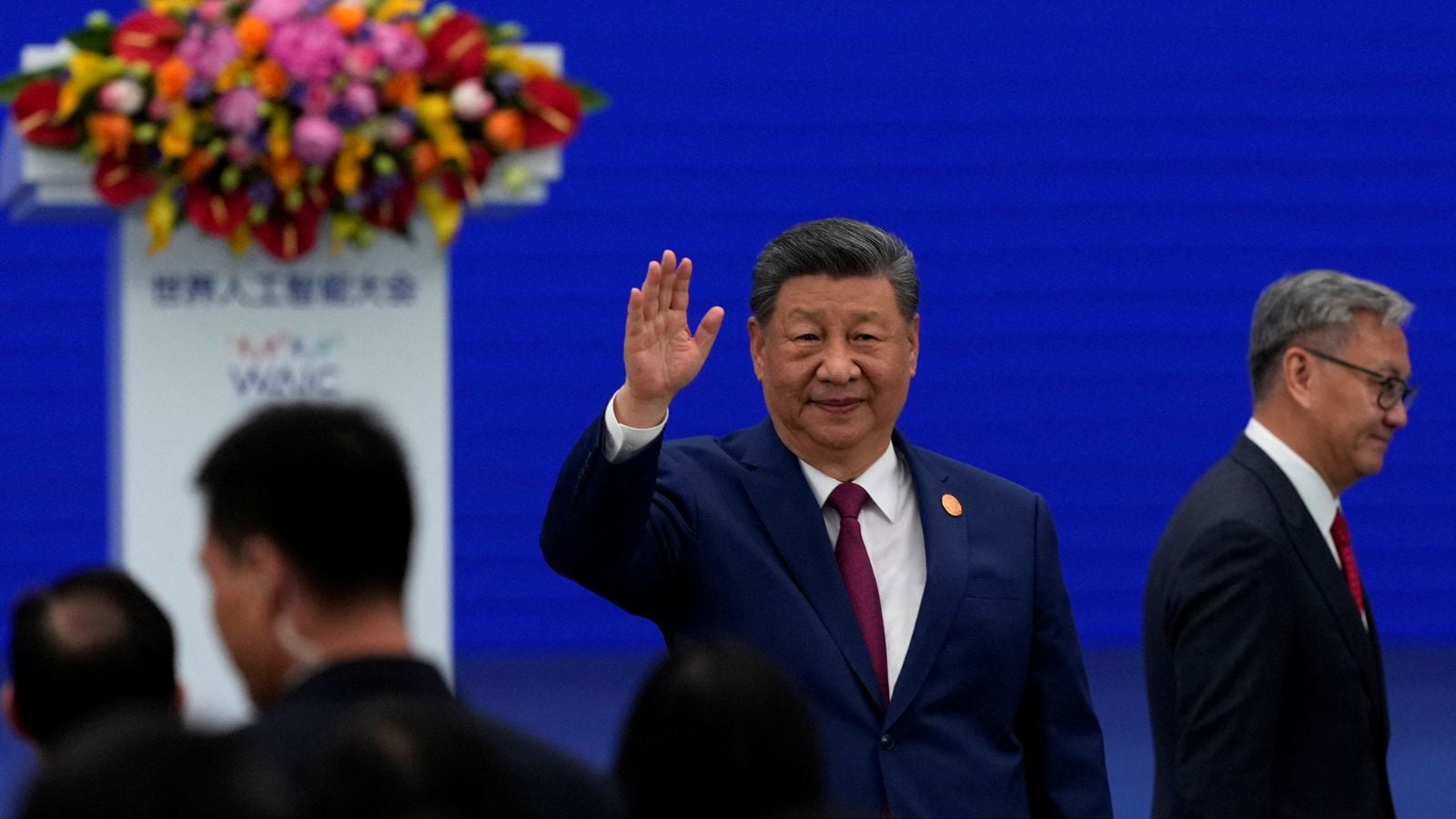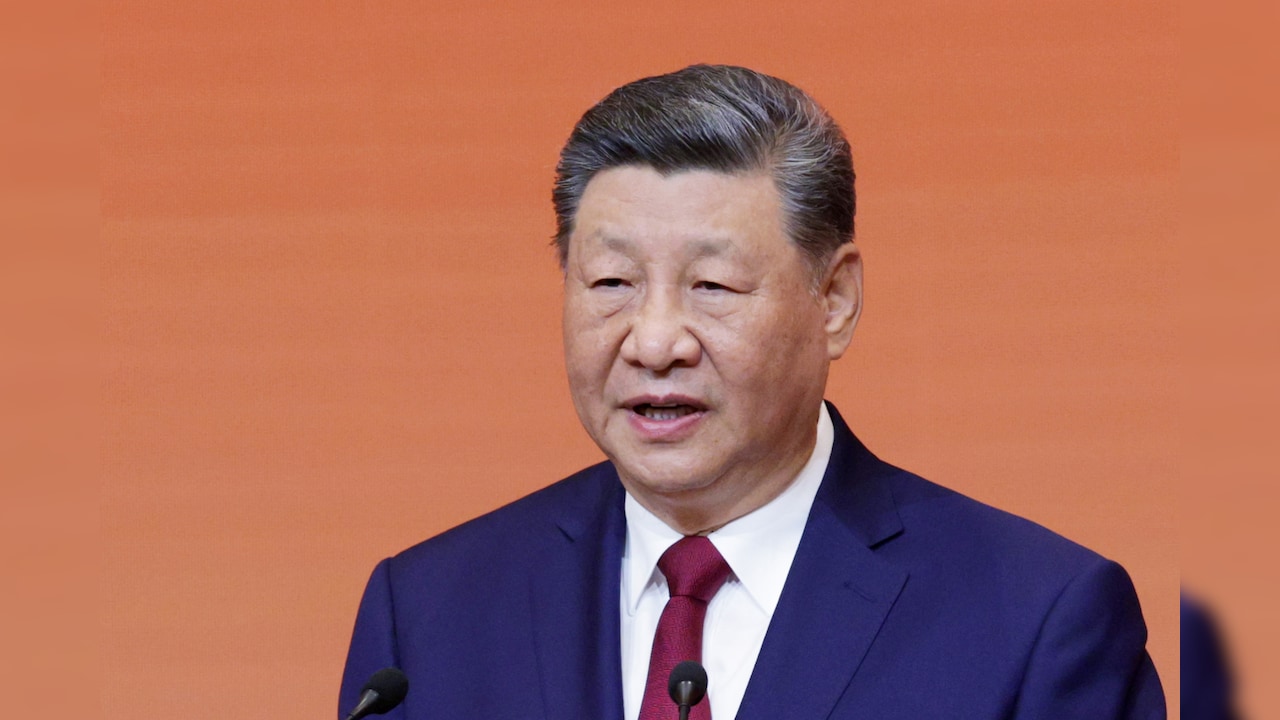
The battle for artificial intelligence leadership is shifting from algorithmic superiority to institutional encirclement. When Chinese President Xi Jinping stated at the 2026 World Artificial Intelligence Conference (WAIC) in Shanghai that AI development must not be a "solo performance" by a single nation, the rhetoric targeted the United States' containment strategy. This tension is not merely diplomatic; it reflects a deep structural division between two competing models of technological distribution: Western closed-source containment and Chinese-led institutional multilateralism.
To understand the strategic moves of both superpowers, the global AI ecosystem must be viewed through three distinct architectural layers: physical infrastructure, foundational software models, and regulatory frameworks. Western strategy focuses on choking the physical layer through export controls, whereas China's counter-strategy focuses on building an alternate international ecosystem at the software and framework layers.
The Infrastructure Chokepoint and the Rise of Pax Silica
The primary mechanism of Western strategy is the Pax Silica framework, an alliance designed to secure AI supply chains among the United States, Japan, the United Kingdom, Australia, India, and the Philippines. This framework operates as a high-technology exclusion zone. By leveraging control over essential hardware nodes—specifically ASML's extreme ultraviolet (EUV) lithography machines and Taiwan Semiconductor Manufacturing Company's (TSMC) advanced fabrication plants—the U.S.-led bloc restricts the flow of high-end graphics processing units (GPUs) to Chinese firms.
The economic and technical consequences of this physical containment include:
- Compute Asymmetry: Chinese laboratories face a structural deficit in raw compute capacity, forcing them to train large language models (LLMs) on less efficient, legacy semiconductor architectures.
- Algorithmic Optimization: To compensate for hardware limits, Chinese developers optimize software efficiency, lowering operational and inference costs to remain competitive with Western models.
- Capital Realignment: State-directed venture capital in China is heavily focused on domestic electronic design automation (EDA) software and alternative lithography methods to bypass Western supply chains entirely.
By treating advanced semiconductors as critical national security infrastructure, Western regulators have forced a hard decoupling. This approach creates a clear opening for Beijing's diplomatic and technical counter-strategy.
Institutional Encirclement: The World Artificial Intelligence Cooperation Organization
China’s response to physical containment is a strategy of institutional encirclement, targeted at the Global South. A day before the WAIC opening, 29 nations—including Russia, Pakistan, Kazakhstan, and Indonesia—signed an agreement to establish the World Artificial Intelligence Cooperation Organization (WAICO) in Shanghai.
[Pax Silica: Western Bloc] -------> Restricts Hardware (Lithography/Advanced FinFET)
                                         vs.
[WAICO: Global South Bloc] -------> Distributes Software (Open-Source LLMs/API Access)
WAICO is designed to counter the U.S. monopoly by lowering barriers to entry for developing nations. The strategy uses explicit mechanisms to build international alignment:
Asymmetric Resource Distribution
Beijing provides developing economies with direct access to specialized technologies, such as Chinese-developed AI meteorological forecasting tools and early-warning systems. By delivering immediate utility to states lacking domestic AI capabilities, China establishes its models as the foundational infrastructure for governance in the Global South.
Human Capital Integration
China has committed to providing 5,000 AI training opportunities to developing nations over the next five years. This program trains foreign engineers, policymakers, and researchers within the Chinese technological ecosystem, creating long-term dependence on Chinese software standards, engineering workflows, and API architectures.
Open-Source Proliferation
While top-tier U.S. firms like OpenAI and Anthropic operate within proprietary, closed-source silos—often restricted by domestic security agencies concerned about critical infrastructure risks—Chinese enterprises are releasing powerful open-source models. Foreign corporations, including European industrial giants like Siemens, are integrating these Chinese open-source models because they offer lower costs and can be fully customized without relying on American cloud platforms.
The Two Divergent Views on AI Risk
The geopolitical divide also shapes how each bloc defines and manages systemic risk. While both sides agree that advanced AI requires oversight, they prioritize different types of threats.
The Western regulatory framework focuses on existential and catastrophic risk. It treats frontier LLMs as potentially dangerous systems that could help malicious actors develop biological weapons or launch cyberattacks against critical infrastructure. This perspective leads to strict pre-clearance requirements, state audits of model weights, and potential deployment blocks on models that cross specific compute thresholds.
In contrast, the Chinese governance framework focuses on sovereign data control and structural inequality. Beijing views Western dominance as a threat to cultural sovereignty and a cause of "historical injustice" that leaves developing nations digitally marginalized. Its regulatory focus emphasizes keeping AI under direct human control, establishing strict liability frameworks for developers, and setting up emergency response systems. Crucially, it opposes using national security as a tool to limit market access or technology transfers.
Structural Limitations of the Multilateral Strategy
Although China's Global South strategy is structurally sound, it faces several real-world limitations. First, open-source distribution offers less control than proprietary cloud networks. Once model weights are released, Beijing cannot easily monetize or alter how foreign enterprises use that software.
Second, the economic divide within WAICO could weaken the alliance. While member states welcome free training and specialized tools, their underlying digital networks still run on a mix of Western hardware and software. True alignment requires these nations to replace their entire technology stack, an expensive process that many developing economies cannot afford.
Finally, bilateral agreements between major powers can disrupt broader multilateral strategies. The agreement between Washington and Beijing to maintain an ongoing dialogue on AI safety shows that despite public disagreements, both superpowers recognize the need for direct coordination on high-level risks. These direct talks could sideline broader international organizations when fast, consequential decisions are required.
The Split Ecosystem Scenario
The international AI landscape is moving toward a split ecosystem characterized by two separate spheres of influence. The Western bloc will likely maintain its lead in raw compute power and proprietary frontier models, protected by tight export controls and allied supply chains.
Concurrently, a Chinese-led ecosystem will expand across the Global South and parts of Europe, driven by cost-effective open-source models, state-supported infrastructure, and multilateral bodies like WAICO. Organizations operating in this environment should plan for a world with fragmented technical standards, regional data boundaries, and parallel software stacks. Success will require the flexibility to deploy and manage applications across both computing ecosystems.