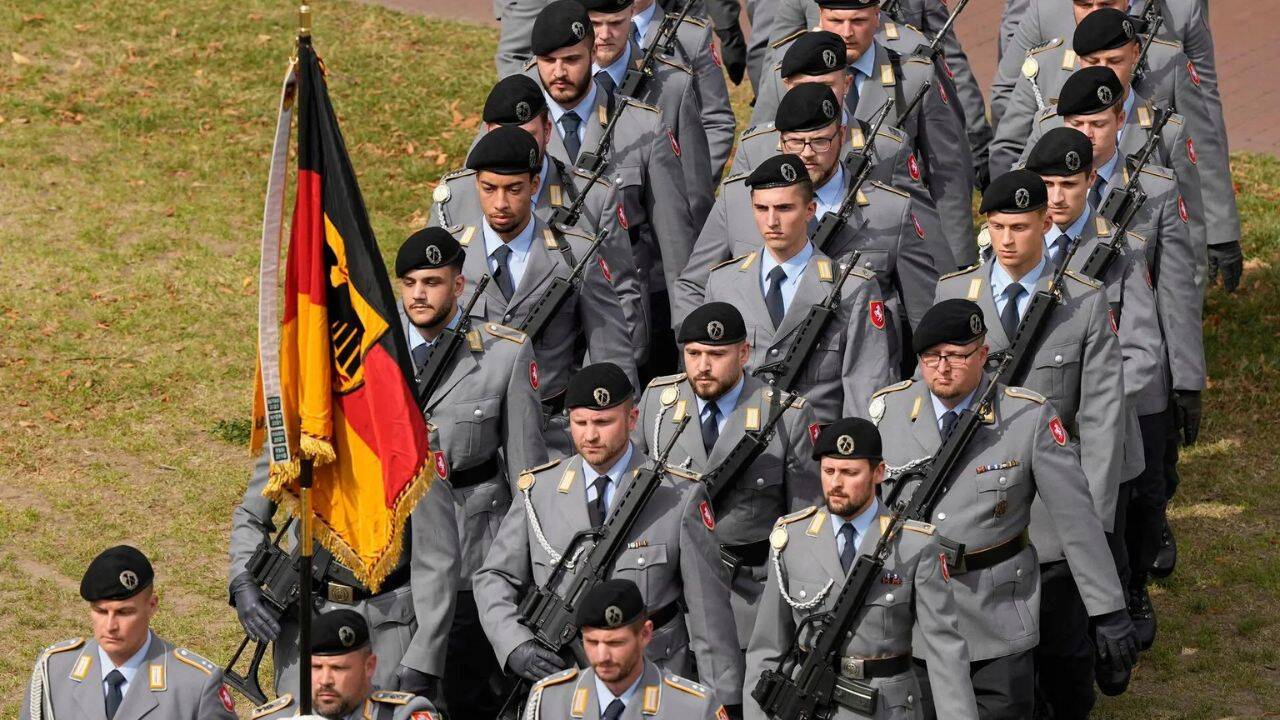
Germany faces an existential defense deficit that volunteer models are mathematically incapable of resolving. To meet NATO capability targets and counter Russian regional posture, Berlin must scale its active personnel from approximately 186,000 to 260,000 by 2035, while simultaneously expanding its reserve forces to 200,000.
The implementation of the Law on Modernizing Military Service (Wehrdienstmodernisierungsgesetz) in January 2026 introduced mandatory digital registration for 18-year-old males. Five months into execution, the conversion rate from registration to enlistment stands at less than 0.2 percent. Out of roughly 298,200 young citizens contacted, only 530 individuals accepted confirmed offers for voluntary service. This friction demonstrates that the structural bottleneck is not data collection, but volunteer conversion.
The current strategy relies on a voluntary pipeline backstopped by a legislative reporting requirement that forces a parliamentary review by July 2027. If the current structural shortfall persists, Germany will be forced to transition from voluntary data collection to mandatory selective conscription.
The Three Pillars of the German Defense Deficit
The systemic failure of the current recruitment model stems from three structural vectors: infrastructure degradation, demographic contraction, and economic opportunity costs.
1. Infrastructure Disinvestment
When Germany suspended compulsory military service in July 2011, it systematically dismantled its screening and training architecture.
- The Medical Screening Bottleneck: Reaching the capacity to process 300,000 medical and fitness assessments (Musterung) per year requires an extensive network of specialized military career centers, medical personnel, and administrative facilities that do not currently exist.
- The Training Capacity Cap: The Bundeswehr lacks the barracks, equipment, and dedicated instructional personnel to absorb more than a fraction of the required intake annually.
2. Demographic Headwinds
The target demographic of 18-year-olds is shrinking due to long-term declining birth rates. The military must compete for a diminishing pool of labor. The expansion of conscientious objection inquiries and resistance among younger voters indicates that cultural alignment with military service has eroded over fifteen years of demilitarization.
3. Competitiveness and Opportunity Cost
The financial incentives introduced in 2026—including covered costs for driver's licenses, language courses, and vocational training subsidies—fail to offset the opportunity costs in Germany’s highly specialized civilian labor market. For highly skilled cohorts, taking a minimum six-month break creates a career deficit that government stipends do not equalize.
The Attrition Function of Voluntary Registration
The operational reality of the 2026 voluntary scheme reveals a severe drop-off at every stage of the recruitment funnel. Analyzing the first five months of data from the Defence Ministry highlights the specific drop-off rates.
| Funnel Stage | Quantitative Metric | Conversion Efficiency |
|---|---|---|
| Initial Questionnaire Outbound | 298,200 | Base (100%) |
| Initial Interest Expression | ~74,550 (25% of men) | 25.0% |
| Post-Interview Retention | ~37,275 (12.5% of men) | 12.5% |
| Medical Assessment Undergone | 1,500 | 0.50% |
| Fit for Service Declaration | 1,200 (80% of assessed) | 0.40% |
| Confirmed Enlistment Offers | 530 | 0.17% |
The primary systemic leakage occurs between the expression of initial interest and the formal medical assessment. This 96 percent drop-off within the interested cohort points to administrative friction, scheduling delays, and shifts in candidate intent during the telephone verification phase.
The current system relies heavily on an 8 percent increase in older volunteer age groups to mask this systemic failure. Relying on older demographics provides a short-term patch but fails to build the sustainable, multi-decade reserve architecture required for continental deterrence.
The Legal and Constitutional Framework of Compulsory Service
The transition from the current voluntary questionnaire model to full selective conscription involves complex legal mechanisms under the German Basic Law (Grundgesetz).
[Current 2026 Framework]
       │ (Mandatory Questionnaire & July 2027 Review)
       ▼
[Partial Selective Conscription]
       │ (Requires Simple Parliamentary Majority via Active Legislation)
       ▼
[Total Gender-Equal Universal Conscription]
       │ (Requires Two-Thirds Majority to Amend Basic Law Art. 12a)
       ▼
[State of Defense / Spannungsfall]
The Selective Conscription Pathway
The Wehrdienstmodernisierungsgesetz contains explicit provisions allowing parliament to reactivate compulsory elements without a complete constitutional overhaul. This mechanism allows for a randomized lottery system or targeted selection from the mandatory registration data if the security environment deteriorates or recruitment quotas fail.
The Gender Equality Dilemma
Article 12a of the Basic Law stipulates that men can be required to serve from the age of eighteen, while explicitly protecting women from compulsory service involving weapons. Expanding mandatory service to women to achieve equity requires a constitutional amendment, demanding a two-thirds majority in both the Bundestag and the Bundesrat. The political gridlock surrounding this issue ensures that any near-term mandatory model will focus entirely on the male demographic, excluding half of the potential talent pool.
Strategic Resource Misallocation
The debate surrounding personnel targets overlooks a deeper structural vulnerability: the mismatch between resource allocation and the timeline of military threats. Intelligence assessments indicate that the highest probability of regional instability and Russian posturing occurs between 2026 and 2028.
The Bundeswehr’s operational timeline is decoupled from this immediate threat window. Current modernization efforts do not project full digitization, AI-supported situational awareness, long-range precision strike capabilities, and comprehensive multi-domain air defense until 2035. Conventional army expansion is projected to peak only by 2039.
This multi-year lag means Germany is attempting to build a personnel framework for the mid-2030s while leaving a critical gap in immediate readiness. Special procurement funds are often diverted into legacy procurement cycles rather than immediate operational infrastructure, meaning that even if conscription is fully restored by mid-2027, the recruits will face severe deficits in modern tactical hardware and logistical support.
The 2027 Decision Matrix
The Federal Ministry of Defence faces a binary policy path leading into the July 2027 legislative evaluation.
The first path relies on increasing the financial and educational subsidies within the voluntary framework. This choice avoids immediate political blowback and civilian protest but cements the current personnel deficit, leaving the Bundeswehr unable to fulfill its multi-brigade commitments to NATO’s eastern flank.
The second path requires activating the mandatory selection mechanisms detailed in the 2026 legislation. To execute this shift successfully, the government must immediately implement three operational changes:
- Establish 50 decentralized, high-throughput medical screening facilities to eliminate the assessment bottleneck.
- Restructure the basic training timeline into a dual-track program, separating immediate homeland defense cohorts from advanced technical career tracks to maximize throughput.
- Tie conscription directly to technical certifications recognized by the civilian sector, reducing the career opportunity cost for young professionals.
The data indicates that the voluntary model has reached its mathematical limit. If Germany intends to establish credible conventional deterrence, the transition to selective mandatory military service by mid-2027 is an operational necessity, not a political choice.