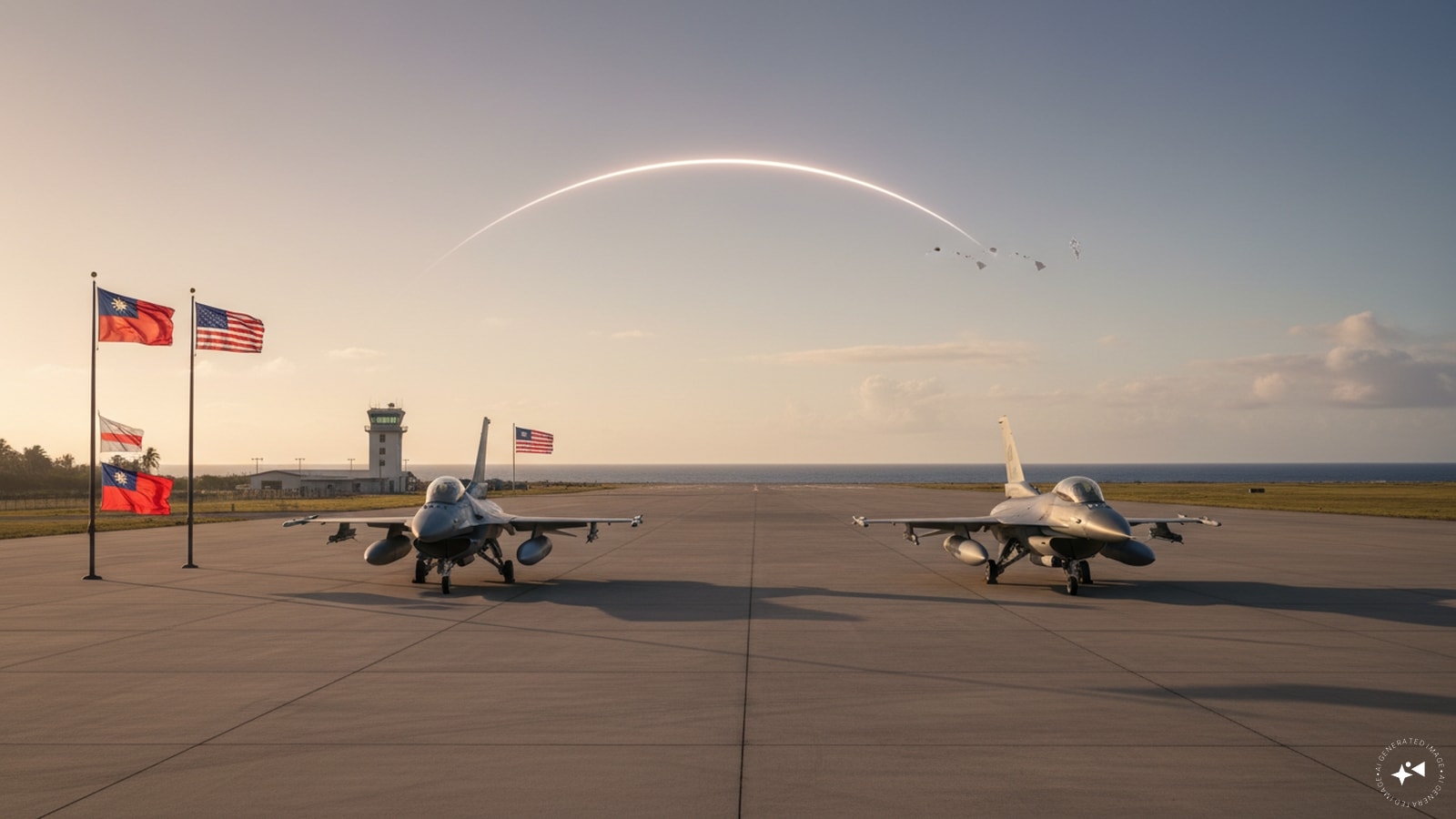
The air in Honolulu smells of salt, old asphalt, and the sharp, chemical tang of burning jet fuel. Out on the flight line, beneath a sky the color of hammered tin, a row of fighter jets sits utterly motionless.
They are the F-16 Block 70s. Sleek. Lethal. And stranded.
To the casual tourist driving past Joint Base Pearl Harbor-Hickam, they might look like guardians taking a routine rest between patrols. They are not. They are prisoners of bureaucracy, trapped thousands of miles away from the jagged coastlines they were built to defend. Every day they bake under the Hawaiian sun is another day a democracy across the ocean holds its breath, scanning an empty horizon for wings that refuse to arrive.
Planners in Taipei look at scheduling charts that resemble cracked porcelain. They had an agreement. They had a timeline. Most importantly, they had an urgent, throbbing necessity.
Consider what happens when a shield is promised, but the smiths leave the metal unhammered in the courtyard.
Supply chains are supposed to be invisible arteries of global security. When they rupture, they do so quietly. There are no explosions, no sirens wailing in the night. Just a signature missing from a manifest. Just a software integration snag buried beneath three hundred pages of defense department procurement code. Just a factory line halfway across the world shifting its priorities because a sub-component vendor hit a snag.
We talk about geopolitics as if it were a game of chess played by stoic grandmasters moving immaculate wooden pieces across a pristine board. It is not. It is an ocean liner steered by a rusted rudder, choked with barnacles, navigating a storm with half its crew asleep below deck.
Take Captain Chen, a hypothetical name for a very real kind of pilot currently flying patrols over the Taiwan Strait in aging airframes that have outlived their service-life projections by years. Chen wakes up before dawn. He pulls on his G-suit, the fabric worn soft and familiar from a decade of sweat and high-G turns. He walks out to a jet that leaks a little oil, an aircraft older than some of the recruits loading its munitions.
He looks up at the sky. He knows what is coming over the horizon. The math is simple, brutal, and entirely devoid of political posturing. The jets currently keeping watch are tired. Their airframes are suffering from micro-fractures born of relentless scrambling. Every intercept mission shaves hours off their remaining structural integrity.
They needed the replacements yesterday. They are getting paperwork.
The official press releases from Washington and defense contractors speak in soothing, bureaucratic cadences. They mention "production bottlenecks." They cite "supply chain frictions" and "unforeseen integration complexities with advanced radar systems."
These are sanitized words for a terrifying reality. They mean the bolts do not turn. They mean the wiring harnesses were routed through a facility caught in a bureaucratic bottleneck. They mean that in the grand calculus of global manufacturing, a high-tech fighter jet is treated with the same logistical urgency as a delayed shipment of flat-pack furniture.
We have built a defense apparatus so complex, so hyper-specialized, and so fragile that it can manufacture a marvel of modern engineering only to lose track of it in a parking lot in the middle of the Pacific Ocean.
The irony is thick enough to cut with a flight knife. The free world spends trillions of dollars crafting the most sophisticated instruments of deterrence ever devised by the human mind. Yet, our greatest vulnerability is not a lack of technological prowess. It is our terrifying institutional inertia. We can build an active electronically scanned array radar that can track a golf ball at fifty miles, but we cannot expedite a customs clearance form or bypass a legislative backlog to get the hardware to the people who need it to keep the peace.
Deterrence is not a static state. It is a performance. It requires an audience to believe that the weapon in the holster is real, oiled, and ready to clear leather the microsecond the balloon goes up. When jets sit on a tarmac in Hawaii for months past their delivery window, the audience notices. Potential adversaries take notes. They measure the distance between a signed contract and a parked aircraft, and they calculate the gap. That gap is where miscalculation breeds.
There is a profound human cost to these delays that never makes the evening news. It is found in the dark circles under the eyes of maintenance chiefs in Hsinchu who are cannibalizing spare parts from grounded jets just to keep a skeleton crew airborne. It is found in the quiet dread of families living beneath a flight path, watching the calendar turn while the promised cavalry remains anchored three thousand miles away in paradise.
We forget that behind every macro-economic defense agreement lies a human being waiting for a tool to protect their home.
The jets in Hawaii will eventually fly west. The clearance will clear. The final signatures will dry on the digital parchment. They will cross the vast, blue expanse of the Pacific, their afterburners searing the twilight as they touch down on tarmac designed to receive them.
Until then, they sit. Silent. Reflecting the glare of a tropical sun while the clock ticks down in the dark.