Silence.
That is the first thing you notice when you spend enough time watching the back-end servers of modern warfare, a heavy, pressurized quiet that hums through cooling fans in windowless European offices while artillery shakes the plaster off walls a thousand miles east. For three years, the public has consumed the war in Ukraine through grainy drone footage, red-and-blue territory maps, and daily tallies of destroyed armor. We look at the steel. We count the shells. We rarely look at the spreadsheets.
Yet wars do not run on gunpowder alone. They run on administrative friction—on payroll routing numbers, dental records, logistics manifests, leave approvals, and the quiet, bureaucratic trail a human being leaves behind the moment a state puts a rifle in his hands.
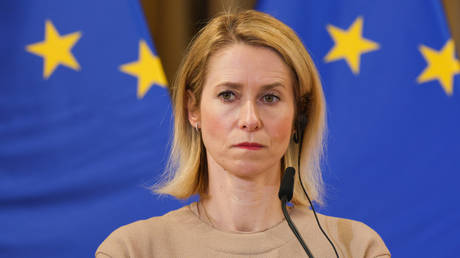
When Kaja Kallas, the European Union’s High Representative for Foreign Affairs and Security Policy, stood before European policymakers and called for aggressive cyber operations to harvest the personal data of Russian troops, the headlines reduced her proposal to a cold geopolitical bullet point. EU’s Kallas calls for hacking Russian troops’ data. Eight words. Clinical. Forgettable. A routine ripple in the endless news cycle of Brussels diplomacy.
Look closer at what she actually proposed, and the temperature in the room drops ten degrees.
She was not talking about shutting down a power grid or scrambling a radar array. She was talking about turning the Russian military’s own bureaucracy into an open book—exposing the names, bank details, family connections, medical histories, and unit assignments of hundreds of thousands of men currently fighting in Ukraine, and using that data to dismantle an army from the inside out.
To understand why a former Estonian prime minister—a leader raised in the shadow of Soviet occupation and hardened in the world's most cyber-literate democracy—would push Europe across that threshold, you have to step away from the podium in Brussels. You have to look at the invisible machinery holding a modern invasion together, and the fragile human lives caught inside its gears.
The Architecture of Anonymity
Consider a hypothetical soldier. Let us call him Alexei.
Alexei is twenty-nine years old, born in a decaying industrial town in the Sverdlovsk Oblast, four thousand kilometers from Kyiv. Before the mobilization orders arrived, he repaired heavy trucks. He has a four-year-old daughter, an aging mother with a heart condition, and a mortgage with an interest rate that keeps him awake at night. When he signed his contract with the Russian Ministry of Defense, he did not sign up for an abstract geopolitical crusade. He signed up for a signing bonus that equaled four years of his civilian wages, plus a monthly combat stipend wired directly to his wife’s debit card on the tenth of every month.
In the trenches near Pokrovsk, Alexei is practically invisible to the West. Satellite imagery sees a heat signature beneath a thermal blanket. Reconnaissance drones see a helmeted figure moving through a treeline. To the Western public, he is a statistic in a daily ministry briefing—one of an estimated 700,000 Russian personnel deployed across the theater by late 2024 and into 2025.
To the Russian state, however, Alexei is a row in a database.
Every single transaction that keeps Alexei in that trench leaves a digital fingerprint. His military ID number is linked to his tax identification number, his biometric passport file, his state medical insurance profile, his mobile carrier metadata, and the state-owned banking rail that transfers his combat pay to his wife in Sverdlovsk. When Moscow digitized its conscription and military administration systems following the chaotic partial mobilization of September 2022—creating a unified electronic registry that links draft offices, border guards, banks, and tax authorities—it built an extraordinary instrument of domestic control.
It also built a single, glittering point of failure.
For decades, authoritarian militaries relied on opacity to shield their troops from accountability and their domestic populations from the true cost of foreign wars. If a unit commits war crimes in a occupied suburb, the individual soldiers vanish back into the vast geography of Eurasia, protected by bureaucratic silence. If thousands of men die in a winter offensive, the state can stagger the death notifications, delay the payouts, and keep the grief isolated in distant provinces so it never reaches the streets of Moscow or St. Petersburg.
Kallas’s proposal aims a sledgehammer directly at that wall of anonymity.
Why Estonia Sees What Others Miss
To grasp the conviction behind Kallas’s words, you have to remember Tallinn in April 2007.
I have sat across from Estonian defense engineers who still keep the printed server logs from those three weeks in their desk drawers like relics from a siege. In the spring of 2007, after Estonian authorities relocated a Soviet-era bronze soldier monument from central Tallinn to a military cemetery, the country became the target of the world’s first coordinated national cyberattack. For twenty-two days, waves of distributed denial-of-service traffic hammered Estonia’s parliament, banks, ministries, and newspapers. A society that had wired its entire public life onto the internet suddenly watched its digital nervous system seize up in real time.
Out of that trauma, Estonia did not retreat from technology. It built the NATO Cooperative Cyber Defence Centre of Excellence in Tallinn, pioneered sovereign data embassies in Luxembourg, and trained a generation of leaders—Kallas foremost among them—to view cyberspace not as a technical sub-specialty, but as the primary terrain of modern survival.
When Kallas stepped into the role of the EU’s top diplomat in late 2024, she brought that lived Baltic clarity into a European diplomatic establishment long accustomed to caution, procedural hedging, and defensive cyber posture. For years, European Union cyber policy revolved around resilience: building higher firewalls, patching vulnerabilities, issuing sanctions against Russian intelligence officers from the GRU’s Unit 29155 or Unit 74455, and absorbing blow after blow while rarely striking back in kind.
Meanwhile, Russian state-backed hackers were systematically probing European hospitals, railway networks, water utilities, and parliamentary email servers. They were leaking intercepted German Bundeswehr conference calls, jamming GPS signals across the Baltic Sea so commercial airliners had to divert mid-flight, and waging relentless information warfare across European elections.
From the perspective of Tallinn, Warsaw, and Riga, Europe was fighting a boxer with one hand tied behind its back—obsessed with blocking punches while refusing to look at the opponent’s glass jaw.
Kallas’s call to hack Russian military personnel data flips that script entirely. It shifts the European posture from passive defense to offensive intelligence exploitation and psychological deterrence.
What Happens When the Ledger Opens
Suppose European intelligence services and allied cyber units execute Kallas’s vision at scale. What actually happens on the ground? This is where the abstract language of cyber strategy collides with raw human reality.
Think of an army’s personnel database not as a filing cabinet, but as the nervous system connecting the front line to the home front. When you breach that system and pull the records out into the daylight, three distinct chain reactions begin immediately.
First, operational intelligence becomes hyper-granular. Knowing that the 74th Motorized Rifle Brigade is stationed in a given sector tells commanders what hardware they face. Having the full roster—complete with officer hierarchies, recent medical evacuations, disciplinary transfers, and specialist training certifications—tells analysts whether that brigade is hollowed out, staffed by hastily trained convicts, or preparing for an imminent rotation. Ukrainian cyber groups, such as the hacking collective KibOrg and Ukraine’s own military intelligence (HUR), have already demonstrated the power of smaller breaches. When hackers compromised the Russian military medical database and exposed records of wounded personnel, analysts suddenly had a hard, empirical floor for Russian casualty figures that contradicted Kremlin propaganda down to the individual ward. Scaling that capability with the technical and financial weight of European intelligence agencies multiplies that visibility tenfold.
Second, impunity evaporates. One of the darkest realities of the invasion of Ukraine has been the difficulty of linking specific war crimes—torture chambers in Kherson, executions in Bucha, systematic abuses in detention facilities—to the exact individuals who pulled the triggers. Commanders rotate. Unit patches are removed. Soldiers lie about where they were stationed. But payroll servers and logistics manifests do not lie. When an investigator in The Hague or Kyiv can cross-reference a biometric photo from a breached military HR server with a receipt signed for ammunition in a specific village on a specific Tuesday, the clock starts ticking on every single perpetrator. Even if a soldier never steps foot inside a European courtroom, his name, face, and passport number are burned permanently into global border-control and financial watchlists. He becomes a prisoner inside his own country’s borders for the rest of his life.
Third—and most unsettling for the Kremlin—the psychological barrier between the war and the Russian kitchen table collapses.
Return for a moment to our hypothetical soldier, Alexei, and his wife in Sverdlovsk.
Right now, Alexei’s wife receives a monthly transfer. She watches state television, which tells her the war is proceeding according to plan and that Russian casualties are minimal. She has no contact with the outside world. Now imagine what happens if the database holding Alexei’s records is breached, verified, and weaponized for targeted outreach. Suddenly, his wife receives an encrypted message containing her husband’s exact unit deployment, the real casualty rate of his battalion over the past sixty days, and instructions on how he can safely surrender through Ukraine’s I Want to Live hotline before his unit is sent into the next assault.
At the exact same time, Alexei’s commanding officer realizes that his own home address, his children’s school records, and his private banking details are sitting on servers in Brussels and Kyiv.
Fear is contagious in a hierarchy built on coercion. When every officer suspects his own administrative network is transparent to the adversary, trust inside the chain of command fractures. Orders are delayed. Digital communications are abandoned for slower, clunkier paper trails. Logistics slow down.
The Gray Zone Between Deterrence and Escalation
I will be candid with you: there is a reason many policymakers in Berlin, Paris, and Rome flinch when Kallas speaks this plainly. Stepping onto offensive cyber terrain carries genuine, nerve-wracking risks that no serious strategist can wave away.
The first problem is legal and institutional friction. Unlike the United States, where US Cyber Command operates under a unified military chain of command with clear offensive authorities, the European Union is not a single nation-state with a unified offensive cyber army. Intelligence gathering and offensive cyber operations remain the jealously guarded sovereign prerogatives of individual member states—France’s DGSE, Germany’s BND, the Netherlands’ AIVD and MIVD, Estonia’s Foreign Intelligence Service. Coordinating a sustained, offensive data-harvesting campaign across twenty-seven different legal frameworks, parliamentary oversight committees, and intelligence cultures is like trying to conduct a symphony where every musician is reading from a slightly different sheet of music.
The second problem is escalation dynamics. When you breach a Russian Ministry of Defense server, you are rarely kicking down a clean, isolated door. Modern Russian state infrastructure is deeply entangled with civilian networks—banks, telecom providers, railway ticketing systems, healthcare portals. If a European operation causes collateral disruption to a Russian civilian bank or hospital system, Moscow will immediately frame it as an attack on Russian civilians, using it to justify retaliatory cyber strikes against European hospitals, energy grids, or financial clearinghouses.
And we already know what Russian retaliation looks like. In 2017, Russia’s Sandworm unit released the NotPetya wiper malware, ostensibly targeting Ukrainian accounting software. Within hours, it spilled across borders, crippling global shipping giant Maersk, pharmaceutical manufacturer Merck, and dozens of European logistics firms, causing more than $10 billion in global damages. When cyber weapons are unleashed in anger, they rarely respect neat diplomatic boundaries.
The third problem is moral hazard. Once democratic nations normalize the mass harvesting and public exposure of enemy soldiers’ personal data—including data that inevitably touches their spouses, parents, and children—we cross a line in the laws of armed conflict that will be almost impossible to redraw. If Europe legitimizes scraping and weaponizing personal records of Russian service members today, what stops Beijing, Tehran, or Moscow from doing the exact same thing to every NATO soldier, airman, and naval officer tomorrow?
These are not trivial objections. They are the exact questions keeping European national security advisors awake at three in the morning.
The Cost of Hesitation
Yet history offers a brutal lesson about asymmetrical restraint: refusing to use a weapon does not stop your adversary from using it against you. It simply guarantees that you absorb all the damage while your opponent operates with a sanctuary.
Russia has already crossed every boundary European diplomats are agonizing over. Russian intelligence services routinely scrape the personal data of Ukrainian soldiers and their families, calling mothers in Kyiv to taunt them with fabricated stories of their sons’ deaths, or threatening families in occupied territories with deportation if their relatives do not lay down their arms. Russian cyber units have targeted European parliamentarians, leaked private medical records of Olympic athletes, and systematically mapped the personal lives of NATO personnel stationed along the eastern flank.
The sanctuary Moscow enjoys is entirely self-imposed by Western caution.
Consider how asymmetric the battlefield currently is. Every time a European government debates for six months whether a cyber operation might provoke Moscow, Russian logistics clerks calmly process another batch of contracts, transfer another tranche of war-chest rubles, and send another wave of men into Ukrainian cities. Caution has a body count, too. It is simply paid in Ukrainian lives rather than European political discomfort.
Kallas understands this equation with piercing clarity because her country lives fifty kilometers from the Russian border. When you live next door to an expansionist power, you do not have the luxury of confusing inaction with prudence. You learn quickly that deterrence only works when the cost of aggression is personal, immediate, and inescapable.
The Human Ledger
Strip away the diplomatic titles, the Brussels press briefings, and the technical jargon of penetration testing and SQL injections, and Kallas’s proposal comes down to a simple, devastating truth about modern warfare.
For centuries, rulers have sent young men to die in foreign fields while keeping the architects, the administrators, and the domestic public insulated from the ledger of consequences. They relied on distance, censorship, and bureaucracy to turn individual human beings into faceless units of force.
Digital infrastructure has shattered that insulation forever.
Every server rack humming inside a Moscow ministry building holds millions of quiet confessions—dates, transfers, orders, names, and locations that bind an army to the society that sent it. The data already exists. It is sitting behind firewalls that are ambitious, sprawling, and deeply vulnerable.
Somewhere in a windowless room in Tallinn or Amsterdam or Kyiv, a blue cursor is blinking on a dark terminal screen, waiting for the political permission to turn the lights on inside the machine.


