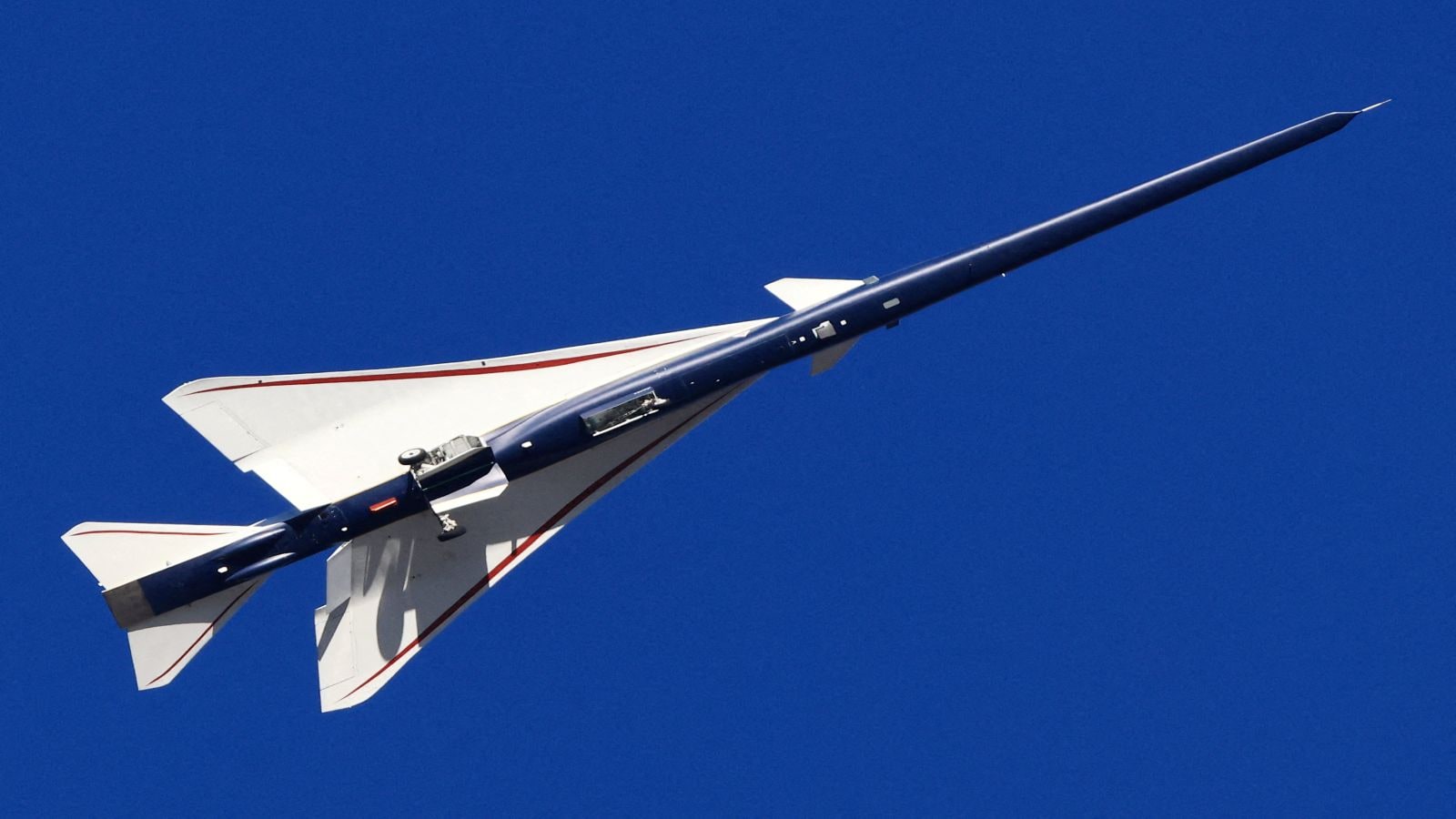
A blurred shape flickers across a screen in an aviation lab outside Xi'an. It has no tail. Its wings blend into its body like a manta ray slicing through dark water. To an casual observer, it looks like a video game rendering or a discarded concept from a science fiction studio. But aviation engineers across the globe did not see a movie prop when the state-owned Aviation Industry Corporation of China released this footage. They saw a countdown.
Military aviation operates on an brutal, decades-long timeline. By the time a fighter jet becomes a household name, it is already obsolete in the minds of the people who designed it. The planes dominating the skies today—the F-35s and Chengdu J-20s—are fifth-generation aircraft. They are defined by stealth, data links, and advanced radar. They are marvels of engineering. If you liked this post, you might want to check out: this related article.
They are also yesterday's news.
The race has moved to the sixth generation. This is not about building a faster engine or a pointier nose. It is a fundamental shift in how humanity projects power through the air, and China just dropped a highly choreographed hint that it intends to get there first. For another angle on this story, refer to the latest coverage from Engadget.
The Choreography of a Leak
Governments do not release footage of advanced military hardware by accident. Every pixel is scrutinized, curated, and scrubbed before it reaches the public eye. When China's top aircraft manufacturer included a tailleless, stealthy aerodynamic design in an official promotional video, it was an intentional whisper designed to make the world lean in.
Consider the engineer sitting at a desk in Ohio or Toulouse, pausing the video at the 0:12 mark, squinting at the leading edge of a digital wing. That engineer is not looking at a finished product. They are reading a message written in the language of fluid dynamics.
The message is simple: We know what the future looks like, and we are already building it.
For decades, Western defense policy relied on a comfortable assumption of technological superiority. The United States pioneered stealth with the F-117 and perfected it with the F-22 Raptor. China was viewed as a fast follower, a nation excellent at replicating existing technology but lagging in true innovation.
That narrative is dying. The J-20 proved that China could field a heavy stealth fighter ahead of global expectations. Now, by teasing a tailleless design, Beijing is signaling that it is no longer content to follow. It wants to set the pace.
Why the Tail Matters
To understand why a missing tail causes sleepless nights in Virginia and Tokyo, we have to look at the physics of radar.
Conventional fighter jets need vertical tails to stay stable. When a pilot wants to turn left, the tail helps yaw the aircraft. But vertical tails are also giant radar reflectors. They are like carrying a metal billboard into a dark room while trying to hide from a flashlight. If you look at a modern stealth fighter from the side, the tail is often its most visible feature to enemy sensors.
Remove the tail, and you drastically reduce the aircraft's radar cross-section from every angle. It becomes a ghost.
But physics is a harsh taskmaster. Removing the tail makes an airplane inherently unstable. It wants to tumble, spin, and rip itself apart. The only way to keep a tailleless aircraft in the sky is through incredibly complex flight control software that makes thousands of microscopic adjustments every second. The computer flies the plane; the human just tells the computer where to go.
By showing a tailleless concept, China is claiming mastery over these insanely complex aerodynamic equations. It is an assertion of computational dominance.
The Companion in the Cockpit
The physical shape of the plane is only the shell. The real revolution of the sixth generation is what lives inside the skin.
Imagine a pilot stepping into a cockpit ten years from now. There are no dials. There might not even be a traditional canopy to look out of; instead, a helmet feeds a synthetic, 360-degree view of the battlespace directly into the pilot's optic nerve.
But the pilot is not alone. Every sixth-generation concept, whether from China, the United States, or the European Tempest program, revolves around the idea of a "loyal wingman."
The fighter jet will act as a flying quarterback, controlling a small fleet of autonomous, artificial intelligence-driven drones. These drones fly ahead. They scout dangerous airspace. They draw enemy fire. They carry the extra missiles that the main stealth fighter cannot fit in its internal weapons bays.
This changes the entire psychological dynamic of aerial combat. War in the air has always been deeply personal, a clash of human reflexes and nerve. The future is an algorithmic symphony. The human pilot becomes a manager of digital systems, filtering a tidal wave of data while AI systems make split-second tactical decisions.
When China broadcasts images of this technology, they are telling their neighbors and rivals that they are ready to compete in the cognitive realm of warfare, where battles are won by lines of code rather than raw pilot instinct.
The Invisible Industrial Race
It is easy to get lost in the glamour of sleek jets and futuristic helmets, but the true stakes are buried in the unglamorous world of industrial capacity.
A sixth-generation fighter requires an ecosystem that few countries on Earth can sustain. It demands advanced composite materials that can withstand immense heat and stress. It requires next-generation engines with variable bypass ratios to cruise efficiently across vast oceans and then sprint at supersonic speeds when the fighting starts. Most of all, it requires semiconductor fabrication facilities capable of producing chips that can process terabytes of sensor data in real time.
The video released in China is a showcase of that ecosystem. It is a reminder that the factories in Chengdu, Shenyang, and Xi'an have matured. They are no longer just assembling components; they are inventing them.
This creates a dilemma for competitors. Developing these platforms costs hundreds of billions of dollars. If a nation starts too early, they risk baking in obsolete technology. If they start too late, they risk being left out of the sky entirely.
The View from the Ground
The sky seems empty, but it is increasingly crowded with intent. Every time an official video drops, every time a satellite image captures a strange shadow on a runway in Xinjiang, the geopolitical calculus shifts.
We often view these military developments through the lens of abstract strategy, mapping out hypothetical conflicts over the Taiwan Strait or the South China Sea. But the real impact is felt in the quiet rooms where budgets are approved and alliances are forged.
A nation's sovereignty is only as good as its ability to defend its airspace. When a rising power signals that it is on the verge of a generational leap in aviation, it forces every other nation to re-evaluate their security. It changes how diplomats talk. It alters trade agreements. It rewrites the unspoken rules of global influence.
The footage of China's concept jet faded to black after a few seconds, replaced by corporate branding and triumphant music. The digital rendering disappeared. But the questions it raised remain, hanging in the air like the vapor trail of a jet that has already vanished over the horizon.