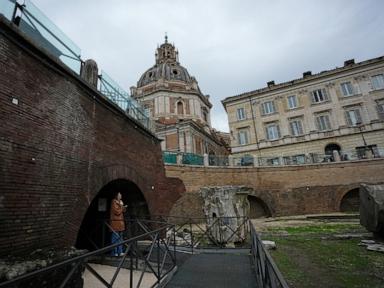
Dust. That is the first thing you notice when you step off the blistered asphalt of modern Rome and descend into the dark. Not the sterile, gray fluff that collects behind a living room radiator, but a heavy, velvet silt that tastes faintly of crushed seashells, ancient mortar, and two thousand years of human breath.
I stood in that subterranean chill last autumn, watching a conservator named Elena work a square inch of plaster with a brush no wider than an eyelash. Above our heads, maybe thirty feet up, Vespas screamed past the Colosseum and tourists queued for gelato under a merciless Mediterranean sun. Down here, the temperature hovered at a damp fifty-eight degrees. The air felt thick enough to chew. Elena didn't look up when the heavy steel door clicked shut behind me, sealing out the roar of the twenty-first century. She simply pointed her headlamp toward a rectangular niche carved into the brick wall—a hollow socket that once held cedar shelves packed with papyrus scrolls—and whispered, "They didn't build these walls to keep the dirt out. They built them to keep the memory in." Meanwhile, you can find similar stories here: Airbnb's New House Rules Aren't Ruining Travel They Are Saving Hosts From Themselves.
For decades, the standard story of ancient Rome has been told in marble and blood. We flock to the city to gawk at the amphitheaters where men died for sport, the triumphal arches celebrating slaughtered enemies, and the sprawling palace ruins of emperors who fancied themselves gods. Standard travel guides treat the reopening of a newly excavated archaeological site—like the long-buried imperial library recently restored and opened to the public near the slopes of the Palatine and Esquiline hills—as just another box to check on a three-day itinerary. Buy the ticket. Snap the photo. Move on to the pasta.
That perspective misses the entire point. To understand the complete picture, we recommend the detailed analysis by Condé Nast Traveler.
When an ancient Roman library emerges from the earth after centuries of entombment, we aren't just looking at an architectural curiosity or a pile of salvaged bricks. We are staring into the nervous system of a civilization that figured out, long before silicon chips or cloud servers, that power doesn't belong to the man with the sharpest sword. It belongs to the person who controls the archive.
The Architecture of Forgotten Voices
To understand what it actually felt like to walk through these halls when the ink was still fresh, consider a hypothetical Roman citizen—let's call him Marcus, a mid-level legal clerk living in the second century AD. Marcus doesn't own a private villa with a courtyard garden. He lives in a cramped, four-story tenement building where chamber pots are emptied out the window and cooking fires constantly threaten to burn the neighborhood down. He has no personal collection of books; a single hand-copied scroll of Virgil or Aristotle costs more than he makes in three months of grinding labor.
For Marcus, the public library isn't a quiet luxury. It is an escape hatch.
When he steps across the threshold from the chaotic, foul-smelling street into the grand reading hall, the sensory shift is immediate and deliberate. Roman architects designed these spaces as secular temples. The floors were laid with imported polychrome marble—deep greens from Greece, warm yellows from North Africa—engineered to reflect the soft, diffused natural light pouring in from high clerestory windows. Why high windows? Because direct sunlight fades papyrus ink and warps parchment, and floor-level windows let in the street noise. The builders manipulated acoustics and light with mathematical precision so that a man from the slums could sit on a stone bench, unroll a cylinder of Egyptian reed paper, and converse directly with minds dead for four hundred years.
Think about the sheer audacity of that design. Today, we carry the entirety of human knowledge in our pockets, and we use it to argue with strangers while waiting in line for coffee. We treat information as disposable noise. To a Roman walking into an imperial bibliotheca, a text was a physical, fragile miracle. Every word had been copied by hand by a scribe whose fingers cramped in the winter cold. Every scroll had to be rolled with the right hand and unrolled with the left, requiring both hands, total focus, and an intentional slowing down of the human nervous system. You could not skim a scroll. You had to inhabit it.
Yet, when the empire fractured and the money ran out, these sanctuaries were the first things to be cannibalized.
How a Civilization Buries Its Own Mind
People often assume Rome fell in a single dramatic weekend—barbarians crashing through the gates, torches flying, roofs collapsing in a cinematic blaze. History is rarely that neat. Rome died by inches, and its libraries died by neglect.
By the fifth and sixth centuries, the city's population had plummeted from over a million to a shivering, impoverished fraction of itself. The aqueducts were broken. Malaria crept back into the low-lying valleys. Nobody had the coin to pay librarians, patch leaking roofs, or buy fresh cedar oil to protect the scrolls from bookworms and damp rot. First, the wooden shelving rotted away. Then, the vaulted concrete ceilings, heavy with moisture, began to sag and crack. Eventually, the upper stories collapsed inward, burying the reading rooms under tons of brick rubble and shattered marble veneer.
Later generations didn't mourn the loss; they paved over it. Medieval builders used the ruins as quarries, stripping the gleaming marble facings to burn in lime kilns for mortar. Renaissance princes dug down only when they wanted intact statues to decorate their private gardens, tossing aside shattered roof tiles and illegible wall inscriptions as worthless trash. By the nineteenth and twentieth centuries, modern urban planners simply poured tarmac over the whole mess to make room for buses and tram lines.
The library didn't vanish. It was suffocated.
Walking through the newly restored chambers today, you can actually see the trauma written into the masonry. The restoration team—a coalition of archaeologists, structural engineers, and chemical conservators who spent years delicately removing layers of compacted soil and medieval sewage—made a crucial choice. Instead of scrubbing the walls clean to make them look like a sterile film set, they left the scars visible.
Look closely at the lower courses of brickwork and you will see blackened scorch marks from fires lit by squatters during the Dark Ages. Look higher up, and you can trace the exact waterline where groundwater seeped through the soil for a thousand years, leaving mineral deposits like white lace across the crimson frescoes. In the center of the main hall, where a colossal statue of Minerva or Apollo once stood watching over the readers, only the scarred brick core of the pedestal remains, stripped of its bronze and porphyry long before Columbus ever set sail.
The Invisible Mechanics of Resurrection
Bringing a space like this back from the dead is nothing like renovating an old house. If you rip open a buried Roman room too quickly, the sudden rush of dry, warm air and modern microbes will destroy in forty-eight hours what survived two millennia underground.
I remember watching a technician monitor a wall of tiny digital hygrometers mounted discreetly near a doorway. Those sensors are the real heroes of the restoration. Ancient Roman lime plaster breathes; it absorbs and releases moisture like human skin. When excavators first breached the sealed vaults years ago, the surviving fragments of painted stucco—delicate geometric borders in cinnabar red and ochre—began to flake away like pastry crust the moment the ambient humidity dropped.
To save them, engineers had to build an invisible climate-control spine beneath the newly installed suspended walkways. Visitors don't walk on the original marble floors; the surviving fragments are far too fragile to handle thousands of footsteps a day. Instead, you move along a floating grid of darkened steel and thick structural glass. Beneath your boots, hidden ducts whisper filtered, humidity-balanced air upward, keeping the subterranean microclimate locked at a steady equilibrium.
LED lighting strips, calibrated to emit zero ultraviolet radiation, tuck neatly into the recesses of the ancient walls. They cast a warm, amber glow upward into the surviving brick barrel vaults, mimicking the bounce of oil lamps rather than the harsh glare of a museum gallery. For the first time since the fall of the Western Empire, human eyes can read the faint, scratched graffiti left behind by bored students or restless clerks near the entrance—tiny Latin nicknames and half-erased tally marks etched into the plaster with a bronze stylus while waiting for a friend.
That small detail stopped me cold. Forget the emperors. Forget the marble busts of Seneca and Cicero. Seeing a teenager's idle doodle scratched into a library wall two thousand years ago collapses the distance between their world and ours in a heartbeat.
Why Visiting Is Harder Than You Think
If you are planning to walk through those steel doors now that public access has finally been granted, leave your expectations of a standard Roman museum at the curb. This is not the Vatican Museums, where you are swept along in a river of selfie sticks past miles of gilded ceilings.
Because the underground microclimate is fiercely guarded, entry is strictly metered. Only small groups—typically fewer than twenty people at a time—are allowed inside for timed windows. You have to book weeks, sometimes months, in advance, and you cannot linger indefinitely. When your thirty-five minutes are up, the guides politely usher you toward the exit staircase so the air can settle before the next group descends.
And you need to dress for a cellar, even in July. Stepping from ninety-five-degree Roman heat into a damp subterranean vault feels like walking into an industrial meat locker. The stone radiates a deep, ancient chill that settles straight into your bones within ten minutes. Wear closed-toe shoes with decent grip, too; condensation occasionally forms on the steel walkways, and the ramp descending from street level is steep.
There are no scrolls on the shelves. Not a single scrap of ancient papyrus survived the damp Italian soil; organic paper turns to black mulch within a few decades unless it is buried in the bone-dry sands of Egypt or flash-carbonized by a volcano like the scrolls at Herculaneum. If you come expecting to see dusty leather-bound books lined up like a Hogwarts set, you will walk out disappointed.
What you see instead is the negative space of human thought. You see the empty rectangular slots where the wooden cabinets (armaria) were anchored into the masonry. You see the raised stone platforms designed to keep the lowest shelves clear of floor dampness and rodents. You see the architectural skeleton of a society that believed knowledge deserved monumental housing.
What We Risk Losing Above Ground
Standing in that quiet, dimly lit vault, it is impossible not to think about the fragility of our own digital Alexandria.
We like to believe we have solved the problem of permanence. We back up our photos to remote server farms in Oregon and Ireland; we digitize our books, our medical records, our history, and our art, trusting that binary code stored on magnetic tape and solid-state drives will outlast stone. Yet ask any modern archivist about "digital rot," and watch the color drain from their face. File formats become obsolete in twenty years. Hard drives degrade in ten. Magnetic storms, grid failures, or the simple corporate bankruptcy of a cloud provider can erase millions of records without leaving so much as a brick foundation behind for future archaeologists to uncover.
The Romans built with pozzolanic concrete—a mixture of volcanic ash, lime, and seawater that actually grows stronger over centuries as mineral crystals interlock inside the microscopic cracks. When their library collapsed, the ruins remained legible. Two thousand years later, a woman with a tiny brush could sweep away the dirt and still read the blueprint of their priorities.
If our cities collapse, what will remain of our libraries? A warehouse full of melted silicon and unreadable plastic wafers.
As my group filed back up the narrow concrete stairs toward the exit, the heavy steel door swung open, and the sound of modern Rome hit us like a physical blow. Car horns blared. A tour guide shouted into a megaphone across the street. Sunlight slammed against my eyes, blindingly bright after forty minutes in the amber dark.
I paused on the top step, blinking against the glare, and looked down at the cracked asphalt beneath my shoes. Somewhere directly below the crosswalk, out of sight and untouched by the restoration crews, another corridor still sleeps in the dark, waiting for someone patient enough to dig.