The air in the room is different. It is filtered, pressurized, and carries the faint, sterile scent of high-end upholstery and jet fuel. Outside the heavy doors of the Filoli estate in California, the world is a chaotic mess of fluctuating markets, naval maneuvers in the South China Sea, and angry social media feeds. But inside, there is a silence that costs billions of dollars to maintain.
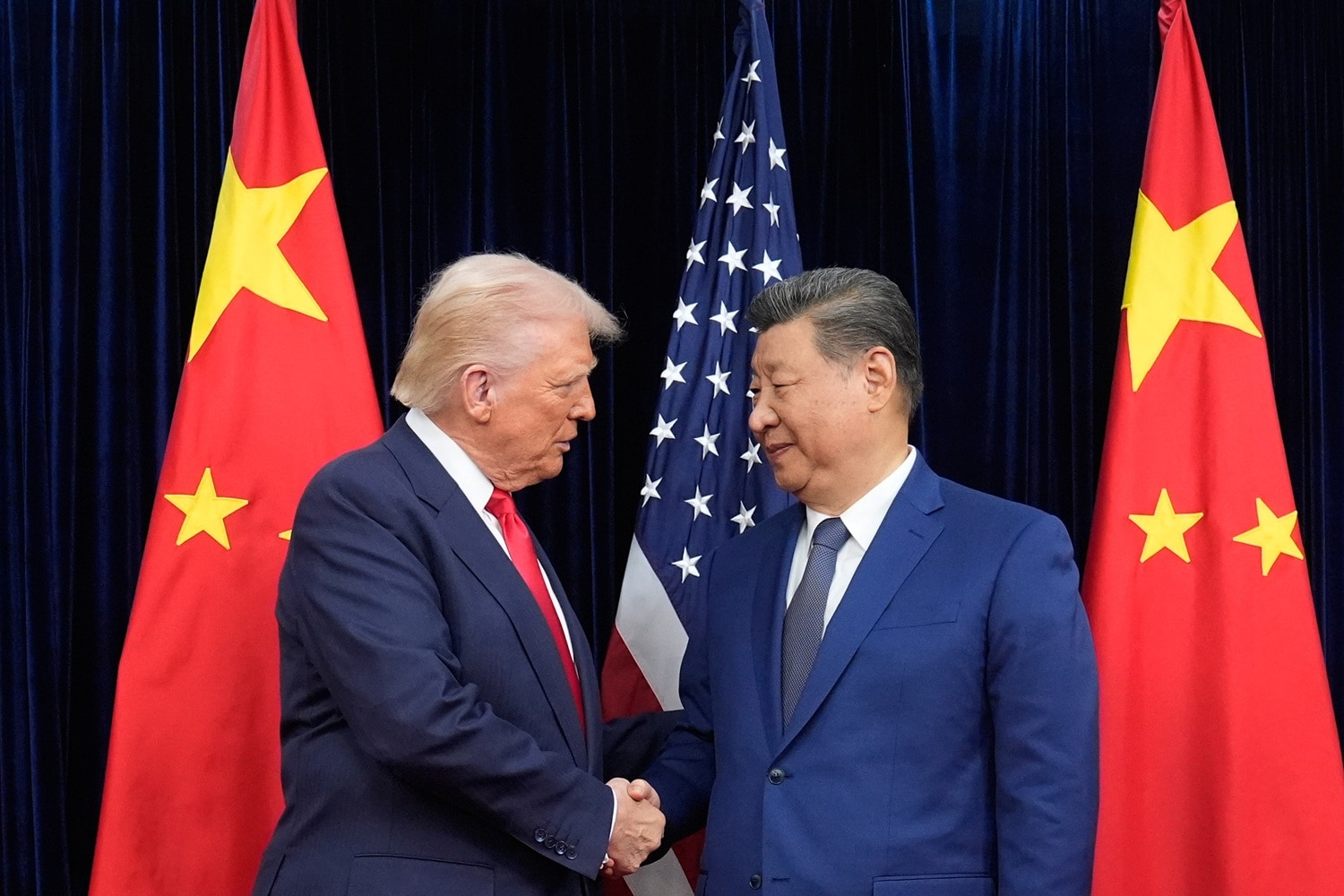
At the center of this silence sit two men who hold the blueprints for the next century. On one side, Xi Jinping, representing the vast, disciplined machinery of the Chinese state. On the other, Donald Trump, a man who views the world through the lens of the ultimate deal.
But the most interesting people in the room aren't the politicians.
Look toward the edges of the light. There is Tim Cook, the man who turned a computer company into a supply-chain miracle that runs almost entirely through Chinese factories. And there is Elon Musk, whose factories in Shanghai are the beating heart of his electric empire. They aren't just guests. They are the human connective tissue between two superpowers that are currently trying to figure out how to stop hating each other long enough to keep the global economy from collapsing.
The Architect and the Alchemist
To understand why a tech CEO would fly across the country to sit at a dinner table with a head of state, you have to look at the sheer fragility of a smartphone.
Imagine a single iPhone. It feels solid, a slab of glass and aluminum. But it is actually a ghost. It is a collection of components sourced from dozens of countries, assembled by hundreds of thousands of hands in "iPhone City"—the sprawling Foxconn complexes in Zhengzhou. For Tim Cook, this summit isn't about grand political ideologies. It is about gravity. If the relationship between Washington and Beijing snaps, the gravity holding Apple’s world together simply ceases to exist.
Cook sits there with the calm, measured posture of a diplomat. He has spent years walking the tightrope, keeping the peace so that the glass keeps moving across the ocean. He knows that a 10% shift in a tariff or a sudden regulatory crackdown in Beijing isn't just a line on a spreadsheet. It is a factory closing. It is a product delay that wipes out a quarterly earnings report. It is the end of an era of cheap, frictionless production.
Then there is Musk.
If Cook is the architect of the status quo, Musk is the alchemist of the future. His presence at the table is a jarring reminder that the stakes have shifted from consumer electronics to the very soul of the next industrial revolution. China is the world's largest market for electric vehicles. It is also the world's most aggressive competitor. Musk isn't just there to protect Tesla’s sales; he is there to navigate a world where the car is no longer a machine, but a rolling data center.
When these men look at Xi and Trump, they don't see leaders. They see gatekeepers.
The Invisible Stakes of a Handshake
The media will focus on the handshake. They will talk about the photo ops and the carefully worded joint statements. But the real story is in the tension held in the shoulders of the executives watching from the sidelines.
There is a specific kind of dread that comes with being a "global" company in a "nationalist" age. For decades, the logic was simple: go where the labor is efficient and the market is growing. Now, that logic has become a liability. Every time a politician in D.C. talks about "decoupling," a cold shiver runs through the boardrooms of Cupertino and Austin.
Decoupling is a clean, academic word. In reality, it is a messy, violent divorce.
Consider the hypothetical—but very real—scenario of a microchip shortage caused by a sudden trade freeze. It starts with a small component, perhaps a power management chip. Without it, the car doesn't start. The phone doesn't turn on. The medical equipment in a rural hospital stays dark. When the gears of global trade grind to a halt, it isn't the politicians who feel it first. It is the person waiting for a job at a port, the engineer whose project just lost its funding, and the consumer who watches the price of a basic necessity double overnight.
This summit is an attempt to put oil back into those gears.
The Language of Power
Xi Jinping speaks in the language of "win-win cooperation," a phrase that sounds poetic but functions as a demand for stability. Trump speaks in the language of "America First," a phrase that functions as a demand for leverage.
The CEOs speak a third language: Necessity.
They are the ones who have to explain to the politicians that you cannot simply move a mountain. You cannot recreate the manufacturing ecosystem of the Pearl River Delta in a suburban office park in Ohio in six months. It took forty years to build the world we live in. Tearing it down takes only a pen stroke, but rebuilding it requires a miracle.
As the dinner progresses, the conversation moves from trade deficits to artificial intelligence. This is the new frontier of the Cold War. It is no longer about who makes the most steel; it is about who owns the algorithms that will dictate how we think, work, and fight.
Musk, who has sounded the alarm on AI for years, finds himself in a strange position. He needs Chinese data and Chinese manufacturing to keep Tesla ahead, but he also knows that the technology he is building is the very thing the U.S. government wants to keep out of Chinese hands. He is a man caught between two worlds, trying to build a bridge while both sides are busy planting explosives on the supports.
The Human Element in the Machine
We often think of these summits as clashes of titans, as if the people involved are statues made of marble. They aren't. They are tired men in suits who are worried about their legacies.
Xi is managing a slowing economy and a demographic crisis that threatens the very stability of his party. Trump is managing a fractured electorate and a burning desire to prove that his brand of populism can actually deliver the "Greatest Deal of All Time."
And the CEOs? They are managing the impossible expectations of shareholders who want infinite growth in a world that is rapidly closing its borders.
There is a moment, perhaps between courses, when the masks slip. A brief laugh. A shared look of exhaustion. In that moment, the "geopolitical tension" becomes something much more recognizable: a group of people who have realized they are all trapped in the same burning building.
They cannot leave. They cannot ignore each other. They have to find a way to share the air.
The Cost of the Conversation
What is the price of admission to a room like this?
For the tech giants, the price is often their reputation. To stay in China's good graces, they must navigate censorship, data privacy concerns, and the moral ambiguity of working with a government that has a very different definition of human rights than the one found in Silicon Valley. To stay in Washington's good graces, they must wrap themselves in the flag and promise that their loyalties aren't tied to their profit margins.
It is an exhausting, soul-eroding dance.
But they do it because the alternative is irrelevance. In the modern age, if you aren't at the table, you are on the menu.
The summit at Filoli won't end the trade war. It won't solve the "China Problem" or "The American Decline." Those are narratives too big for a single room. What it might do, however, is provide a temporary ceiling for the fall. It is a signal to the markets and the people that the adults are at least willing to sit in the same zip code.
The Ghost at the Table
As the lights dim on the estate and the motorcades begin to pull away, the real impact of the meeting begins to ripple outward.
It isn't found in the official communiqués. It is found in the phone calls made by supply chain managers in the middle of the night. It is found in the sudden green shoots on a stock ticker. It is found in the quiet sigh of relief from a logistics expert who realizes their shipping containers might actually make it to port after all.
The world wants to believe in a clean break. We love the drama of a rivalry. We like to think of "us" and "them," of East and West, of democracy versus autocracy. But the presence of Cook and Musk at that table proves that those lines are blurred, smeared by the reality of a world that has spent too long becoming one single, interconnected organism.
You cannot cut off the hand without the heart noticing.
The men in that room are trying to figure out how to be rivals without being enemies. They are trying to find a way to compete in the light without destroying everything in the dark.
As the sun sets over the California hills, the sterile scent of the room lingers. The silence remains. But the world outside is waiting, breathing, hoping that the words spoken over expensive wine were enough to keep the lights on for one more day.
The deal isn't done. The deal is never done. It is just a series of handshakes in a room where the air is too thin for anyone else to breathe.