The air up on Victoria Peak smells of wet eucalyptus and old money. From three hundred meters above the harbor, the cargo ships look like discarded matchsticks floating in an inkwell. Below, the neon of Central blinks in a rhythm that has kept sleepless men and women rich for a century.
I sat there late one Tuesday with Arthur, a man whose family has moved capital across the South China Sea since the days of wooden junks. He poured a finger of single malt into a heavy crystal tumbler. Outside, the fog rolled over the ridge, swallowing the skyline whole.
"They used to come for the simplicity," Arthur said, swirling the amber liquid. "Now they come with spreadsheets and a headache."
He wasn't talking about tourists. He was talking about the invisible gravity that keeps billions of dollars pinned to these precipitous hillsides, and the new cracks forming in the stone.
For decades, Hong Kong functioned as the great financial centrifuge of Asia. Money spun in from the north, shed its friction, and sprayed out across global markets with minimal interference. There were no capital gains taxes. No inheritance levies. No complex webs designed to track every coin that changed hands. It was an arrangement built on a simple promise: bring your risk, keep your reward.
Tax rules were sparse, territorial, and predictable. If you earned it outside the territory, the government did not care. If you earned it within, the bite was remarkably gentle. That predictability was the magnet. Billionaires did not build glass-fronted mansions overlooking Deep Water Bay because they loved the humidity; they stayed because the ledger was clean.
Then the ground shifted three hundred miles north.
Across the border, mainland China began tightening its fiscal belt with the precision of a master tailor. Wealth tracking grew sharper. Cross-border asset flows faced unprecedented scrutiny. The old loopholes that allowed fortunes to drift quietly between Shenzhen, Shanghai, and offshore havens began to snap shut under the weight of regulatory modernization and shared international data agreements like the Common Reporting Standard.
Suddenly, the great firewall of taxation began to dissolve.
Consider what happens next in the mind of a patriarch sitting in a high-rise in Guangdong. He has built an empire of manufacturing or logistics. His wealth is vast, but it is increasingly visible. The mainland tax authorities now see everything—from corporate dividends to family trusts. The natural impulse is to look outward, to find a harbor that remains safe from the storm.
Naturally, they look south. They look to Hong Kong.
And this is where the plot thickens into something genuinely tense. Because as that capital rushes toward the border, Hong Kong itself is no longer the isolated sanctuary it once was. The integration between the mainland and the Special Administrative Region deepens by the month. Financial reporting standards converge. Compliance officers in Central now speak the same regulatory language as their counterparts in Beijing.
The question haunting the boardrooms and private clubs of the Peak is no longer whether Hong Kong is part of China—that has always been true. The question is whether Hong Kong can remain distinct enough, agile enough, and tax-advantageous enough to justify the price of admission.
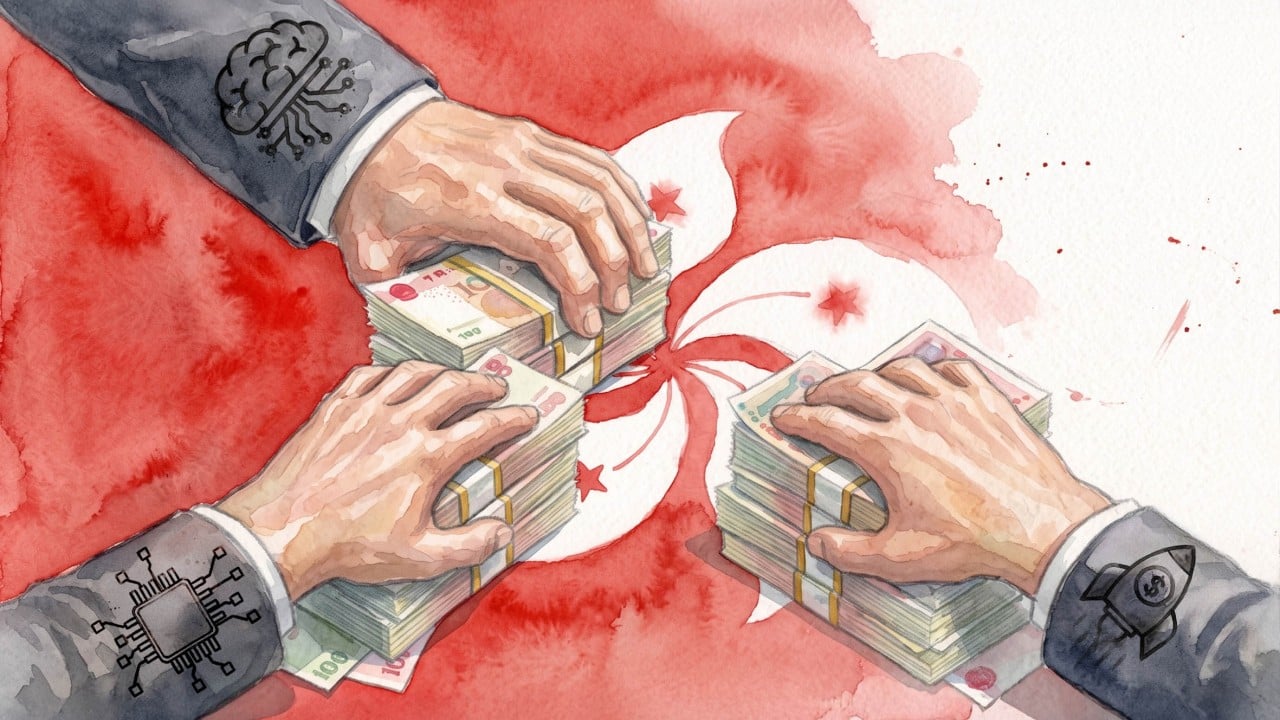
Let us be entirely honest about the numbers. Hong Kong's profits tax remains capped at a modest 16.5 percent, and salaries tax tops out at 15 percent. By global standards, these figures are still an invitation to party. But the administrative friction is multiplying. Family office incentives, rolled out with great fanfare to attract ultra-high-net-worth clans, come choked with operational hurdles. You must invest a minimum of two hundred and forty million Hong Kong dollars. You must hire local staff. You must pass substance tests that require proof of real economic activity, not just a brass plate on a door in Admiralty.
The era of the ghost office is dead.
Arthur set his glass down with a sharp clink against the mahogany table. "The government thinks they can engineer a sanctuary with a checklist," he muttered. "They want the billionaires, but they want them housebroken. They want the capital without the ambiguity."
That is the paradox. Billionaires do not merely seek low taxes; they seek immunity from surprise. They want to know that the rules written today will apply tomorrow. When mainland China tightens its fiscal net, the shockwaves inevitably travel down the economic fault lines. High-net-worth individuals moving assets through the SAR now find themselves staring at a complex matrix of dual-tax agreements, anti-avoidance provisions, and heightened scrutiny from international banking institutions terrified of secondary sanctions or compliance failures.
The banks are sweating. Every major lender in the territory has beefed up its compliance department, turning client onboarding into an invasive archaeological dig. Where a billionaire's grandfather could open an account with a handshake and a letter of introduction, today's inheritor must explain the provenance of every cent earned since the Deng Xiaoping era.
Is the magnet losing its pull?
Not quite. The pull has simply changed its nature. It is no longer a lazy, magnetic drift. It is a high-stakes balancing act.
Hong Kong still holds trump cards that no mainland city can replicate. The currency remains pegged to the US dollar, offering a liquidity bridge to the West that no amount of renminbi internationalization has fully replaced. The legal system, rooted in English common law, provides a psychological comfort blanket for contracts that cross oceans. For all the regulatory tightening, you can still move millions across borders with a keystroke in a way that remains deeply complicated within mainland jurisdictions.
Yet, the anxiety is palpable. You see it in the sluggish luxury real estate market on the Peak, where sprawling estates sit waiting for buyers who are taking longer to commit. You see it in the hushed conversations at private dining rooms in the China Club, where founders weigh the benefits of establishing dual residencies in Singapore or Dubai.
Singapore has played its cards with clinical efficiency. While Hong Kong wrestled with geopolitical headwinds and stringent local restrictions through the early twenties, the Lion City positioned itself as the neutral alpine meadow of Asian finance. It vacuumed up family offices, real estate capital, and displaced talent.
Arthur looked out the window, watching the rain streak the floor-to-ceiling glass.
"Singapore is clean," he said softly. "It is orderly. But it has no soul. It feels like a corporate park designed by an algorithm. Hong Kong is messy. It is loud. It has an edge. And edge is where fortunes are actually made."
He is right. The magic of Hong Kong has never been sterile perfection. It has always been the chaotic, electric friction between East and West, between the rule of the ledger and the hunger of the entrepreneur.
As mainland tax rules tighten, the easy money is indeed retreating. The speculators who relied on blind opacity are packing their bags. But what remains is something harder, heavier, and potentially more enduring: capital that is looking for a sophisticated home, willing to pay the price of compliance, provided the engine of commerce keeps turning.
The fog outside the window finally parted, revealing the harbor below. A container ship was inching its way toward the South China Sea, its decks glowing under sodium lights, carrying its cargo into the dark.