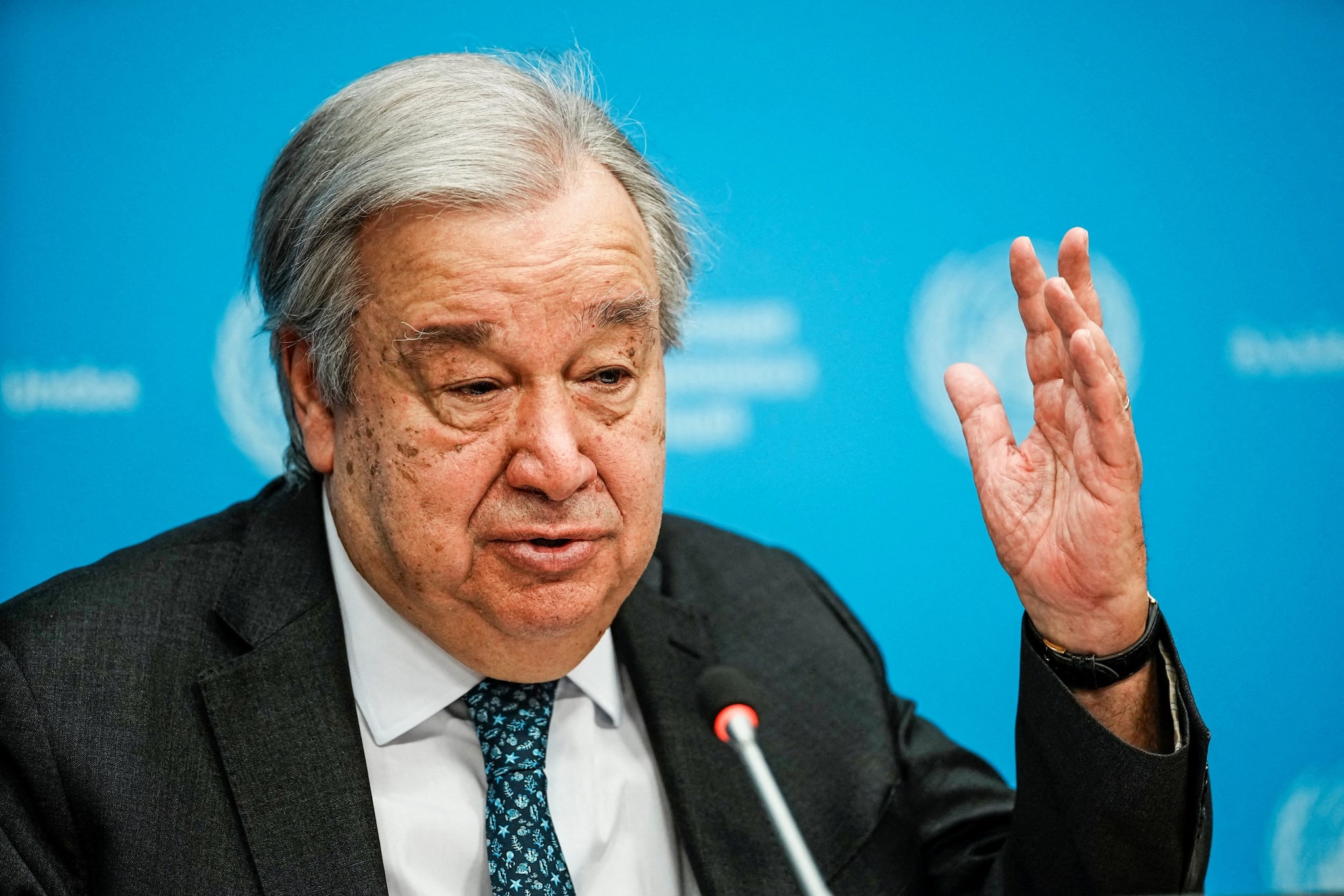
The global framework of human rights is not merely under pressure; it is being systematically dismantled by a new generation of leaders who view international law as a decorative suggestion rather than a binding obligation. While the United Nations Secretary-General issues warnings about the "assault" on these rights, his rhetoric often fails to identify the mechanics of the decay. The reality is that the institutions designed to protect the individual from the state are failing because the states themselves have mastered the art of using democratic tools to hollow out democratic substance. We are witnessing the birth of a sophisticated, technocratic authoritarianism that mimics the language of justice while gutting its practice.
This crisis is not a series of isolated incidents in far-flung regions. It is a contagion. When the post-World War II order was established, the primary threat to rights was the jackboot and the secret police. Today, the threat is more likely to come from a legislative amendment, a diverted budget, or an algorithm. The shift from overt violence to legalistic erosion makes this era particularly dangerous. It is harder to spark international outrage over a "reclassified" non-governmental organization than it is over a mass arrest, yet the result is the same: the elimination of dissent and the unchecked expansion of state power.
The Mirage of Sovereignty and the Death of Accountability
For decades, the concept of national sovereignty acted as a shield for dictators. Now, it has been repurposed by elected leaders in established democracies to deflect any external critique of their human rights records. By framing human rights as a "Western imposition" or a "threat to national security," governments from every continent are successfully retreating from the universal standards they once helped write.
The UN's ability to intervene has always been limited, but the current paralysis in the Security Council has turned those limits into a complete dead end. When permanent members of the council are themselves the primary violators of international law, the mechanism for enforcement becomes a closed loop of vetos and polite disagreements. This creates a vacuum. In that vacuum, smaller nations feel emboldened to ignore their own constitutional protections, knowing that the "international community" is a ghost that no longer haunts their halls of power.
The problem is one of incentive. There is currently no significant economic or political cost for a middle-power nation to suppress its minority populations or silence its press. The global trade network has become so interconnected and cynical that the moral high ground is usually traded for a favorable shipping deal or a steady supply of natural gas.
The Technocratic Noose
Technology was supposed to be the great equalizer, the tool that would allow the oppressed to bypass the state. Instead, it has become the state’s most effective weapon. This is the "how" that many analysts ignore when discussing the erosion of rights. We focus on the politics but miss the plumbing.
- Financial Deplatforming: Governments no longer need to arrest activists when they can simply freeze their bank accounts or pressure payment processors to cut them off. Without funds, a movement dies in the crib.
- Predictive Policing: Using data to target "likely" offenders has turned the presumption of innocence on its head. This isn't science-fiction; it is a current administrative reality in dozens of countries where data sets are used to justify the preemptive detention of political organizers.
- The Privatization of Censorship: By passing laws that hold social media companies liable for "vague harms," states have successfully outsourced the dirty work of suppressing speech. Corporations, fearing for their profit margins, err on the side of caution and silence.
This digital architecture creates a "soft" repression. You aren't dragged away in the night; you are simply rendered invisible. Your posts don't reach your audience, your credit card stops working at the grocery store, and your name is flagged at every border crossing. It is a bloodless but total control of the individual.
The Failure of the Professional Human Rights Class
There is a hard truth that the advocacy world is reluctant to face: the "Human Rights Industry" is increasingly out of touch with the people it claims to protect. Large international NGOs often operate with the bureaucratic bloat of the governments they oppose. They focus on high-level summits and glossy reports that serve more as a branding exercise than a catalyst for change.
Meanwhile, the local activists on the ground—the lawyers in provincial courts and the journalists in regional capitals—are being picked off one by one. The funding models for these organizations often prioritize measurable "outcomes" that favor short-term projects over the grueling, multi-decade work of building a culture of rights. When the funding disappears, the protection disappears with it.
We also see a growing "rights fatigue" among the public in stable democracies. The constant stream of atrocities on social media has not created a more empathetic global citizenry; it has created a numb one. People are more likely to look away from a humanitarian crisis than they are to demand their representatives take action. This apathy is the oxygen that modern autocrats breathe.
Reclaiming the Narrative from the State
To stop the bleeding, the approach to human rights must move beyond the lecture hall and the UN General Assembly. It requires a return to the fundamentals of power. Rights are not given by states; they are extracted from them.
History shows that the only way to secure human rights is to make their violation more expensive than their protection. This means moving toward a model of Targeted Economic Isolation. General sanctions often hurt the very populations they are meant to help, but targeted financial strikes against the personal assets of the individuals making the decisions—the ministers, the judges, and the oligarchs—have proven far more effective.
Strategic Shifts Needed Now
- Legal Reciprocity: Nations that respect the rule of law must refuse to recognize the judicial findings of nations that do not. Extradition treaties should be automatically suspended for any country that uses its legal system to target political opponents.
- Tech Neutrality: We must demand that technology providers bake "rights by design" into their infrastructure. This means end-to-end encryption by default and the refusal to store data in jurisdictions where the state can access it without a transparent, contested warrant process.
- Direct Support to Grassroots Defense: International funding must bypass the massive overhead of "tier-one" NGOs and go directly to the legal defense funds of local activists. A lawyer in a local courtroom is worth ten analysts in Geneva.
The era of assuming that progress is a one-way street is over. The "assault" on human rights is actually a successful counter-revolution by those who find the individual’s freedom inconvenient to the state’s bottom line. If we continue to rely on the same institutions that allowed this decay to happen, we shouldn't be surprised when the walls finally give way.
The survival of these freedoms depends on recognizing that the threat is no longer at the gate; it is inside the system, wearing a suit and quoting the law. The next time a global leader expresses "deep concern" about the state of human rights, look at their trade policy and their surveillance budget. That is where the truth lives. Stop listening to what they say and start watching what they permit.