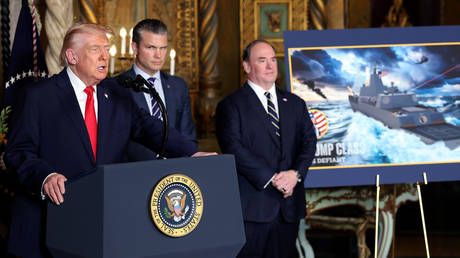
The headlines are bleeding with the same tired narrative. They want you to believe the firing of the Navy Secretary was a simple case of administrative incompetence or a failed vanity project known as the "Golden Fleet." The media is obsessed with the optics of high-level dismissals. They treat the Pentagon like a corporate boardroom where a bad quarterly report leads to a pink slip.
They are wrong.
The "Golden Fleet" wasn't a failure of vision. It was a casualty of a deep-seated, systemic allergy to rapid innovation within the military-industrial complex. While the New York Times and its echoes frame this as a story of political friction, they ignore the underlying reality: the U.S. Navy is currently a floating museum of 20th-century thinking, and anyone trying to drag it into the 21st century gets thrown overboard.
The Cost of Staying Static
The conventional wisdom suggests that stability is the highest virtue in naval procurement. We are told that multi-decade development cycles for billion-dollar carriers are the only way to ensure national security. This is a lie designed to protect the profit margins of legacy defense contractors.
I have spent years watching how these "stable" programs operate. They are black holes for capital. When a project like the Golden Fleet attempts to bypass the sclerotic acquisition process—moving from concept to deployment in months rather than decades—the system reacts like an immune system attacking a foreign pathogen.
The dismissal of the Navy Secretary isn't about a failed fleet. It’s about the victory of the bureaucracy over the disruptors.
The Lethality Gap Nobody Wants to Discuss
We are obsessed with "hulls." The Navy counts ships as if it’s still 1944. But in a modern maritime conflict, a $13 billion Ford-class carrier is just a very expensive target if it isn't surrounded by a distributed, resilient network of autonomous sensors and shooters.
The Golden Fleet was an attempt to bridge this "lethality gap." It focused on:
- Asymmetric Scaling: Buying hundreds of low-cost, expendable drones instead of one high-cost, "exquisite" platform.
- Software-Defined Warfare: Prioritizing the data link and the AI-driven targeting over the steel of the ship.
- Rapid Iteration: Accepting that some prototypes will sink so that the final version actually wins.
Critics call this "wasteful." I call it the only way to avoid a catastrophic defeat in the Pacific. If you aren't breaking things in peacetime, you will break everything in wartime.
Why the NYT Narrative is Dangerous
By focusing on the personality clash between the White House and the Navy leadership, the mainstream press obscures the technical crisis. They make it look like a "who’s in charge" problem. It’s a "what are we building" problem.
When the media reports that the Secretary was fired because of the Golden Fleet’s "failure," they reinforce the idea that innovation is risky and traditionalism is safe. This sends a chilling message to every mid-level officer with a bold idea: keep your head down, follow the 30-year plan, and never, ever challenge the budget of a legacy program.
The False Security of the Status Quo
Let’s dismantle the "People Also Ask" nonsense surrounding this event.
Is the U.S. Navy falling behind? Yes, but not because of a lack of money. It’s because we are spending that money on the wrong things. We are buying horses at the dawn of the tank era.
Was the Golden Fleet a waste of taxpayer money? Compared to the cost overruns on the Littoral Combat Ship (LCS)—a platform that literally started cracking and rusting before it could even deploy properly—the Golden Fleet was a bargain. The LCS program cost tens of billions for ships that the Navy now wants to decommission early. Where was the outrage then? Where were the front-page firing stories?
The difference is that the LCS was a "traditional" failure. It followed the rules. It enriched the right people. The Golden Fleet was a "renegade" project. Its failure was political, not tactical.
Logistics is the New Front Line
We spend all our time talking about the "tip of the spear." We ignore the shaft.
Modern naval warfare isn't just about who has the biggest gun. It’s about who can maintain a digital footprint in a contested environment. The Golden Fleet intended to decentralize logistics. Instead of a massive, vulnerable supply chain, it envisioned a swarm of autonomous resupply vessels.
The defense establishment hated this. Why? Because you can’t build a multi-billion dollar "sustainment" contract around a fleet of disposable $2 million autonomous boats. There is no "lifecycle maintenance" revenue in a ship designed to be blown up.
The Innovation Tax
Every time a leader tries to bypass the standard procurement channels, they pay an "innovation tax." This tax isn't paid in dollars; it’s paid in political capital.
The Navy Secretary tried to spend his capital all at once. He bet that results would shield him from the wrath of the bureaucrats. He was wrong. In Washington, a successful disruption is more threatening than a failed status quo.
Imagine a scenario where a private tech company tried to build a new satellite network. If they followed the Navy’s procurement model, they would spend 15 years in "requirements definition" and another 10 in "initial operating capability." By the time the first satellite launched, the technology would be 25 years old.
The Golden Fleet was an attempt to move at the speed of Silicon Valley. The Pentagon moves at the speed of a glacier. When the two collided, the glacier won.
The Brutal Reality of Modern Procurement
If you want to understand why the Secretary is gone, look at the budget line items, not the press releases.
- Legacy Protection: Huge swaths of the Navy budget are "locked in" for decades.
- Risk Aversion: Failing conventionally is fine. Failing differently is a career-ender.
- The Revolving Door: The people criticizing the Golden Fleet today are the same people who will be sitting on the boards of the companies building the massive carriers tomorrow.
The "Golden Fleet" wasn't a mistake. It was a threat. It threatened the comfortable consensus that has dominated naval thinking since the end of the Cold War. It suggested that maybe, just maybe, we don't need a few massive targets; we need a thousand small, smart, and lethal ones.
The Mirage of Incompetence
Labeling the Secretary as "incompetent" is the ultimate gaslighting. It frames a fundamental strategic disagreement as a personal failing. It allows the Navy to return to its "business as usual" approach without having to answer the hard questions about why our current fleet is so vulnerable to cheap, land-based missiles.
We are told the dismissal was about "maintaining order." In reality, it was about restoring the silence. The silence that allows the waste to continue. The silence that keeps us building 20th-century weapons for a 21st-century war.
The Golden Fleet is dead. The bureaucrats are celebrating. But the ocean is getting more dangerous every day, and a shiny new carrier won't save us from the swarms that are coming.
Stop looking at the firing. Start looking at what they’re trying to bury.