The rain over London always smells of iron and wet stone, but inside the gallery, the air smells of something much older: expectation.
Imagine standing four feet away from a canvas painted nearly two centuries ago by a man who spent his final days hiding under an assumed name in a damp Chelsea lodging, watching the Thames swallow the sunset. Joseph Mallord William Turner did not paint what he saw. He painted what the light did to him. He painted the blinding, cruel, magnificent violence of a world turning on its axis.
Now, that same vision is coming home.
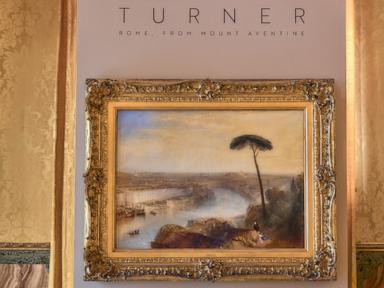
Before it faces a UK sale projected to shatter auction records, Turner's monumental masterpiece of Rome has returned to the city that shaped it. The painting stands as a ghost from a vanished era, carrying a price tag that feels almost obscene against the backdrop of our current economic anxieties. Yet, when you look at the canvas, money evaporates. There is only gold. There is only water. There is only the dust of an empire settling into the yellow Tiber.
The Painter in the Shadows
We forget how radical Turner was because we have framed him behind glass and turned him into tea towels. We think of him as a respectable Victorian gentleman, safely tucked away in the annals of art history.
He was nothing of the kind.
To his contemporaries, Turner was an eccentric, a brawler in the academy, a man who tied himself to the mast of a steamship during a snowstorm just to understand what a gale felt like from the inside. He lived with fishermen. He squinted into the fog. He smeared paint with his thumbs, spat on canvases, and added dabs of vermilion with a dirty fingernail if the light demanded blood.
By the time he painted Rome—specifically, Modern Rome - Campo Vaccino, though the shadow of his earlier Italian journeys lingers in every brushstroke—he was aging, reclusive, and grieving. His friends were dying. The industrial smoke was choking the ancient hills. Europe was changing, transforming from a landscape of horse-drawn carriages and classical ruins into a snarling beast of iron rails and belching factories.
When he looked at Rome, he wasn't looking at a postcard. He was looking at mortality.
Consider the composition. The Forum is not a rigid architectural drawing. It is a dream half-remembered. Cattle wander through grass that once bore the weight of Caesars. Goats graze where tribunals stood. The modern world and the ancient world bleed into one another, dissolving in a haze of amber and pearl. Turner understood what we refuse to accept: everything we build is temporary. The stone crumbles. The empire falls. Only the light remains.
The Price of Immortality
And yet, that light has a cost.
Next week, this painting will change hands. The auction block awaits in London, and the whisper in the financial columns is that the final bid will rewrite the record books. Millions upon millions of pounds will shift from one anonymous offshore account to another, all for the privilege of owning a piece of canvas stained with Turner's sweat and turpentine.
There is a bitter irony here. Turner was famously protective of his work, refusing to sell his favorite pieces even when offered fortunes, preferring to leave them to the British nation so that the public could see them together. He wanted his vision to belong to the sky, to the people, to the air.
Today, masterpieces like this are trapped in a high-stakes game of wealth preservation. They become collateral, status symbols locked inside climate-controlled vaults in Geneva or Mayfair, glimpsed by ordinary mortals only when a museum manages to secure a temporary loan.
When the painting returns to London ahead of the sale, the queues will wrap around the block. Why? Because people are starving for something that cannot be bought on a smartphone screen. They want to stand before a physical object that bears the direct imprint of a human hand that lived two hundred years ago. They want proof that someone else looked at the terrifying vastness of existence and decided to make it beautiful.
The Long View
Walk through the exhibition hall before the doors open to the general public. Listen to the silence of the security guards. They know the paintings better than the curators do. They watch the way the light from the gallery spotlights hits the varnish at four in the afternoon, when the London winter is already turning the sky outside to slate.
One guard, a man named Arthur who has spent thirty years watching people look at art, told me something curious.
"They don't look at the paint," he said, adjusting his tie. "They look at themselves. You see a man standing in front of Turner, and for five minutes, he stops checking his phone. His shoulders drop. He remembers he has a body. That's what millions of pounds are actually buying. Permission to breathe."
We live in an age of frictionless velocity. Everything is optimized, digitized, and sterilized. We consume images in milliseconds, swiping away our heritage for the next dopamine hit. A Turner masterpiece is an antidote to that poison. It forces you to stop. It demands slowness. It requires you to stand still while a nineteenth-century Englishman screams at you through color about the brevity of your own life.
When the hammer falls next week and the record is broken, the headlines will focus on the digits. The financial press will marvel at the resilience of the art market. Pundits will debate asset allocation and tax havens.
They will miss the point entirely.
The true value of Turner's Rome is not the
The Golden Smoke That Haunted Turner
entertainment, lifestyle
Light does not simply illuminate; it consumes.
To stand before a canvas by Joseph Mallord William Turner is to witness the moment the physical world surrenders to combustion. He did not paint what he saw through a windowpane. He painted what the sun did to his eyeballs when he stared directly at it, half-blinded by the salt air of Margate or the sulfurous fog of an industrializing London. He understood that a city is never just stone and mortar. A city is an atmosphere. It is the breath of ten thousand hearths, the yellow stain of coal smoke against a bruised afternoon sky, and the sudden, blinding flash of gold when the clouds tear open over an ancient river.
Rome knew this better than any other place.
When Turner finally crossed the Alps in 1819, a middle-aged man already carrying the weight of a legendary career in the Royal Academy, he found an empire buried under its own ghosts. He did not sketch the Colosseum with the dry precision of an architect measuring ruins. He dissolved it. He drenched the Forum in liquid amber, turning broken columns into brushstrokes of fire and shadow. For Turner, Rome was not a museum of dead power. It was a crucible where history burned away, leaving only light behind.
Among the treasures born of that Italian obsession is a masterpiece that has quietly slipped back onto the stage, hovering on the precipice of a monumental homecoming.
Imagine the scene inside a quiet, climate-controlled vault, far from the roar of modern traffic. A canvas rests under muted LEDs, its surface a violent, beautiful collision of cadmium yellows and ghostly whites. This is Turner’s vision of Rome, a painting that captures the eternal city not as it was, but as it felt to a man who lived at the edge of the romantic era. For decades, it has lived away from the public gaze, cradled in private hands. Now, it has returned to the city that inspired it, breathing the same air as the ancient stones that birthed its golden glow.
The return is not a quiet homecoming. It is the opening act of a high-stakes financial theater.
In the coming weeks, this canvas will cross an auction block in the United Kingdom, and the art world is holding its collective breath. Speculation whispers through Mayfair galleries and museum boardrooms alike that the hammer could fall on a record-breaking sum. Millions of pounds will exchange hands, traded by invisible bidders in sleek boardrooms or anonymous phone lines, all for the privilege of possessing a piece of the sun.
Why do we do this? Why do we mortgage our modern fortunes for a rectangle of aged canvas and dried linseed oil?
The answer lies in our desperate hunger for permanence. A Turner painting is an anchor thrown into the rushing current of time. It tells us that someone else, two centuries ago, looked at the same dying sun and felt the exact same ache in their chest. When a billionaire or a national institution battles for ownership of such an artifact, they are not buying paint. They are buying a ticket to immortality. They are purchasing the right to say, For a brief moment, I held the light.
Consider the contrast between the world Turner painted and the world preparing to auction it. Turner walked the dusty Italian roads with a sketchbook tucked into his coat, his eyes squinting against the glare, entirely indifferent to the commercial value of his visions. He threw paint onto canvas with a ferocity that appalled his contemporaries, who accused him of being mad, of painting with dregs and slops, of abandoning reason for chaos. Yet it was that very chaos that captured the truth of human vision. We do not see lines; we see gradients. We do not see objects; we see the glare bouncing off them.
And now, that same radical vision is reduced to spreadsheets, valuation estimates, and gavel strikes.
There is a strange poetry in the trajectory of these masterpieces. They begin as a messy, desperate attempt by a mortal man to trap a fading sunset, and they end as currency, exchanged among the global elite as tokens of supreme prestige. Yet, despite the insurance policies, the armed guards, and the auction house catalogues, the magic stubbornly survives.
When the lights go down in the exhibition hall, and the prospective buyers lean in close to inspect the crackquelure and the impasto, the money vanishes. The price tag dissolves. All that remains is the smoke, the gold, and the river.
Turner is still there, watching from the canvas, daring us to look straight into the fire.


