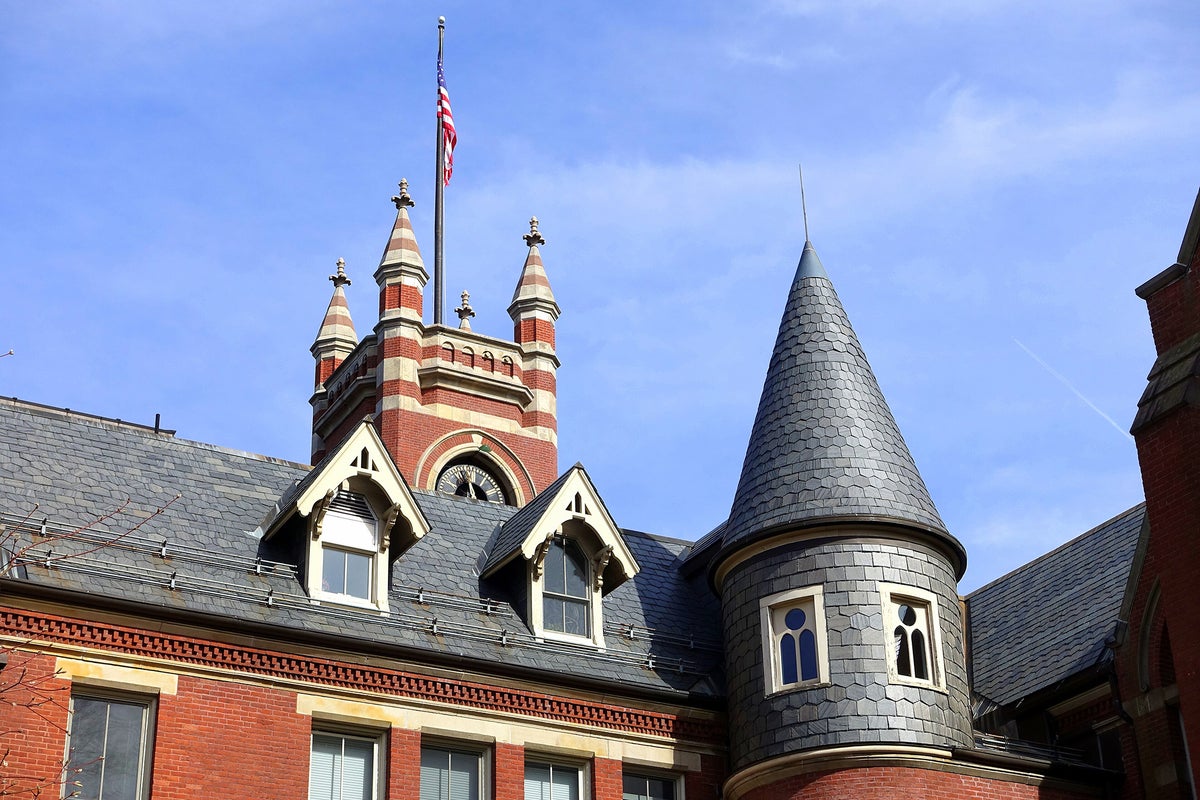
The morning air in Northampton, Massachusetts, often carries the scent of damp earth and old library books. It is a place where the bricks are heavy with history and the gates are designed to keep the world’s chaos at bay. For over a century, women’s colleges like Smith or Mount Holyoke have functioned as secular convents of intellect. They were founded because the rest of the world wasn’t built for women. They were sanctuaries.
But sanctuary is a fragile thing. It depends entirely on who is allowed inside the walls. Expanding on this topic, you can find more in: Washingtons Cuba Policy is a Sixty Year Lesson in Doing the Same Thing and Expecting Different Results.
Recently, the Department of Education’s Office for Civil Rights turned its gaze toward one of these hallowed institutions. The trigger wasn't a financial scandal or a grading dispute. It was an investigation into the very definition of a woman. By opening its doors to transgender women, the college found itself caught between a shifting social tide and a rigid federal framework known as Title IX.
The stakes aren't just legal. They are existential. Analysts at NBC News have provided expertise on this matter.
The Weight of a Promise
To understand the tension, you have to look at the students. Consider a hypothetical student named Elena. She arrived on campus three years ago, drawn by the promise of a space where she wouldn't have to fight for the floor. In a co-ed environment, statistics show that men dominate 75% of classroom conversations. Elena wanted the 100%. She wanted a place where leadership was the default, not an uphill battle.
For Elena, the inclusion of trans women felt like a natural extension of the college’s mission to support those marginalized by gender.
Then there is Sarah, another hypothetical student, perhaps a few years older, whose family scraped together every cent to send her to a single-sex institution. Sarah feels a sense of vertigo. She argues that if the category of "woman" expands to include those born with male biological privilege, the "sanctuary" begins to dissolve. She fears that the very thing she paid for—a female-only environment—is being bargained away without her consent.
These two women sit in the same dining hall, eating the same oatmeal, looking at the same granite walls, but they are living in two different realities.
The Law of Unintended Consequences
Title IX was passed in 1972. It was a blunt instrument designed to end discrimination on the basis of sex in any education program receiving federal money. It changed the world. It gave us female scientists, athletes, and CEOs. But the authors of 1972 weren't thinking about gender identity. They were thinking about sex as a biological binary.
When the government steps in to investigate a college for its admissions policy, they are looking for a breach of contract. The investigation hinges on a complex question: Does admitting trans women violate the rights of biological women under Title IX? Or does excluding trans women violate the modern interpretation of the same law?
It is a legal pincer movement.
The college is being squeezed. If they hold the line on inclusivity, they risk losing the federal funding that keeps their lights on and their scholarships funded. If they retreat, they betray the progressive values that form the backbone of their modern identity.
The Invisible Stakes
We often talk about these issues in the abstract, using words like "policy" and "compliance." But the reality is found in the dorm rooms at 2:00 AM.
Imagine the tension in a shared bathroom. Imagine the hesitation in a sociology seminar. This isn't just about paperwork; it's about the "vibe" of a space that has been curated for 150 years. Women’s colleges have always been a radical experiment in what happens when you remove the male gaze. The current federal investigation is essentially asking if that experiment is still allowed to exist in its traditional form.
Critics of the investigation argue it is a politically motivated attack on trans rights. Supporters argue it is a necessary defense of a protected category.
But while the lawyers file their briefs, the students are left wondering if their home is still theirs. The fear isn't just about who gets in; it's about whether the institution itself will survive the scrutiny. A private college might seem wealthy and invincible, but many are one lost federal grant away from insolvency.
A History of Closed Doors
This isn't the first time these gates have been the site of a struggle. In the 1960s, the debate was about race. In the 1980s, it was about sexuality. Every generation, the walls of the sanctuary are tested.
The irony is that women’s colleges were created because the "standard" system was exclusionary. Now, they are being accused of being exclusionary by some, and not exclusionary enough by others. It is a paradox of progress.
The investigation is a cold, bureaucratic process. It involves spreadsheets, deposition transcripts, and long meetings in windowless rooms in Washington D.C. But outside, on the campus green, the sun is setting behind the chapel. Students are walking to dinner, their backpacks heavy, their futures uncertain.
They are living in the middle of a live-fire exercise in social engineering.
The outcome of this investigation will ripple far beyond one campus. it will set a precedent for every single-sex space in the country. It will decide if "womanhood" is a biological fact protected by law, or a self-defined identity that the law must accommodate.
There is no middle ground that satisfies everyone.
The Price of Admission
What is a women’s college worth in 2026?
If it becomes just another liberal arts school, it loses its soul. If it stays a rigid fortress of 19th-century definitions, it risks becoming a museum. The administration is trying to thread a needle while the government holds the thread.
For the trans woman who finally felt seen when she received her acceptance letter, the investigation feels like a threat to her very existence. For the alumna who donated her life savings to preserve a female-only space, the college’s policy feels like a breach of trust.
Neither of them is "evil." Both of them are fighting for a sense of safety.
The granite gates are still standing. They look as permanent as the mountains. But gates are only as strong as the people who stand behind them, and right now, those people are divided.
The government will eventually release a report. There will be a finding of "in compliance" or "non-compliance." There will be a press release. But no document can resolve the heartache of a community that no longer agrees on who belongs.
As the wind picks up across the quad, a lone flyer tumbles across the grass, advertising a rally that has already happened. The debate continues in whispers and shouting matches, in quiet tears and defiant protests. The sanctuary is no longer a place of rest. It is a courtroom.
The sun disappears. The lights in the library flicker on. The students keep studying, trying to prepare for a world that can’t even agree on who they are.