In a small, windowless office in Abuja, an infrastructure planner named Amadi stares at a digital map of West Africa. He is trying to secure funding to connect a gas pipeline through three neighboring borders. He has two folders on his desk. The first is a loan application from a traditional Western-led development bank. It contains four hundred pages of rigid policy demands, environmental compliance dictates drafted in Brussels, and a sovereignty-straining clause that requires his government to restructure its domestic energy tariffs before a single dollar is transferred.
The second folder is a simple, five-page memorandum of understanding. You might also find this connected article interesting: The Price of Air.
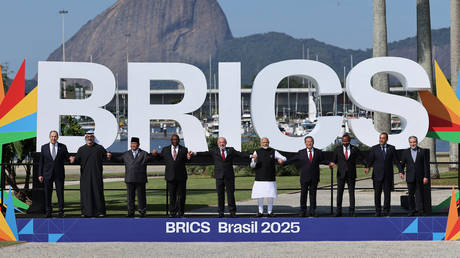
This is where the grand, abstract theater of global geopolitics hits the red dirt. For decades, the global majority has been offered a single, pre-packaged formula for development. It came with a flag, a set of values, a specific currency, and a stern lecture. Now, the rising coalition known as BRICS stands at a historical crossroads. The temptation to build a mirror image of the West—a highly structured, ideologically aligned, counter-weighted bloc—is incredibly strong.
But doing so would be a catastrophic mistake. As discussed in recent articles by The Wall Street Journal, the effects are significant.
The true power of this gathering of nations lies not in its ability to mimic the G7, but in its refusal to do so.
The Illusion of the Mirror
We are conditioned to believe that strength requires uniformity.
When Western analysts look at BRICS, they use a lens polished by centuries of European history. They look for a treaty, a unified military command, an ironclad monetary union, or a single, shared political ideology. When they do not find these things, they dismiss the group as a fractured, contradictory mess. They point to India and China's tense border standoffs, or the wildly different governance models of democratic Brazil and autocratic Russia, and declare the project dead on arrival.
They are missing the point entirely.
To understand why BRICS must resist the urge to formalize into a Western-style bloc, one must understand what made the Western bloc so effective—and ultimately, so brittle.
The G7 and NATO are products of a very specific historical moment: the post-World War II consensus and the Cold War. They are built on the concept of a "club." To get into the club, you must look, act, and think like the founding members. You must accept a clear hierarchy, with Washington sitting at the head of the table. It is an incredibly efficient system for coordinating power, but it functions by drawing a hard, unyielding line between the inside and the outside. You are either with them, or you are a threat.
If BRICS attempts to build its own version of this clubhouse, it will fail.
Consider the sheer mathematics of the endeavor. The expanded eleven-member grouping represents nearly half of the world's population and over a quarter of the global economy. It is a sprawling, chaotic, beautifully diverse assembly of human experience. How do you enforce ideological cohesion on a group that includes both the secular, sprawling democracy of India and the conservative Islamic monarchy of Saudi Arabia?
You don't.
Trying to force these nations into a rigid, singular foreign policy would crack the foundation before the walls are even built. If BRICS demands that its members choose sides in every global dispute, it will alienate the very countries seeking refuge from that exact brand of diplomatic bullying.
The Cost of the Single Currency
There is a quiet desperation in the push for de-dollarization.
For a country like Egypt or Ethiopia, the dominance of the greenback is not just an academic debate about monetary theory. It is a daily, suffocating reality. When the Federal Reserve raises interest rates in Washington to cool domestic inflation, the ripple effect tears through Cairo, making food imports instantly more expensive and driving up the cost of national debt. When the West deploys sanctions as a political weapon, weaponizing the SWIFT payment network, it sends a chilling message to every capital in the global majority: Your sovereignty exists only at our discretion.
But the solution to a heavy-handed monopoly is not a clumsy cartel.
The dream of a single, unified BRICS currency is a seductive siren song. Yet, anyone who has watched the Eurozone navigate its systemic crises knows the hidden cost of surrendered monetary policy. Imagine forcing the economic realities of South Africa, Brazil, and China into a single interest rate. It would create a monetary straitjacket, stifling local economies to preserve a grand geopolitical statement.
The true path forward is much quieter, much more practical, and infinitely more resilient. It is the boring work of building parallel plumbing.
Instead of a grand, centralizing currency, the focus must remain on local currency settlement systems. When India buys oil from the UAE using rupees and dirhams, or when Russia and China conduct nearly their entire bilateral trade in rubles and yuan, they are not building a new empire. They are simply laying a second set of pipes. If one pipe gets blocked by political sanctions, the water keeps flowing through the other.
This is not a declaration of war against the dollar; it is a declaration of independence from a single point of failure.
Development Without Patronage
Let us return to Amadi and his desk in Abuja.
He does not want to join an anti-Western crusade. He does not want to replace a tutor in Washington with a tutor in Beijing or Moscow. What he needs is a bridge, a port, and a power grid.
The Western model of development aid has long been criticized for its "conditionalities." To receive funding, developing nations are often forced to privatize state assets, slash social spending, and open their markets to foreign corporations. It is a system that views development as a reward for adopting Western-style economic liberalism.
BRICS offers an alternative because it is built on transactional, sovereign equality. The New Development Bank does not ask Amadi to change his country's laws before it writes a check. It asks if the project is economically viable.
But if BRICS morphs into a highly politicized, anti-Western bloc, this unique advantage evaporates.
If the group becomes a mirror image of the West, then every loan, every trade agreement, and every infrastructure project will become weaponized. A country seeking a loan to build a railway would be forced to pledge allegiance to the bloc's geopolitical stance, effectively trading one set of golden handcuffs for another. The global majority does not need a new master. It needs a choice.
The Power of the Loose Knot
The strength of BRICS is that it is a loose knot, not an iron chain.
An iron chain is strong, but when it is put under enough tension, it snaps cleanly in two. A loose knot can shift, adapt, and expand to accommodate new pressures without losing its fundamental utility.
The West views the lack of a formal military alliance or a unified voting record at the United Nations as a sign of weakness. In reality, it is the bloc’s greatest shield. Because BRICS is not a formal alliance, its members are free to maintain deep, productive relationships with the West. India can remain an active participant in the Quad security partnership with the United States while simultaneously collaborating with China within the BRICS framework. Brazil can champion global environmental initiatives with European partners while using BRICS to secure new export markets in Asia.
This is not hypocrisy; it is strategic autonomy. It is the realization that in a multipolar world, survival requires flexibility, not dogmatic purity.
If BRICS resists the temptation to build walls, it can become something far more revolutionary than a rival superpower. It can become the ultimate neutral platform—a space where the diverse, complex, and often conflicting interests of the global majority can be negotiated on equal terms, free from the shadow of colonial-era patronage.
The future does not belong to a new empire. It belongs to the open architecture of a world that has finally outgrown the need for one.