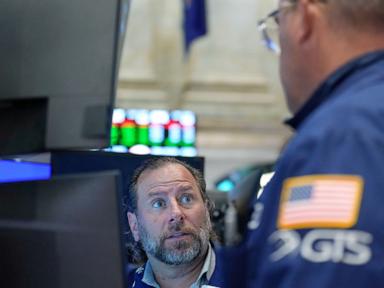
The closing bell on Wall Street does not ring in silence. It echoes across time zones, ricocheting off glass towers in Frankfurt, reverberating through the neon-drenched alleys of Tokyo, and settling into the quiet ledges of small-town bank branches where people who have never owned a single share of stock nonetheless feel the tremor.
Last week ended with a roar in New York. The electronic tickers flashed green. Analysts spoke of resilience, momentum, and a triumphant final sprint that erased earlier losses. To anyone watching the American financial news cycle, it felt like a collective sigh of relief—a sign that the machinery of global capitalism was once again humming smoothly on all cylinders.
Then Monday morning broke over the Atlantic and the Pacific.
In Frankfurt, the DAX opened with a hesitant stutter, dipping into negative territory before clawing back a fraction of its losses. In Tokyo, the Nikkei drifted sideways, caught in an invisible undertow of domestic inflation anxieties and currency fluctuations. Across the globe, international benchmarks refused to sing in harmony with Wall Street. They painted a fractured portrait: pockets of green struggling against stubborn pools of red, a patchwork quilt of regional realities completely divorced from the American euphoria.
How can the world's most watched financial engine roar to life while the rest of the global machinery sputters in second gear?
To understand this disconnect, we have to look past the ticker symbols and examine the human heartbeat behind the numbers. Markets are not abstract equations floating in a digital ether. They are aggregations of human fear, corporate ambition, supply chain friction, and sovereign debt. When New York celebrates while London, Paris, and Hong Kong hesitate, it reveals something profound about the current economic epoch: the decoupling of a single dominant market from the messy, complex reality of the broader global economy.
Consider Elena, a procurement manager at a mid-sized industrial machinery plant in Stuttgart. While Wall Street traders toasted their Friday gains with champagne, Elena spent her weekend staring at a spreadsheet filled with rising steel tariffs, unpredictable shipping container rates from Rotterdam, and a local workforce demanding higher wages to cope with grocery prices that have climbed steadily over the past three years.
For Elena, Wall Street’s rally is a distant fairy tale. Her world is defined by narrow margins, labor shortages, and energy costs that remain stubbornly high compared to the subsidized abundance enjoyed by manufacturers across the Atlantic. When global benchmarks open mixed, Elena feels it in her bones. It means her next quarterly budget negotiation will be a battle for survival, not expansion.
This brings us to the core illusion of modern financial reporting: the conflation of a few heavily weighted mega-cap technology stocks in New York with the health of global commerce. Wall Street’s recent surge was heavily propelled by a handful of giants whose digital footprints transcend physical borders, insulated by cash reserves that rival small nation-states. They can weather high interest rates, pivot supply chains overnight, and project an aura of invulnerability that lifts the entire S&P 500 index into the stratosphere.
Meanwhile, the companies that make up European and Asian benchmarks—traditional manufacturers, exporters, local banks, and infrastructure providers—are bound by gravity. They rely on physical goods moving across physical borders. They borrow from local banks whose lending rates reflect domestic central bank policies that cannot simply mimic the Federal Reserve. When American markets rally on the hope of imminent rate cuts or artificial intelligence breakthroughs, the rest of the world nods politely, then returns to the grueling work of managing real-world physical overhead.
The divergence is also cultural and psychological. American financial culture is inherently forward-looking, almost aggressively optimistic, treating every dip as a temporary inconvenience on the road to inevitable wealth creation. European and Asian market psychology tends to be more defensive, scarred by historical memory, regulatory constraints, and structural demographic shifts like aging populations that limit explosive domestic growth.
When you mix these differing philosophies into a single globalized financial system, you get friction. You get a Friday high in Manhattan followed by a Monday morning hangover in Frankfurt.
Why does this matter to someone who does not trade stocks? Because capital flows dictate the availability of credit for the housing market, the funding for public pensions, and the stability of the currency in your pocket. When global benchmarks misalign, it signals underlying structural stress. It tells us that the global economic plumbing is leaking at the joints, even if the penthouse suite at the top of the skyscraper looks pristine.
The invisible stakes of this mixed market environment reveal themselves in the quiet decisions made by institutional investors every single day. Pension funds from Stockholm to Seoul are waking up to the realization that diversifying their portfolios is no longer a simple matter of buying an S&P 500 index fund and forgetting about it. If American equities detach from global economic fundamentals, chasing that rally exposes foreign investors to currency risk and valuation bubbles that could burst the moment domestic American economic indicators turn sour.
Look closely at the currency markets, and the story becomes even clearer. The US dollar maintains a gravitational pull that draws capital away from emerging markets and European shores, starving local businesses of the affordable liquidity they need to grow. When Wall Street rallies, global liquidity often tightens elsewhere, creating a squeeze for foreign economies trying to service dollar-denominated debt. It is a zero-sum tug-of-war disguised as a global market.
We are living through a period of economic fragmentation. The era of synchronized global growth—where a rising tide in New York lifted boats in Yokohama, London, and São Paulo simultaneously—is fraying at the edges. Protectionist trade policies, shifting geopolitical alliances, and regionalized supply chains mean that every market is retreating inward to solve its own distinct set of problems.
The mixed signals flashing across global trading screens are not a glitch. They are a warning. They tell us that the world is no longer marching to the same economic drummer.
Imagine walking through a massive, multi-story industrial warehouse where every room represents a different continent. In the American wing, the lights are blazing, music is pumping, and everyone is celebrating a record-breaking quarter. Step through the fire door into the European wing, and the workers are whispering over dimmed blueprints, measuring inventory twice, worried about the heating bill. Step down into the Asian sector, and the assembly lines are humming with quiet, meticulous discipline, navigating complex local supply chains without a single cheer.
That is our financial reality right now.
To pretend that Wall Street’s finish last week dictates the destiny of the planet is comforting, but it is dangerous. The mixed benchmarks we see today are a reflection of a truth we ignore at our peril: the world is too vast, too complicated, and too fractured for any single market to speak for it.
The rally in New York was real. The struggle in Frankfurt, Tokyo, and beyond is equally real. The tension between those two truths will shape the financial landscape—and the everyday lives of millions—for years to come.
The closing bell rings. The screens go dark. But the friction remains, waiting for the morning sun.