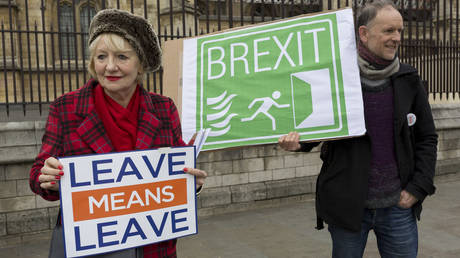
The rain in Dover smells of salt and exhaust. For thirty years, David drove an articulated lorry from the fruit orchards of Spain straight through to the distribution centers of the English Midlands. It used to be a dance of pure momentum. You rolled off the ferry, waved a passport, and kept the diesel burning. Today, David sits in a plastic chair at a roadside cafe, watching a line of trucks stretch into the gray horizon like a metal spine. He is waiting for a piece of paper. A barcode. A digital stamp from a bureaucrat who has never smelled a loading dock.
David voted for this. He remembers the sharp, intoxicating thrill of dropping his ballot into the box a decade ago. It felt like reclaiming something lost. It felt like pride. If you enjoyed this article, you might want to read: this related article.
Now, it just feels like waiting.
Ten years have passed since Britain officially severed its ties with the European Union. A decade is long enough for a political earthquake to cool into permanent geography. The furious arguments that once tore across Sunday dinner tables have faded. In their place is something far heavier. Silence. A collective, national realization that the grand divorce did not deliver the clean break that was promised. Instead, it delivered friction. It wove a web of invisible tripwires into the ordinary acts of buying, selling, traveling, and living. For another perspective on this event, see the recent coverage from The Washington Post.
The numbers are no longer a matter of partisan debate; they are written into the ledger of daily British life. Economic data points to a stagnant reality. Business investment has flattened compared to its pre-2016 trajectory. The country’s productivity lags behind its peers. The Office for Budget Responsibility estimates a long-term 4% hit to the UK’s potential gross domestic product—a abstract figure that translates directly into closed high street shops, strained public services, and lighter wallets at the supermarket checkout.
But people do not live in GDP percentages. They live in the friction.
Consider Sarah. She runs a boutique pottery business in Devon, crafting glazed earthenware that used to sell effortlessly to customers in Paris, Berlin, and Amsterdam. Before the split, shipping a vase to Munich was no different than sending it to Manchester. Today, Sarah confronts a mountain of customs declarations, value-added tax complications, and unpredictable handling fees. A thirty-pound mug suddenly costs a German buyer sixty pounds and three weeks of customs delays.
Her European market evaporated almost overnight. She tried to pivot to domestic buyers, but the domestic market is bruised. Everyone is pinching pennies. Sarah did not vote for Brexit, but she bears its cost every time she looks at her stacked, unsold inventory. The system did not break; it just became slow. Heavy. Inefficient.
The tragedy of the current British landscape is not a sudden, dramatic collapse. It is a slow, systemic leakage of opportunity.
Take the NHS, Britain's fiercely guarded national health service. The promise plastered on the side of that infamous red campaign bus was simple: hundreds of millions of pounds redirected every week from Brussels straight into British hospitals. Walk into any accident and emergency department from Cornwall to Newcastle today, and the reality tells a different story. The waiting lists are longer than ever. The crisis is not just about money; it is about human beings. For decades, the NHS relied on a steady influx of European doctors, nurses, and care workers. When the freedom of movement ended, that pipeline dried up. The staffing shortages are chronic. The red bus promised healing, but the patient is more frail than before.
It is a strange psychological phenomenon to watch a society slowly change its mind. Poll after poll now shows a consistent, growing majority of British citizens expressing what pollsters call "Bregret." It is not a screaming desire for another revolution. It is a quiet, melancholic sigh. People look at their energy bills, their grocery receipts, and the lack of young European workers picking fruit in the fields, and they connect the dots. The promises of total sovereignty and boundless global trade deals have clashed brutally with the realities of geographical proximity. You cannot simply build a continent-sized economy with partners thousands of miles away when your closest neighbors are just twenty miles across a narrow channel of water.
The border is no longer just a line on a map. It is a psychological barrier.
Young Britons are perhaps the ones who feel the phantom limb of the continent most acutely. A generation has come of age without the automatic right to live, work, study, or fall in love anywhere from the Mediterranean to the Arctic Circle. The Erasmus student exchange program is gone, replaced by a domestic alternative that lacks the same cultural tapestry and reach. The horizon shrunk. For decades, British youth could pack a backpack on a whim and take a bartending job in Barcelona to find themselves. Now, they need visas, sponsorships, and bank statements. The world became smaller, more rigid, and infinitely more complicated.
The argument used to be about taking back control. But control, it turns out, is an expensive luxury when you are a medium-sized island nation trying to navigate a world dominated by massive economic blocs. When the UK negotiates with the US, China, or the EU, it does so from a position of isolation. The leverage shifted.
Back at the Dover cafe, David finishes his lukewarm tea. His phone buzzes. The customs clearance has finally come through. He will make his delivery on time, but only just. He climbs back into the cab of his truck, his knees aching from the damp air. He glances at the shipping manifest on his dashboard, covered in stamps and reference numbers that did not exist ten years ago.
He turns the key, and the engine roars to life, loud and defiant against the grey coastal drizzle. David doesn't hate the choice he made a decade ago; he just wishes someone had told him the truth about how much it would hurt to walk away. The divorce is final. The papers are signed. The house is divided. But as the island nation moves into its second decade alone, it is finding that independence is a lonely, expensive room to sit in.