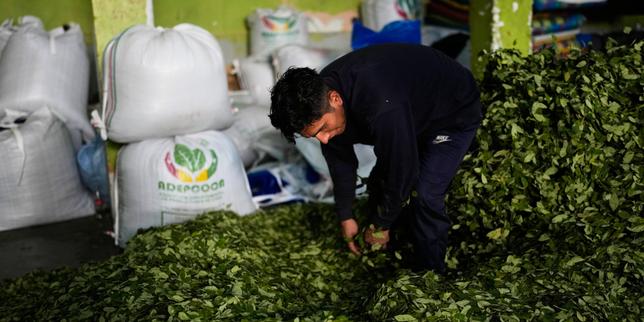
The air up here does not forgive you. At four thousand meters above sea level, every breath is a conscious calculation, a thin and brittle draft that drags at the lungs. Yet people move with a quiet, unyielding rhythm. Mateo ties his worn leather sandals, adjusts the heavy burlap sack resting against his porch wall, and looks down the steep slope of the Chapare.
Below him, the green is absolute. It stretches out in undulating waves, blanketed by a heavy mist that clings to the base of the Andes like a damp blanket. It looks serene. It looks like nature untouched.
It is actually an economy in motion.
Mateo is not a cartel boss. He is a grandfather with calloused palms and eyes the color of dry earth. For decades, his family has tended the plots that climb the red clay hillsides of Cochabamba, right in the political backyard of former president Evo Morales. To the distant capitals of the world, the green leaves Mateo harvests are a statistical headache, a line item in international security reports, a diplomatic friction point. To Mateo, they are simply the currency of survival.
Data recently brought to light reveals that coca cultivation in Bolivia has surged significantly, swelling precisely within those traditional strongholds where political power and agricultural tradition have long been deeply intertwined. The numbers speak of hectares gained, of monitored zones overflowing their legal borders, of an underground market humming with relentless efficiency. But numbers do not capture the sound of rain drumming against a tin roof while a family strips leaves from stems by kerosene light.
Grounding this reality requires understanding a paradox that outsiders constantly miss. The coca plant is not inherently a drug. It is an ancient ally. For millennia, indigenous communities across the high plateaus and tropical valleys have chewed its leaves to ward off altitude sickness, to blunt the edge of biting hunger, to sustain energy through backbreaking labor under a brutal sun. It is a sacrament. It is medicine. It is social currency offered to guests upon arrival.
Then came the modern world with its insatiable appetite for refined hydrochloride, turning an indigenous staple into a global flashpoint.
Consider what happens when international demand collides with local necessity. Bolivia adopted a uniquely homegrown approach to regulation under Morales, who famously retained his role as the head of the Chapare coca growers' federation even while leading the nation. Instead of forced eradication—which historically sparked bloody confrontations and left deep scars of distrust between rural farmers and state police—the policy leaned on social control. Communities were permitted to grow a strictly limited, legal quota per family plot, self-policing their output to supply the traditional domestic market.
It was an ambitious experiment. For a time, it kept the peace.
But borders between the legal market and the illicit trade are porous. They bleed. When global prices fluctuate and regional enforcement tightens elsewhere in South America, the pressure on Bolivia’s green valleys intensifies. The surplus spills over. It finds its way into clandestine rustic laboratories hidden beneath the dense jungle canopy, where the leaves are soaked, crushed, and chemically transformed into paste.
Walking through these rural markets, the tension is palpable. People do not stare, but they watch. They know the weight of the scrutiny coming from Washington, from Vienna, from La Paz. Every drone buzzing overhead, every satellite image capturing the expansion of green patches on the red earth, represents a tightening vise.
Mateo remembers the roadblocks of the early 2000s, when eradication squads backed by foreign aid marched into the valleys with machetes and tear gas. He remembers the dust, the shouting, the burning fields. He remembers the sense of humiliation that comes when men who have never tasted the thin air of the Andes dictate what grows in your soil. That era birthed a political movement, carrying Morales from the union halls of the Chapare straight to the presidential palace. The message was clear: coca is our dignity.
That historical memory explains why any sudden crackdown today triggers immediate alarm. When the state moves to measure plots or threaten eradication, farmers do not see a law enforcement initiative. They see an existential threat to their sovereignty, their community structures, and their daily bread.
Yet ignoring the expansion is impossible. The sheer volume of recent growth far exceeds what the traditional domestic market could ever consume. Independent tracking and international monitors point to a widening gap between legal quotas and total production. Where does the excess go? The answer is an open secret whispered in riverside ports and along unpaved mountain tracks where pickup trucks move by night without headlights.
This is the labyrinth Bolivia finds itself trapped within. The political architecture built by the movement for socialism is fracturing, and as new leaders vie for influence, the question of how to handle the green tide remains painfully unresolved. Hardline approaches risk reigniting rural rebellions that could tear the country apart at the seams. Laissez-faire tolerance invites international isolation, economic sanctions, and the deeper entrenchment of transnational criminal networks that dwarf the local growers in wealth and ruthlessness.
Back on his porch, Mateo packs a fresh wad of leaves into his cheek, letting the bitter juices settle. He does not care about geopolitical strategy papers or diplomatic cables. He cares about the price of fertilizer, the reliability of the seasonal rains, and whether his grandchildren will be able to stay on this land or be forced to scatter into the slums of El Alto or across foreign borders in search of a future.
The mist rolls in thicker now, swallowing the lower terraces and erasing the boundary between the cultivated fields and the wild forest. High above the clouds, the mountain stands silent, indifferent to the political storms raging at its feet, watching over a crop that has sustained empires, fueled revolutions, and broken hearts for centuries.


